What moved in marketing this week
Puppet dogs, a new Apple CEO, and Meta surpassing Google
23 Apr 2026
What moved in marketing this week
Puppet dogs, a new Apple CEO, and Meta surpassing Google

Case Studied Brief by Vendry
April 23, 2026

Case Studied Brief
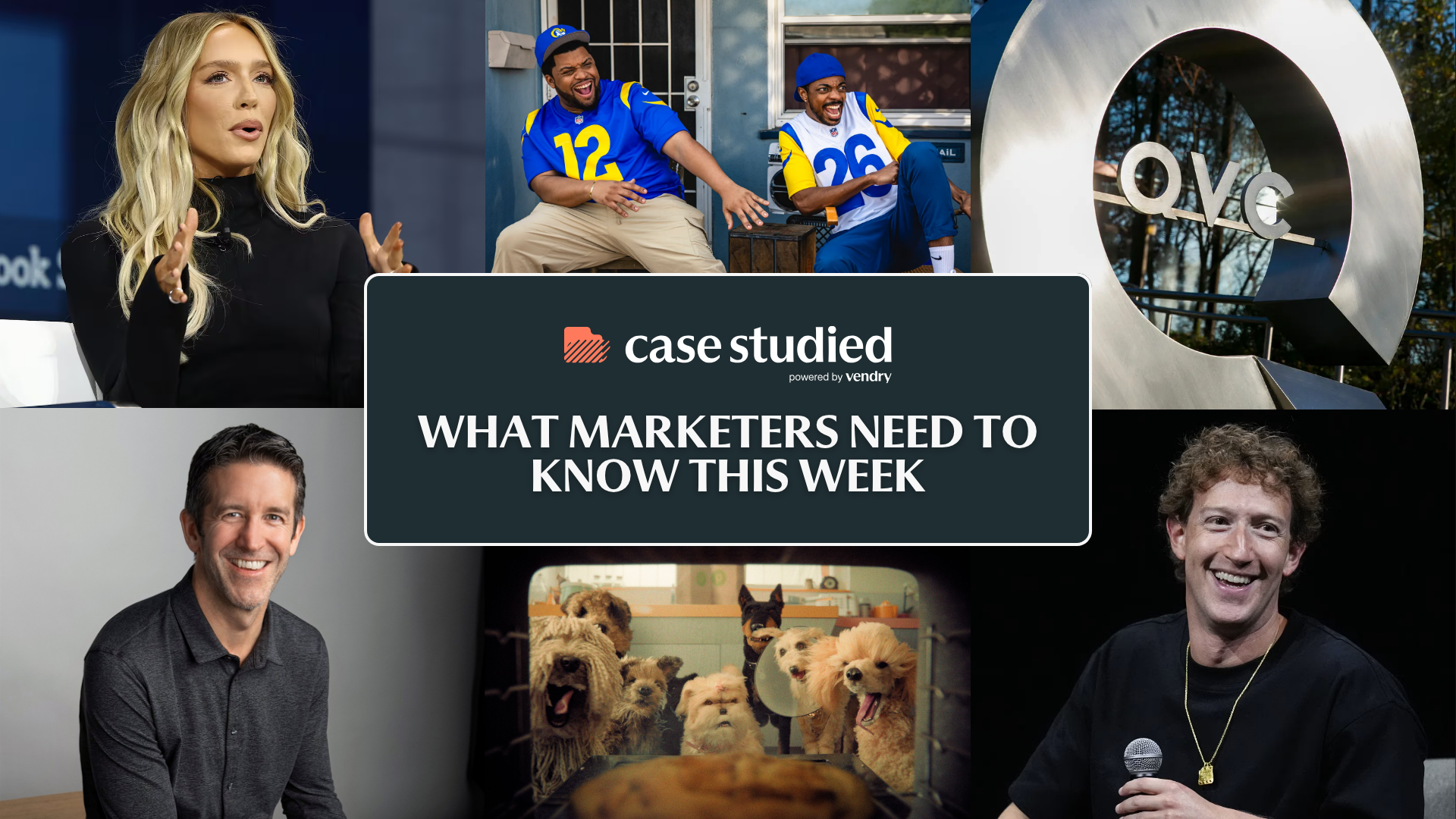
New Apple CEO, ChatGPT ads, and the Rams’ movie
This week's Brief covers leadership shake-ups, AI deals worth billions, and a few campaigns that go against the grain.
The Rams teased their draft pick with a movie. OMO and Arsenal spread awareness about the gender gap in outdoor play. And Publix built a campaign around handmade puppets.
Meanwhile, Tim Cook announced he's stepping down, Amazon wrote Anthropic a $5 billion check, and Meta became the world's biggest ad platform for the first time in history.
Here's what you need to know.
Campaigns of the week 📺
Los Angeles Rams
Thursday is the new Friday
The LA Rams released a short film called "Thursday" as part of their 2026 NFL Draft rollout. It’s a scene-for-scene parody of Ice Cube's 1995 cult classic Friday. The film stars O'Shea Jackson Jr. (Ice Cube's real-life son) and Destin Tucker (Chris Tucker's son), stepping into the iconic roles their fathers played. Terry Crews cameos as a Deebo stand-in, riding up on a beach cruiser flanked by Rams linebackers Jared Verse and Byron Young. Rams guard Kevin Dotson rounds out the cast as "Big K-Dot," a nod to Big Worm. It closes with the original movie’s poster tagline, "A lot can go down between Thursday and Saturday."
Why it stood out: Casting the actual sons of the original “Friday” stars made this campaign sharable and engaging for reasons beyond what they’re actually promoting. The Rams were also very strategic about what they modernized and what they mirrored from the original film. For marketers, “Thursday” is a strong example of a brand showing up to a tentpole moment in a unique way.
📖 Read more: ESPN
Publix
Puppet dogs say what people can't
Publix and creative agency FIG launched "Best Friends," a heartwarming 360 campaign built around the idea that food can communicate what words can’t. It’s centered on a two-minute hero film about a group of neighborhood dogs trying to make amends with their beloved mailman, Bob. The film was directed by Australian director Mark Malloy and brought to life using fully customized, handmade puppets. There was no AI involved. The campaign extends across broadcast, OLV, and social, with five additional spots that follow two dogs while they wait outside a Publix store as their owners shop. Publix also launched influencer partnerships where creators make pie for someone they love.

Why it stood out: At a moment when AI-generated content is everywhere, choosing handmade puppetry says a lot about brand values. It's a reminder that craft and intentionality can be differentiators in and of themselves. It’s also worth noting that the campaign doesn't lead with products. Instead, it focuses on the emotional role food plays in relationships, with Publix existing as a means to that end.
📖 Read more: Little Black Book
OMO x Arsenal
The gender gap starts outside
OMO and Arsenal Women's Football Club have launched "It Starts Outside," a campaign tackling the growing gender activity gap in children's outdoor play. It’s the latest chapter in their ongoing "Dirt Is Good" partnership. It’s anchored in data that Australian girls aged 4–11 are significantly less likely to play freely outside than boys the same age. This gap compounds over time and shows up directly in sport participation rates. The creative features childhood photos of Arsenal's Australian stars Kyra Cooney-Cross, Steph Catley, and Caitlin Foord. The campaign rolled out across social platforms and builds on a partnership that already produced award-winning work (e.g. "It's Part of the Game," which tackled period stigma in sport and earned nine Cannes Lions shortlists).

Why it stood out: Like most purpose-driven campaigns, the specificity of the message helps it stand out. Rather than making a broad statement about girls in sport, OMO pins the conversation to a concrete behavior, outdoor play, and connects it directly to long-term outcomes informed by data. The partnership with Arsenal further helps give the message cultural credibility, while the players’ childhood photos add to its tangibility.
📖 Read more: Little Black Book
Industry news 🤝
Apple names its next CEO
Apple announced that Tim Cook will step down as CEO on September 1, 2026, transitioning to executive chairman of the board. His successor is John Ternus, who’s currently Apple's senior vice president of Hardware Engineering. Ternus is a 25-year Apple veteran who’s been instrumental in some of the company's most defining products, from the iPhone to AirPods. With his new role, Ternus joins the board of directors, while outgoing non-executive chairman Arthur Levinson moves to lead independent director. The transition was unanimously approved by the board and was described as the result of a long-term succession planning process. Cook will leave his seat after Apple’s market cap grew more than twentyfold under his leadership, now sitting at over $4 trillion.

What it signals: Leadership transitions at companies like Apple don't just move markets, they move brand perception. Under Cook, Apple was defined by operational precision, global scale, and a steady expansion into services and wearables. With Ternus being a hardware engineer at heart, there are questions about where Apple's creative and commercial energy will flow next. The evolution of Apple’s brand strategy may also be worth watching. After all, Ternus is someone whose entire career has been about building the physical thing, not selling the idea of it.
📖 Read more: Apple Newsroom
Meta is about to dethrone Google in digital ads
For the first time in two decades of digital advertising, Google is losing its top spot. The Wall Street Journal reported that Meta is projected to surpass Google as the world's largest digital advertising business in 2026, based on eMarketer's latest forecast. Meta is expected to generate $243.46 billion in net global ad revenue this year, narrowly clearing Google's $239.54 billion. Google's headline numbers are significantly reduced by traffic acquisition costs, including an estimated $20 billion paid annually to Apple just to remain the default iPhone search engine. Another key factor is Meta's growth rate, which came in at 24.1% year over year compared to Google's 11.9%. Meta’s big surge can be attributed to Reels ad performance and the Advantage+ AI tool, which dramatically lowered the barrier for advertisers to connect spend directly to outcomes. Together with Amazon, the three platforms are now on track to control 62.3% of all global digital ad spending in 2026.

What it signals: Meta's rise is built almost entirely on one proposition: making ROI easier to prove. Advantage+ automates targeting, creative testing, and bidding in ways that remove friction for brands of every size. Google's search-centric model, meanwhile, is under pressure from AI-driven, zero-click results that erode click-through rates across both organic and paid. The ad dollar is following the path of least resistance to a measurable outcome. And right now, that path runs through Meta.
📖 Read more: Wall Street Journal
Unwell is living up to its name
Alex Cooper's media company Unwell has hired Joanne Bradford as president. A former executive at Pinterest, Yahoo, and Honey, Bradford has been a strategic adviser to Unwell since mid-2025. She will now oversee growth, operations, and the company's in-house ad agency (which already secured multiyear deals with Google, Nestlé, and Sephora). The hire comes alongside a broader executive build-out, with a new CMO and chief content officer also joining the team. But it also arrives at a complicated moment. A Bloomberg investigation recently reported high employee turnover, a struggling slate of shows outside of Call Her Daddy, and allegations that Cooper's husband and co-CEO Matt Kaplan berated staff on set—with crew members threatening to walk off projects. The report lands alongside an already-public falling-out with former talent Alix Earle.

What it signals: The Bradford hire reads differently in light of the Bloomberg reporting—less like a strong step forward and more like a stabilization play. Bringing in a seasoned operator with deep revenue experience is the right move for a company trying to grow beyond its founder's personal brand. But the internal issues suggest the structural problems run deep. It’s worth watching how these new hires impact Unwell’s trajectory.
📖 Read more: Bloomberg
e.l.f. Beauty's CMO got promoted out of marketing
e.l.f. Beauty promoted Kory Marchisotto, its longtime global CMO, to a newly created role: President of e.l.f. Brands. In this position, she’ll oversee the expansion of e.l.f. Cosmetics, e.l.f. Skin, Keys Soulcare, and Well People across categories and global markets. The move is part of a broader C-suite reshuffle at the company. Oshiya Savur—formerly of Maesa, Charlotte Tilbury, and Unilever—is stepping in as the new CMO, while Ekta Chopra was elevated to a newly created Chief Technology and AI Officer role. Marchisotto joined e.l.f. in 2019 and has been widely credited as the architect behind the brand's disruptive marketing playbook. The brand has now seen 28 consecutive quarters of growth and net sales projected to hit $1.61 billion in fiscal 2026.

What it signals: When a CMO gets promoted to president, it says a lot about where the company sees growth actually comes from. Marketing hasn't just been a support function at e.l.f., it's been the engine itself. These C-suite changes suggest the company is making a deliberate bet that the next phase of growth requires a marketer driving the brand portfolio, while a new marketing leader and a dedicated AI officer handle execution and infrastructure. It’s worth watching how the brand approaches marketing, technology, and scale under this structure.
📖 Read more: Marketing Dive
MarTech moves 🤖
A leaked deck reveals ChatGPT is selling ads
A leaked pitch deck revealed that StackAdapt, an independent demand-side platform, partnered with OpenAI to sell ad placements inside ChatGPT. The deck, shared with select buyers and reviewed by Adweek, frames the offering as a new "discovery layer." It targets users in the middle of actively researching and comparing products. CPMs range from $15 to $60, driven by prompt relevance rather than cookies or behavioral targeting. There’s a $50,000 minimum spend to enter the pilot. Since the leak, OpenAI confirmed the program exists, though it has adjusted the minimum spend threshold upward. Sources suggest it now sits between $100,000 and $200,000 depending on the partner. Ads will only appear to free and entry-tier users, will remain clearly labeled as sponsored, and will not influence ChatGPT's answers or access private chat data.

What it signals: Search advertising was built on intent and catching people right before they act. ChatGPT ads are targeting people earlier at the thinking stage, when they’re still forming opinions. The question here isn't whether ChatGPT becomes an ad platform (since it clearly already is). It's how the ads placed inside ChatGPT will impact both advertisers’ revenue and consumers’ trust.
📖 Read more: Adweek
Vendry hit 1,000 completed agency RFPs this month. Here's how it works: a brand submits a brief, Vendry sources and vets agencies against it, and the brand gets a shortlist back in about 10 days. Brands pay nothing. Agencies pay when a match turns into a signed contract. The marketplace has 4,000+ vetted agencies on it now, covering paid media, creative, CRM, influencer, experiential, and most other disciplines a marketing team would hire for. Customers include Shopify, Coca-Cola, Columbia Records, Burt's Bees, Roc Nation, and Magic Spoon, plus a long list of venture-backed and mid-market companies. Vendry also runs Case Studied, the newsletter you're reading.
For some context: a normal agency search takes three to six months. You've got sourcing, RFPs, capability decks, reference calls, scope negotiations. Meanwhile CMO tenures keep getting shorter, boards keep squeezing marketing budgets, and the people running the search are usually the same senior ICs who should be doing actual marketing work. Getting that process down to 10 days changes what a team can realistically ship in a quarter.

What it signals: Agency sourcing is starting to look like legal search, recruiting, and fractional talent. Anyone can find an agency on Google. The thing Vendry gets paid to do, by agencies, is the vetting, the fit work, and giving the client a real process to run. Our bet is that most marketing teams will source agencies this way within a few years.
📖 Read more: Vendry
Amazon and Anthropic go all-in
Anthropic and Amazon announced a major expanded partnership. Amazon committed a fresh $5 billion investment in Anthropic—with up to $20 billion more available in the future—bringing its total investment to $13 billion. In return, Anthropic committed to spending more than $100 billion on AWS technologies over the next decade, securing up to 5 gigawatts of computing capacity for training and running Claude. The timing here is notable. Anthropic's run-rate revenue surpassed $30 billion in 2026, up from approximately $9 billion at the end of 2025. That explosive growth put real strain on infrastructure. With the deal, the full Claude Platform will be available directly within AWS. That gives more than 100,000 existing AWS customers access through their existing accounts with no additional credentials or contracts required. Claude is now the only frontier AI model available across all three of the world's largest cloud platforms: AWS, Google Cloud, and Microsoft Azure.

What it signals: The depth and breadth of this partnership is certainly eye-catching. But one of the more compelling parts of the deal is Claude being available directly through AWS. It suggests that AI access is increasingly becoming a default feature of tools organizations already use, not a separate procurement decision. That lowers the barrier for teams that have been slow to adopt AI. At the industry level, this deal is another signal that the AI race is happening at the infrastructure layer.
📖 Read more: Anthropic
Adobe launches AI agents for marketers
At its annual Summit conference in Las Vegas, Adobe unveiled CX Enterprise. It’s a new end-to-end agentic AI system designed to help brands manage the entire customer lifecycle, from acquisition and engagement to conversion and loyalty. At the center of the launch is the CX Enterprise Coworker, an AI agent that moves away from traditional campaign-based execution toward continuous, real-time engagement. It monitors signals, recommends next-best actions, and manages cross-channel experiences automatically. The announcement comes as Adobe's stock shed roughly 30% of its value in 2026, with investors questioning whether legacy software giants can hold their ground against AI-native competitors.

What it signals: Adobe is betting that the answer to AI disruption isn't fighting AI-native tools but becoming the orchestration layer between them. By building an agent system that works across every major AI platform, Adobe is positioning itself as the enterprise connective tissue. For marketing teams already embedded in Adobe's ecosystem, CX Enterprise is an evolution of what’s already used. For those watching from outside, it shows that some software giants are rebuilding for an environment where humans build strategy and AI agents execute.
📖 Read more: Wall Street Journal
Editors Choice 👀
🧅 The Onion just closed a deal to turn Alex Jones' Infowars into a full comedy network. 📖 Read more: Variety
🛒 QVC's bankruptcy proves that TikTok Shop ate live shopping's original inventor alive. 📖 Read more: Bloomberg
🍔 Trump openly admitted his DoorDash and McDonald's Oval Office delivery stunt was tacky. 📖 Read more: LA Times
End the search: Vendry makes it simple to find your next agency partner. Share your needs and get connected with vetted, top-tier options in under a week—at no cost to you.
Don't miss the next Case Studied™.
Join 40,000+ marketers and receive a breakdown of the world's best brands every week.