What’s shaping marketing right now
Ribs, LEGOs, and a $965 billion IPO
04 Jun 2026
What’s shaping marketing right now
Ribs, LEGOs, and a $965 billion IPO

Case Studied Brief by Vendry
June 04, 2026

Case Studied Brief
Jingles, IPOs, and claymation
This week's Brief covers celebrity campaigns, impactful industry hires, and of course, AI news.
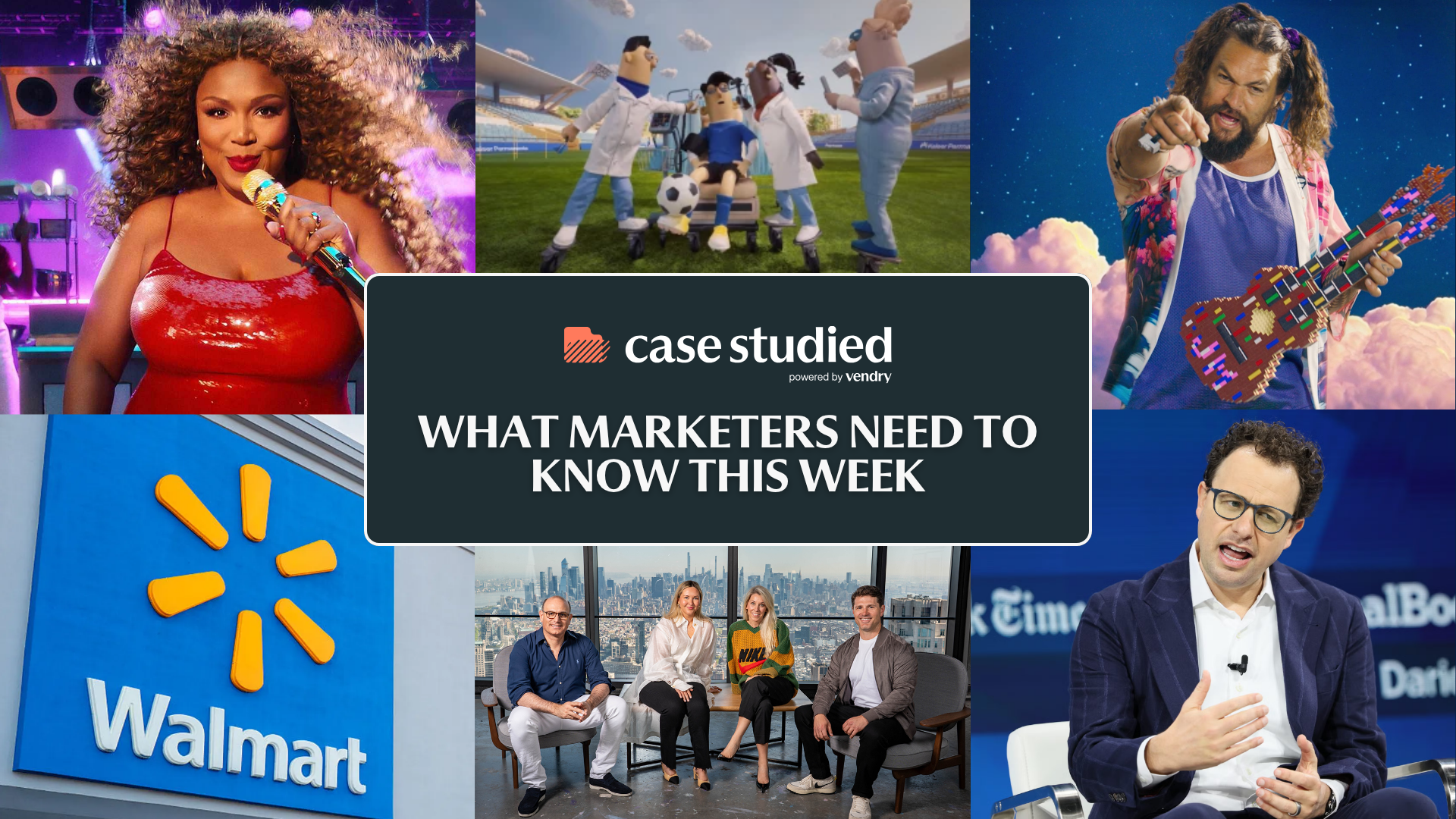
Lizzo remixed a jingle. Jason Momoa played with Legos. And NPR launched videos about human curiosity.
Meanwhile, Anthropic filed for an IPO, OpenAI brought on a B2B marketing veteran, and Walmart ended its exclusive deal with The Trade Desk.
Here's what you need to know.
Campaigns of the week 📺
Chili's
Lizzo said yes to the jingle
Chili's tapped four-time Grammy winner Lizzo to co-write and co-produce a new version of its iconic Baby Back Ribs jingle. The campaign debuted on YouTube and features Lizzo preparing to serve ribs, using kitchen tongs as a makeshift microphone, and playing a custom flute designed to look like a Baby Back Rib. She also recorded a full a cappella rendition of the original jingle. The campaign is anchored by a real product upgrade: Chili's revamped its ribs to include meatier portions with up to 50% more ribs and a new caramelized barbecue sauce crust.

Why it stood out: The partnership origin story is worth noting here. Lizzo dressed up, unprompted, as a Chili's mozzarella stick for Halloween last year. Fast forward seven months and she partnered with the brand on this jingle collaboration. Lizzo’s organic brand affinity is clearly reflected in the resulting creative. The rib-shaped flute and the a cappella rendition are a natural extension of Lizzo’s persona as a performer. The timing also lines up with Lizzo's new album dropping June 5.
📖 Read more: Fast Company
NPR
Ask more, know more
After its March debut in print and out-of-home, NPR's "For Your Right to Be Curious" campaign expanded into video. Created with Mischief @ No Fixed Address, three new spots tackle hard societal questions (think: birthright citizenship, grocery prices, technology's effect on kids). Each video opens with a quiet slice-of-life scenario and a voiceover capturing the inner anxiety of the protagonist. The spots close with real NPR audio clips addressing each topic directly. The campaign's first phase is already proving its worth. Post-campaign data showed 73% of respondents believe that NPR fights for the public's right to be curious, 75% felt NPR is fighting for independent journalism, and 65% said they were more likely to tune in after seeing the work.
Why it stood out: The structural decision to close each spot with real NPR audio is an interesting creative choice here. Rather than making claims about journalistic quality, the campaign demonstrates it directly by letting the actual reporting make the closing argument. The timing also adds context. NPR has faced a politically charged year, with significant federal funding cuts. The post-campaign data—particularly the 65% lift in intent to tune in—suggests the message landed with the audience the organization was aiming to reach.
📖 Read more: Ad Age
Lego
Even Aquaman needs playtime
Lego tapped Jason Momoa as its newest "Playmaker" for its "Never Stop Playing" PSA campaign. Timed to World Play Day on June 11, the spot is built around a sobering tension: Lego's global research found that more than 60 million families don't play together at all. Fewer than half hit the five hours of weekly playtime that’s linked to improved family happiness and wellbeing. In the campaign, Momoa is on a mission to help families rediscover play through simple actions like linking two Legos bricks together. The campaign marks the continuation of collaborations between Momoa and Lego. He voiced Aquaman in The Lego Movie 2, has several mini-figure lookalikes of his past movie characters, and has spoken publicly about being a fan of the brand since childhood.

Why it stood out: The Momoa casting follows a similar logic to the Lizzo-Chili's partnership. The talent had a documented history with the brand prior to the campaign kickoff, which helps the creative feel more organic. It's also worth noting that the campaign is built around proprietary research. Anchoring the PSA to a specific data point helps give the message more weight, while tying the campaign to World Play Day gives it a natural news hook.
📖 Read more: Variety
Kaiser Permanente
Son Heung-min got a claymation checkup
Kaiser Permanente expanded its "A Better Idea for Health Care" campaign to the national stage. The healthcare provider partnered with LAFC star and South Korean national team captain Son Heung-min on a campaign ahead of the 2026 World Cup. Created with Droga5 New York, they created spots using stop-motion animation to follow an animated Son through Kaiser Permanente's integrated health care system. Along the way, he finds that physical, mental, and social health are treated as equally important and interconnected. The campaign spans film, social, digital, audio, and out-of-home, and builds on a pilot that launched in select markets last fall. The partnership is a clear fit: Kaiser Permanente already serves as the Official Team Physicians of LAFC, giving the collaboration genuine institutional roots rather than a surface-level celebrity deal timed to the tournament.
Why it stood out: This one has institutional roots that predate the campaign. Kaiser Permanente serves as the Official Team Physicians of LAFC, which means the Son Heung-min collaboration is an extension of an existing relationship (rather than a World Cup opportunity buy). Since healthcare campaigns tend to default to either clinical imagery or feel-good lifestyle footage, the use of stop-motion animation is also a notable creative choice. Meanwhile, choosing Son was a pretty straightforward casting call. He’s one of the most globally recognized footballers heading into the World Cup.
📖 Read more: Little Black Book
Industry news 🤝
OpenAI hired its first enterprise CMO
OpenAI brought on Colin Fleming, the former CMO of ServiceNow, to lead marketing for its business unit. Fleming spent just over two years at ServiceNow after a 13-year run at Salesforce, where he served as EVP of global marketing. He brings a deep bench of experience selling complex software to large organizations. Fleming announced his departure from ServiceNow on LinkedIn, calling the decision "gut-wrenching" but adding that he would have "regretted not taking the swing." The hire comes as OpenAI is actively building out its enterprise business and competing for corporate contracts against Microsoft, Google, and Anthropic.

What it signals: Bringing in a CMO with Fleming's specific background suggests OpenAI is no longer content to let product reputation do the selling for them at the enterprise level. Consumer awareness of ChatGPT is already near universal, so the growth frontier is now in corporate adoption. Hiring someone with Fleming's pedigree in SaaS and enterprise software tells you where OpenAI sees its next major revenue opportunity. It also suggests the company understands that selling to businesses requires trust, relationships, and sustained messaging.
📖 Read more: AdWeek
No vendor pitches. No generic panels. Just the people who've built AI visibility ecosystems.

What it signals: There's no shortage of AI "hacks" and generic webinars promising to fix your visibility. BreakingSilos 2026 brings together practitioners who've actually built visibility ecosystems where SEO, social, PR, content, and brand reinforce each other. And AI is citing them for it. Find out exactly how.
Ogilvy got serious about sports and NIL
Ogilvy expanded its Sports & Entertainment division through a strategic investment by parent company WPP in the social-first sports agency Article 41. As part of the deal, Article 41 co-founder Vickie Segar has been named Ogilvy's first-ever Global Chief Sports & Entertainment Officer. It’s a newly created role that puts her at the top of the agency's management team. Co-founder Ben Gildin joins in a senior strategy and client partnerships role, while Article 41 Managing Director Meredith Allen takes on the additional title of Ogilvy North America Influencer Lead. The move positions Ogilvy as a global creative network with end-to-end capability across brand strategy, fan engagement, creator marketing, and athlete NIL at scale.

What it signals: Agencies have been building out sports marketing capabilities for several years now, but the addition of NIL infrastructure is a telling detail with this deal. Since the NCAA began allowing athletes to profit from their name, image, and likeness in 2021, the market has grown quickly and brands are still figuring out how to navigate it at scale. By bringing Article 41's expertise in-house, Ogilvy is positioning itself to help clients move faster in that space. The decision to create a C-suite role for Segar rather than folding Article 41 quietly into an existing division also says something about how seriously WPP is treating the investment. For brands that have been treating sports sponsorships and athlete partnerships as separate line items, this kind of full-service capability under one roof could change how those conversations get structured.
📖 Read more: Ogilvy
Anthropic filed for its IPO
Anthropic filed confidentially with the SEC for a U.S. initial public offering on June 1, becoming the first of the major AI labs to make a formal move toward going public. The company did not disclose the size or terms of the offering, but noted the filing gives it the option to go public once the SEC completes its review. A debut could potentially come as soon as this fall. The move comes on the heels of Anthropic's latest funding round, which valued the company at $965 billion, overtaking OpenAI's $852 billion valuation from March. The company is currently reporting annualized revenue of $47 billion, driven largely by enterprise and developer adoption of its Claude models.

What it signals: Anthropic’s filing could mark the start of a highly consequential stretch of tech listings. SpaceX is expected to begin its own IPO roadshow on June 4 and OpenAI is also preparing to file. It’s also a signal that the AI arms race is officially moving from private funding rounds to public markets. For the marketing and media industry, a publicly traded Anthropic means greater transparency, more pressure to commercialize, and almost certainly an accelerated push into enterprise and advertising products.
📖 Read more: New York Times
The Trade Desk names its fourth CFO in a year
The Trade Desk appointed Nate Olmstead as its new chief financial officer, effective July 9. Reporting directly to CEO Jeff Green, Olmstead is the company's fourth finance chief in roughly 12 months. His appointment follows the termination of predecessor Alex Kayyal after just six months on the job. Before joining The Trade Desk, Olmstead served as CFO of the AI company Penguin Solutions and he held the same role at Logitech. The hire comes during a difficult stretch for the company: TTD’s stock is down roughly 70% over the past year, several senior executives and four board members have departed, and the company faces growing competitive pressure from Amazon's DSP. Agency partners Dentsu and WPP have also reportedly pulled back from The Trade Desk's Open Path offering.

What it signals: Leadership churn at this scale is rarely just a personnel story. For one of adtech's most closely watched independent players, the CFO revolving door reflects deeper investor and partner anxiety about The Trade Desk's path forward. Olmstead's background in enterprise finance and AI companies could give Green a steady hand heading into the back half of the year. But the real test is whether stable leadership can address the competitive threats closing in around TTD.
📖 Read more: Adweek | Trade Desk
MarTech moves 🤖
Hightouch cut out the identity middleman
Agentic marketing platform Hightouch launched Exposure Log Matching for The Trade Desk. This new capability allows advertisers to directly match TTD campaign exposure data to their own first-party customer and household IDs, without routing through a third-party identity provider. The Trade Desk already gives advertisers detailed records of every impression, click, and conversion, but those events arrive behind anonymized identifiers like UID2s, mobile device IDs, and cookies. Historically, closing that gap meant exporting logs to a vendor, waiting several days, and receiving a file keyed to a proprietary ID. And after all that, it still required additional engineering to connect back to the brand's own customer model. Hightouch's Match Booster capability removes that intermediary entirely, resolving exposure logs directly in the brand's own data warehouse on a daily or hourly basis. The company reportedly plans to expand the capability beyond The Trade Desk to other ad platforms.

What it signals: The identity layer has long been one of adtech's most entrenched and expensive middlemen. Tools like Hightouch’s Exposure Log Matching represent a meaningful shift in where data power sits. When brands can tie campaign exposure directly to their own consented customer records without a vendor, they can gain cleaner measurement, faster reporting, and more control over their own identity model. As first-party data becomes the primary currency of digital advertising, the infrastructure that connects it to media platforms without leakage or delay will be a major competitive advantage.
📖 Read more: Adweek
NVIDIA and Microsoft reinvented the PC
NVIDIA unveiled RTX Spark, a new superchip built in collaboration with Microsoft that reimagines the Windows PC as a personal AI agent platform. The chip delivers 1 petaflop of AI performance, up to 128GB of unified memory, and the full NVIDIA CUDA and RTX technology stack. It all comes in the form of a slim laptop or compact desktop form factor. The partnership goes beyond hardware, too. NVIDIA and Microsoft are building new Windows security primitives and the NVIDIA OpenShell runtime to let AI agents run safely and privately on users' primary devices (with users controlling exactly what agents can and cannot do). Adobe is rearchitecting Photoshop and Premiere from the ground up for RTX Spark, promising up to 2x faster AI and graphics performance. Devices from ASUS, Dell, HP, Lenovo, Microsoft Surface, and MSI are expected to launch this fall, with Acer and GIGABYTE to follow.

What it signals: RTX Spark is the clearest signal yet that the PC is being repositioned as an AI workspace rather than just a computing tool. For marketers and creative teams, the implications are significant. If local AI agents are capable of running 120-billion-parameter models, editing 12K video, and generating 4K AI content on a laptop, it changes what individual contributors can produce without enterprise infrastructure. The creative stack is getting faster, more private, and more powerful.
📖 Read more: NVIDIA
Walmart Connect is done being exclusive
Walmart Connect announced new offsite retail media partnerships with Yahoo DSP and Magnite. It marks the first time the retailer's first-party customer data can be activated outside of its own Walmart DSP through third-party platforms. Through the deal, advertisers using Yahoo's DSP can now access Vizio CTV inventory via Magnite, with Walmart's audience data and closed-loop measurement capabilities powering the buys. The move follows the end of Walmart Connect's four-year exclusivity agreement with The Trade Desk last fall, and signals a clear shift toward an open, multi-DSP strategy for the network. The expansion is currently in a closed proof-of-concept phase, with additional platform partnerships planned. For context, offsite retail media ad spending in the U.S. is forecast to top $17 billion in 2026, a nearly 30% year-over-year increase. Walmart Connect excluding Vizio already posted 44% year-over-year revenue growth in its most recent quarter.

What it signals: Retail media is moving from walled garden to open ecosystem, and Walmart is betting that broader distribution of its first-party data will accelerate advertiser spend more than exclusivity ever could. Connecting Walmart's purchase data to CTV inventory through established programmatic pipes is exactly the kind of full-funnel, closed-loop offering that advertisers have been asking for.
📖 Read more: Marketing Dive
Editors Choice 👀
📱Turns out, running a Cannes Lions beach activation is way harder than you might think. 📖 Read more: Adweek
⚖️ Florida sued OpenAI and Sam Altman, making it the first state to take legal action over AI safety and harm to minors. 📖 Read more: Variety
⚽ The NWSL has new execs that plan to turn World Cup buzz into lasting brand partnerships. 📖 Read more: Marketing Brew
📺 NBCU has data showing that cutting premium video for social is costing brands more than they think. 📖 Read more: Marketing Dive
Reach into the inbox: Did you know you can advertise in the Case Studied newsletter? That means having a direct line to 41,000+ senior marketers via a newsletter with a 52% open rate.
Don't miss the next Case Studied™.
Join 40,000+ marketers and receive a breakdown of the world's best brands every week.