The marketing moves that defined the week
A blush ambassador, a $53 billion bid, and a screensaver city comes to life.
23 Jul 2026
The marketing moves that defined the week
A blush ambassador, a $53 billion bid, and a screensaver city comes to life.

Case Studied Brief by Vendry
July 23, 2026


Today’s Case Studied is sponsored by eTail Boston
Your next big breakthrough starts here. From high-impact strategies to peer-powered insight, eTail delivers more than inspiration—it delivers results.
Case Studied Brief
Billion-dollar bids, blush, and broken trust
This week's Brief comes at you with a mix of heartfelt brand moments and boardroom drama, plus a fresh round of AI stories.
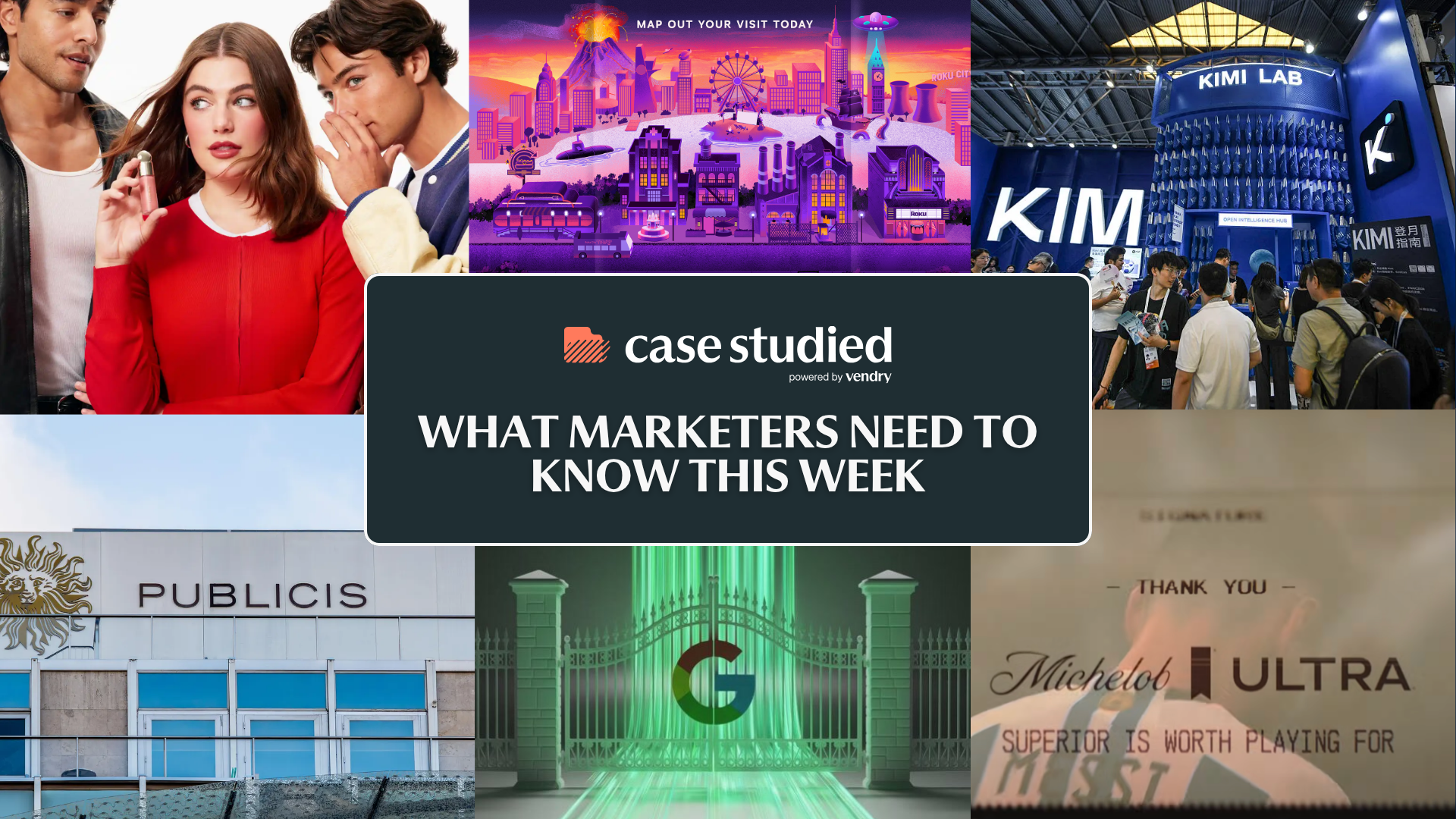
On the campaigns side, Rare Beauty found its first ambassador, Michelob Ultra closed out Messi's legacy, and Roku finally let fans inside the city they'd been imagining for years.
Industry news brought a crisis communications lesson, a $53 billion buyout bid, and a media mega merger's latest legal setback. Meanwhile, MarTech news reveals AI's growing footprint across markets and models.
Here's what you need to know.
Campaigns of the week 📺
Rare Beauty
The blush that outlasts every suitor
Rare Beauty named Off Campus star Ella Bright as its first-ever brand ambassador. Bright fronted a new campaign called "Made You Blush," built around the brand's best-selling Soft Pinch Liquid Blush. The campaign video features a string of men who try, and fail, to make Bright blush. They cycle through charm, jokes, and grand gestures, before she declares that only one thing actually works on her: the blush itself. Bright, who plays Hannah Wells on the Prime Video series based on Elle Kennedy's bestselling novels, said in a statement that she's been a longtime fan of the brand. She specifically called out the Rare Impact Fund, a mental health nonprofit founded alongside the brand, as part of why the partnership meant something to her personally. The rollout coincides with Bright's breakout year on the streaming series.
Why it stood out: This campaign marks an inflection point for Rare Beauty. Since its launch in 2020, the brand leaned almost entirely on founder Selena Gomez's platform, community, and personal story, so naming an outside ambassador for the first time signals a shift in how it plans to grow its reach. That shift is also well-timed: the partnership lands squarely inside Bright's breakout year on Off Campus. In doing so, Rare Beauty follows a familiar playbook of brands partnering with rising streaming talent during moments of peak cultural attention.
📖 Read more: Cosmopolitan
Michelob Ultra
This bar tab has 20 years on it
Michelob Ultra, the official beer sponsor of the FIFA World Cup 2026, released "Tab Closed" almost immediately after Argentina's final loss to Spain. It used the moment to celebrate Lionel Messi's 20-year World Cup career and his final performance in the tournament. Created by Wieden+Kennedy New York and directed by the agency's Zak DeLange, the spot reimagines a bar tab, tallying up Messi's wins, goals scored, and records broken across two decades of tournament play. It closes on Messi walking off the field for the final time as the tagline "Superior is Worth Playing For" appears printed on the receipt. Michelob Ultra ran it across its digital and social platforms, on Telemundo immediately following the post-game broadcast, and on billboards in Times Square depicting Messi alongside his itemized tab. The brand also commissioned an artist named Andaluz to paint a mural of Messi in the Little Argentina neighborhood of Queens, extending the campaign into OOH.

Why it stood out: Messi was inescapable in the World Cup’s advertising. Per System1 data shared with Adweek, he appeared in 18 of the 80 major World Cup campaigns tested across the U.S., U.K., and Argentina. That put him in nearly a quarter of all major tournament creative, with sponsors spanning Adidas, Lay's, and more. Against that level of saturation, what helped set Michelob Ultra's approach apart was timing. The brand turned around a finished spot after Messi's final match, framing the ad as a send-off rather than a standard sponsorship placement.
📖 Read more: Adweek
Roku
The mystery of Roku City finally gets solved
Roku launched "See You in Roku," its first full brand campaign in five years. It centers on the elusive Roku City screensaver, which is shown on Roku televisions by default during moments of inactivity. After years of keeping the screensaver deliberately out of reach to viewers, the brand finally pulled back the curtain with this campaign. Developed with creative agency Preacher and directed by Andreas Nilsson of Biscuit Filmworks, it includes six cinematic short films that zoom into a different corner of the animated skyline. The landmarks include a hospital where an unresponsive TV is revived and a pirate ship where the crew realizes they don't actually need to pirate anything thanks to Roku's free content library. Alongside the films, Roku built out an interactive map of the city that’s accessible directly from the home screen. The brand also created a clickable "Roku City Tour Bus" feature. The cultural equity of the screensaver is notable. Internal Roku research found that two out of three users say they'd visit Roku City if it existed as a real place, and the fictional metropolis reportedly gets mentioned on X roughly once every 11 minutes.
Why it stood out: Part of what makes this campaign interesting is the years of restraint that preceded it. Roku VP of brand Damon Van Deusen has said the team spent years watching fans theorize about Roku City online and deliberately chose not to open it up, treating the mystery as core to its charm. Van Deusen described the approach as acting like "a shepherd, not a gatekeeper," letting fan curiosity build organically over the years with small Easter eggs and cultural nods before finally rewarding it with a full campaign. That's a departure from how most brands sitting on a viral, fan-loved asset tend to operate, which is typically to capitalize on it quickly rather than let it develop untouched for years.
📖 Read more: Ad Age | Roku Newsroom
DoorDash
Bad roommates, good side income
DoorDash released a new set of Dasher recruitment spots created by agency Quality Meats alongside DoorDash's internal creative studio, Superette. It follows four characters whose everyday financial pressure points get resolved through gig work. One spot titled "Roommate" follows a Gen Z renter desperate to escape a housing situation with an eccentric, ferret-owning roommate, using Dasher income to fund an exit. Another called "You Time" centers on a millennial mom who sneaks away from the chaos of parenting for a few grocery deliveries and a well-earned slushie. "Goals" follows a hockey dad using his Dasher earnings to help fund bigger life ambitions, while "Pants" tells the story of a young job seeker who starts earning immediately through DoorDash rather than waiting through a traditional, drawn-out hiring process.
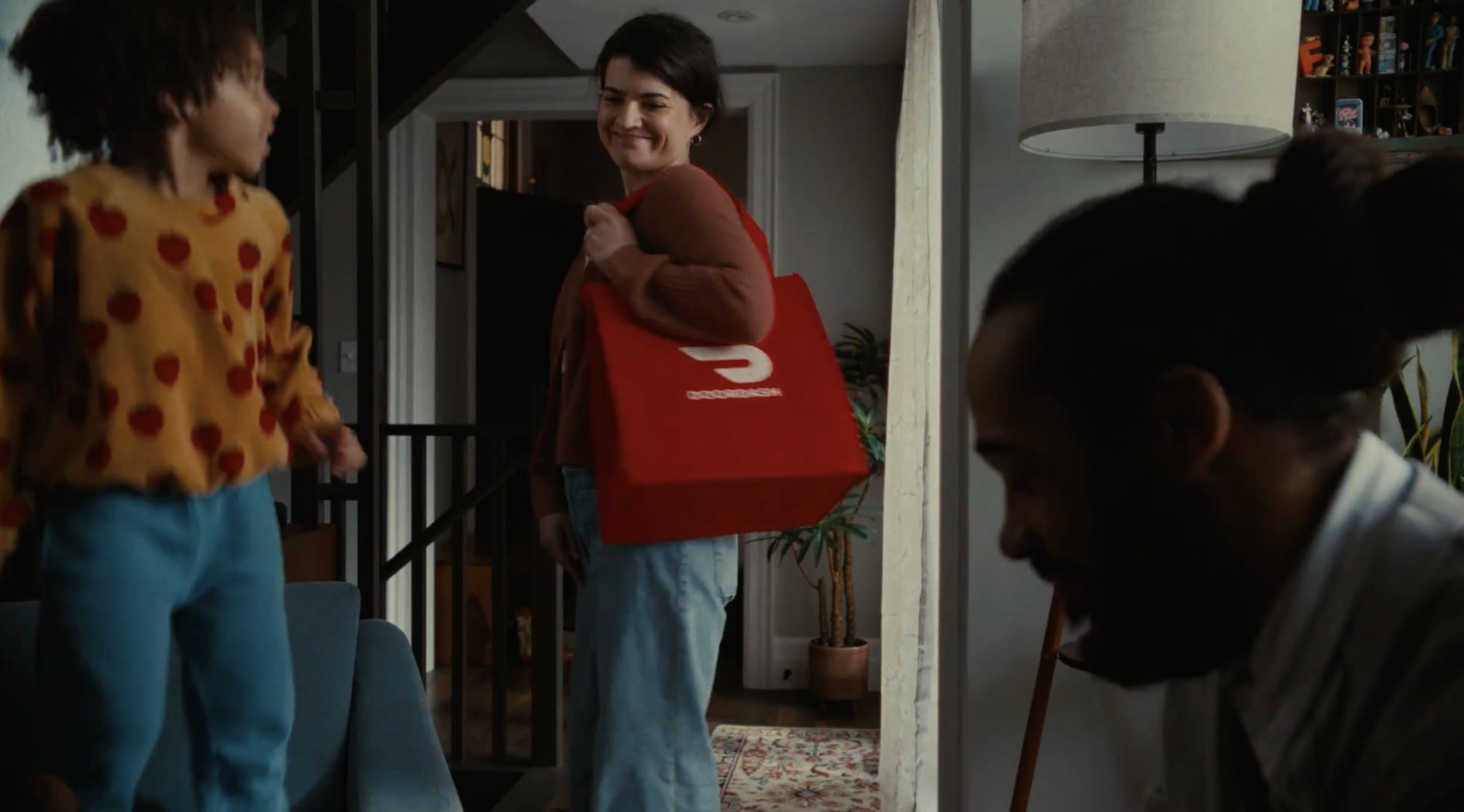
Why it stood out: What elevates this campaign above most gig-work messaging is how specific the details are. Per the creative team at Quality Meats, the writers mined their own personal experiences, including a real college roommate with a pet chinchilla. That helped make the character’s motivation feel more visceral. DoorDash creative lead Yusong Zhang framed the throughline as understanding that flexibility "isn't some abstract idea." It's getting your own apartment, supporting a family, or having more breathing room in a schedule. The approach also positions Dasher income as a means to a specific end in each character's life, rather than framing the job itself as the goal.
📖 Read more: LBB

Skip the predictions. Hear directly from the brands putting new strategies into practice.
eTail Boston brings together retail leaders from Warby Parker, H&M, SharkNinja, REI, Lowe's, Michaels, and dozens more for three days of candid conversations on AI, customer behavior, omnichannel, leadership, and growth.
Walk away with ideas you can actually use.
Industry news 🤝
Taco Bell's crisis response gets a mixed grade
Taco Bell is facing a test of its crisis communications as federal and state health authorities investigate a nationwide cyclosporiasis outbreak potentially linked to its restaurants. In an emailed statement to Restaurant Business, Taco Bell said "the health and safety of our guests is our top priority." It noted that public health officials have not confirmed a link to Taco Bell or any specific ingredient, supplier, restaurant, or retailer. And the brand stated it voluntarily and temporarily removed limited ingredients at select restaurants as a precaution while continuing to monitor the situation. On paper, that statement checks the boxes of textbook crisis response: state priorities, explain what's known, list the steps taken. The problem, according to crisis management experts, is that Taco Bell never surfaced this information anywhere consumers would actually see it. As of this writing, the company's own corporate website and social channels contain no visible mention of the outbreak or its response. Critics point out that customers were left to piece together what's happening from media reports and speculation rather than from the company directly.

What it signals: PR practitioners are treating this as a cautionary tale about the limits of a technically sound statement. Mike Fahey, CEO of Fahey Communications, put it bluntly: "The biggest lesson for business leaders is that silence does not buy you time. It gives everyone else time to define the crisis for you." Ariane Lovell of Trifecta Media Group added that in a crisis, "the response becomes part of the story," and companies are judged not just on the underlying event but on how visibly and quickly they acknowledge it. eMarketer analyst Zak Stambor noted that perception matters as much as facts in the early stages of a food safety investigation and even an unconfirmed link can cause consumers to rethink where they eat. The throughline from these experts is that precautionary action alone needs to be paired with visible, frequent, and easy-to-find communication.
📖 Read more: Forbes
A $53 billion bid lands amidst a reorg
Stripe and private equity firm Advent International have made a joint $53.4 billion offer to acquire PayPal at $60.50 per share, a roughly 28% premium. It would rank among the largest takeovers in payments industry history. Under the proposed structure, Stripe and Advent would each hold an equal stake in a newly private PayPal. The offer lands at a pivotal moment for PayPal. Its new CEO Enrique Lores, who took over in March, already reorganized PayPal into three units covering checkout, Venmo, and payments and crypto. He also announced plans to cut roughly 20% of the workforce, about 4,760 roles, as part of an effort to generate at least $1.5 billion in savings. PayPal has been working with Goldman Sachs and Evercore to evaluate its options, including a potential sale or breakup. According to Yahoo Finance, a person familiar with the matter said PayPal’s board sees the takeover bid as undervaluing the company and facing regulatory and financing hurdles.

What it signals: This bid arrives as PayPal’s stock is down more than 40% over the past 12 months. The company’s market cap slid from around $360 billion in 2021 to roughly $36 billion this year. Mizuho analyst Dan Dolev framed PayPal’s strategic bind as a choice between becoming a digital bank or staying "the world's largest button for paying." For marketers and brands, this deal would combine PayPal's network with Stripe's, one of the largest payment processors in its own right. A combination at that scale could shift how competitive dynamics in digital commerce play out beyond the deal's immediate financial terms.
📖 Read more: The Wall Street Journal
A $110 billion merger hits its most serious legal roadblock yet
A federal judge issued a 14-day restraining order halting Paramount Skydance's proposed $110 billion takeover of Warner Bros. Discovery. The move aligns with a coalition of 12 state attorneys general who sued to block the merger on antitrust grounds. U.S. District Judge Araceli Martínez-Olguín of the Northern District of California barred Paramount from closing the transaction. The deal would unite two movie studios, two streaming platforms, and two news organizations under David Ellison's control. The states argue the combination would concentrate too much power over cable channels and theatrical film distribution. The lawsuit, led by California Attorney General Rob Bonta, alleges the deal would harm movie theaters, basic cable distributors, and audiences by lessening competition in wide-release theatrical distribution and basic cable licensing. Meanwhile, Paramount argues the deal will provide necessary competition to streaming platforms like Netflix.

What it signals: This is the most serious regulatory speed bump the deal has hit yet. Paramount won't face financial repercussions from a delay until the end of September, and the company has pushed for a full hearing on the injunction with live witnesses. With EU and UK regulators also circling the deal, this ruling adds real uncertainty to a merger that would reshape the media landscape by combining CBS, MTV, CNN, and HBO under one roof. It's a reminder that antitrust risk is still very much alive for megadeals, even after they've been signed and celebrated.
📖 Read more: Washington Post
An earnings call becomes a referendum on ad-tech neutrality
Publicis Groupe grew net revenue 4.8% on an organic basis in Q2, reaching roughly $4.3 billion. On the back of that performance, it raised its full-year outlook slightly and now forecasts lower-end growth of 4.5% instead of 4%. But the more pointed conversation on the earnings call centered on Publicis's $2.2 billion acquisition of data-collaboration platform LiveRamp. The deal has unsettled industry stakeholders who long valued LiveRamp specifically for its neutrality as an independent ad-tech vendor. WPP, a major Publicis rival, already indicated it will stop using LiveRamp once the deal closes. When investors pressed executives for more detail on the acquisition's rationale, Publicis offered little beyond reassurance that client response has been positive. CEO Arthur Sadoun called the deal "a non-event" for clients, insisting "LiveRamp technology is neutral by design." LiveRamp has separately launched a brand campaign aimed at reassuring executives of its continued trustworthiness as the deal fuels scrutiny.

What it signals: This is a rare moment where the competitive fallout from an ad-tech acquisition is playing out in public, rather than quietly settling behind the scenes. Publicis views LiveRamp as central to its push into more sophisticated AI agents. It also points to it as a way to strengthen data-driven divisions like Epsilon and the consulting arm Sapient. Sapient represents about 13% of Publicis's total business and has been struggling, declining in the mid-single digits this quarter. But the willingness of a competitor as large as WPP to walk away from a platform over an ownership change underscores how fragile the trust in "neutral" ad-tech infrastructure really is. Once it's owned by a company that’s competing for the same client dollars, tension is clear.
📖 Read more: Deadline
MarTech moves 🤖
Chinese AI models rattle global markets (again)
Moonshot AI's surprise release of Kimi K3 sent a jolt through markets. Investors were pushed to reassess assumptions as the Chinese startup claimed a performance that rivaled top-tier offerings from OpenAI and Anthropic at a fraction of the cost. IG market analyst Tony Sycamore estimated that $314 billion has been wiped from valuation estimates for OpenAI and Anthropic as investors drew comparisons to last year's "DeepSeek moment." The ripple effects extended well beyond the two unlisted U.S. labs, too. Bernstein analysts noted that Alibaba and Tencent, both investors in Moonshot, stand to benefit beyond their direct stakes. Alibaba's cloud business is positioned to gain as AI models become more competitive and cloud providers gain leverage over model makers. Alibaba shares rose as much as 6% in Hong Kong following the announcement, while Tencent gained 4%. The broader Hang Seng Tech Index climbed 4% on the news.

What it signals: This story illustrates how quickly an entire competitive landscape can be repriced. The market's reaction treats a single Chinese lab's product launch as a referendum on whether the American AI labs' cost structures are as durable as their valuations assume. For marketers and brands evaluating which AI vendors to build on, this kind of volatility is a reminder that the leaderboard is being reshuffled in real time. Today's frontier-model assumptions may not hold for long and can change on a clip.
📖 Read more: Bloomberg
Google is quietly walling off the open internet
Google spent the past year rebuilding search around AI, replacing hyperlink results with conversational answers from Gemini. Most recently, it overhauled its search box for the first time in 25 years to support photo, video, and agent-run queries. The result is that people are spending far more time inside Google itself. Users are writing queries three times longer than old-style keyword searches and spending one to nine extra minutes per session in AI Mode. In roughly 75% of sessions, users left AI Mode for the open web at all, according to an October Growth Memo study. Publishers, banks, retailers, and other sites that relied on Google traffic say the effect has been unmistakable. Cloudflare data found that more than half of all web traffic is now nonhuman. Human web traffic to finance, publishing, and retail sites dropped nearly 40% between June 2025 and April 2026. Wikipedia has seen an 8% decline in human visitors over the same period and has started charging AI firms for training access to its data. It’s also promoting its own app to reduce Google dependency. Google disputes the framing, saying it sends out a "relatively stable" number of clicks and has added features like source previews to push users back into the open web.

What it signals: This is clear evidence that AI search isn't just changing how people find information, it's rewriting who profits from the internet's underlying content. Vox Media cited search traffic collapse as a direct factor in its decision to sell off half its business, including The Verge. It begs questions about how ad-supported publishing will adapt after the end of the hyperlink era. Regulators are stepping in. The UK's Competition and Markets Authority mandated that Google add clearer attribution links and opt-out options for AI summaries, with the changes rolling out globally. For marketers, this reshapes where attention and value actually live. Brand-building and content strategies that were built for search-driven traffic now have to reckon with a search engine that increasingly answers the question itself rather than sending anyone anywhere.
📖 Read more: The New York Times
The EU tells Apple and Google to quit gatekeeping AI
The European Commission is requiring Google to give competing AI assistants broader access to Android by July 2027. It’s part of continued enforcement under the Digital Markets Act, the EU's set of Big Tech regulations that took effect in 2023. The European Commission argues that Google and Apple's dominance of the smartphone market gives them an outsized advantage in the AI race. It wants rival virtual assistants to have the same prominence on devices as Google's Gemini and Apple's Siri. According to market research firm Omdia, roughly 427 million iPhones and Android phones fall under EU regulation, and ChatGPT is already installed on about 30% of EU smartphones. Apple and Google have pushed back, warning that granting third-party AI agents deeper device access creates privacy and security risks. Apple already announced in June that it would not launch its new Siri AI assistant in the EU specifically because of Digital Markets Act obligations.

What it signals: This can be seen as a test of how far regulators are willing to go to prevent AI assistants from ending up in the same walled-garden dynamics that shaped the smartphone app economy. Omdia analyst Runar Bjorhovde raised questions about what happens to Google or platform owners generally if users can complete an entire task, like booking an Uber, entirely through a rival AI assistant (aka bypassing the underlying platform altogether). For marketers, the outcome of this fight will shape whether AI assistants become a new, contestable channel for reaching consumers or whether Apple and Google's existing platform control simply gets reasserted at the AI layer.
📖 Read more: CNN
The AI ad wars move to smaller cities
OpenAI, Google, and Anthropic are pulling back their ad spend in saturated hub markets and pushing harder into smaller American metros, according to Sensor Tower's latest State of AI Report. In the first five months of 2026, OpenAI shifted more ad impression share for ChatGPT toward the Midwest, Mountain West, and South rather than larger metros in states like California and Florida. It’s a pattern that Sensor Tower says "suggests a strategy focused on expanding adoption in less-saturated markets beyond major metropolitan areas." Comparing the first half of 2025 and 2026, ChatGPT's ad impression share in Seattle nearly doubled, from 2.4% to 4.6%, while Boston rose from 2.5% to 4.1%. Google's Gemini saw an even sharper jump in Seattle, from 1.5% to 3.8%, and posted the second-largest gain in Philadelphia, up from 3.1% to 4.4%. Anthropic's Claude also grew in Philadelphia (2.6% to 3.2%) and notched gains in Detroit and Chicago. Notably, Gemini and Claude actually saw decreased ad impression share in the San Francisco Bay Area, aka the

What it signals: The initial phase of national splashy campaigns from AI chatbots seems to be giving way to a more targeted growth phase. Rather than focusing on broad brand awareness, brands appear to be more focused on where adoption still has room to run. Pulling back in the Bay Area while ramping up in Seattle, Philadelphia, Boston, and Detroit suggests these companies view saturation in tech-forward hubs as a cue to divert resources elsewhere. However, Gartner analyst Greg Carlucci noted that consumer trust remains shaky, with many people reporting fatigue over AI-generated ads. For marketers watching where AI brand dollars are flowing, this is an early signal that the AI ad wars are entering a market-by-market land grab phase.
📖 Read more: Marketing Brew
Editors Choice 👀
🎥 Ten YouTube creators with 350M+ combined subscribers took over World Cup coverage from the stands. 📖 Read more: YouTube Blog
📢 Bobbie's creative director explains why out-of-home is where the infant formula brand "goes loud." 📖 Read more: Marketing Brew
⚽ Telemundo locked up UEFA Champions League rights for three seasons after its record World Cup run. 📖 Read more: Deadline
Reach into the inbox: Did you know you can advertise in the Case Studied newsletter? That means having a direct line to 41,000+ senior marketers via a newsletter with a 52% open rate.
Don't miss the next Case Studied™.
Join 40,000+ marketers and receive a breakdown of the world's best brands every week.