Boldest bets in marketing this week
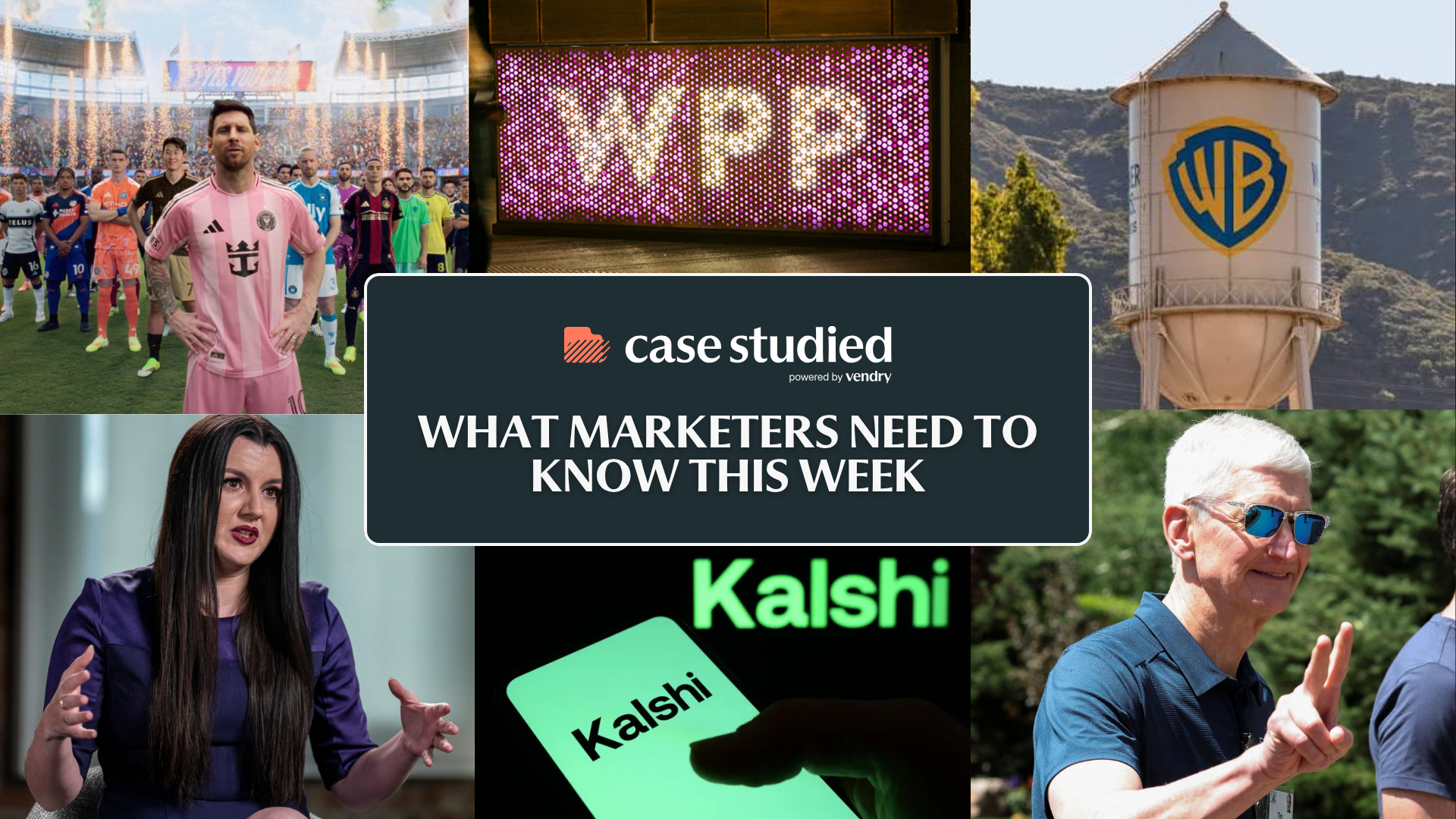
MLS goes big, Apple sues OpenAI, Warner Bros. blocked
16 Jul 2026
Boldest bets in marketing this week
MLS goes big, Apple sues OpenAI, Warner Bros. blocked

Case Studied Brief by Vendry
July 16, 2026

Case Studied Brief
Trade secrets, hard questions, and a $111B lawsuit.
This week's Brief covers star-powered campaigns, a run of AI leadership shakeups, and a legal fight that could reroute Hollywood's biggest merger.
On the campaign side, MLS assembled Messi, Beckham and Magic Johnson for its biggest push in league history. Plus, Anthropic asked the public hard questions about AI.
Meanwhile, Apple sued OpenAI over stolen trade secrets, Fidji Simo stepped back from OpenAI's No. 2 role, and a coalition of states sued to block Paramount's takeover of Warner Bros. Discovery.
Here's what you need to know.
Campaigns of the week 📺
Anthropic
Anthropic shares the hard questions
Anthropic released a new film, officially titled "Hope in Hard Questions," created with agency Mother. Directed by Myles McAuliffe, it’s the latest chapter in Anthropic’s ongoing "Keep Thinking" campaign. The spot opens with footage of a burning house at night as various voices ask questions like, "Can AI be trusted?" and “Who’s gonna hit the brakes if we need to?” Then, more hopeful images come on screen as the questions change direction. Voices ask, “Could AI help me build more connections in the community?” and “Can AI help me be a better teacher, a better mom?” The questions came from conversations Anthropic had with more than 120,000 people worldwide about their hopes and fears about AI. As part of the campaign, Anthropic also launched a hub where people can continue to ask questions and get answers about AI. The company promised to publicly track and report the specific actions it takes in response to the questions it receives.
Why it stood out: This campaign strikes a very different tone than Anthropic’s cheeky Super Bowl ad. Rather than leaning into humor, it focuses on public unease, acknowledging both skepticism and potential around AI. Some viewers noted that the film is visually and structurally similar to Apple's "Think Different" era. That comparison begs the question of how long Anthropic’s “Keep Thinking” campaign may run.
Major League Soccer
MLS sends an invite to World Cup fans
Major League Soccer launched "Thanks World, We'll Take It From Here," which the league is calling the largest coordinated marketing campaign in its 33-year history. Timed to the regular season's return on July 16-17 as the World Cup wraps up, the Ogilvy-produced push features club owners David Beckham, Matthew McConaughey, Magic Johnson and Kevin Durant. These celebrities appear alongside players like Lionel Messi and Son Heung-min. The campaign spans national broadcast, streaming, digital, social, out-of-home advertising and media partnerships. It also extends into music with an Amazon Music Original cover of "Can I Kick It?" produced by DJ Premier with new vocals from Samara Cyn. All 30 MLS clubs are running new-fan offers, including "First Match On Us" where free tickets are provided to first-time attendees. MLS CMO Radhika Duggal told The Hollywood Reporter, "the FIFA World Cup is going to bring millions of new fans into the game, and our job is to make sure their soccer journey doesn't end when the tournament does.”

Why it stood out: This campaign launched on a day with no World Cup matches. Duggal said that was intentional since launching earlier would mean getting drowned out by "too many matches, one right on top of the other." The campaign also showcases an MLS rebrand that began after Duggal joined MLS in 2024. However, it also arrives as MLS faces criticism. Some knocked the league for a lack of visible advertising earlier in the tournament. Even with this push, MLS's fragmented broadcast footprint across Fox, Apple TV, Tubi and other outlets could make it harder to convert casual World Cup viewers into regular MLS watchers.
📖 Read more: LBBOnline
Facebook
Facebook sends Marketplace on a summer road trip
Meta and agency Droga5 launched a new Facebook brand campaign called "Summer Jobs." The hero film follows Gracie, a young woman who uses Facebook Marketplace to find odd jobs and save up enough money to buy her dream truck. While the hero film was directed by Smuggler's Mark Molloy with cinematography from Drew Daniels, there are accompanying social films directed by Rory Wood. They show each how casually browsing Facebook can lead people to unexpected experiences. Droga5 group creative directors Amy Werblin and Erika Kohnen said the campaign "reintroduces Facebook as the place where you come with something specific in mind, a car, a book club, a guitar, but find the community that helps turn it into something bigger and more meaningful." The campaign also includes a series of Marketplace giveaway drops inspired by summer road trips, starting with a truck (like Gracie's) and continuing with more vehicles customized by creators.

Why it stood out: This campaign follows Facebook's first major brand campaign in four years, "A Little Connection Goes a Long Way," which launched last fall from the same agency. It was part of a broader effort to win back millennial and Gen Z users after teen usage on the platform fell from 71% in 2014 to just 32%, per Pew Research. Marketplace has stayed sticky, with 23% of 18-to-34-year-olds saying they browse it daily, per Morning Consult. With this latest campaign, Facebook isn't trying to convince young people to come back for the News Feed. It's leaning into the feature that demonstrably still works for this age group.
📖 Read more: Ad Age
Marshall
Green Day's Billie Joe gets his own amp
The British audio manufacturer Marshall unveiled the 1959BJA Artist Signature, a handwired, 100-watt amplifier developed with Green Day frontman Billie Joe Armstrong. It marks Marshall's first artist-signature amplifier in 14 years. The collaboration builds on the brand's handwired 1959HW Plexi platform but introduces a bespoke "Dookie Mod" circuit, inspired by the sound Armstrong created on Green Day's breakthrough album. It keeps the amp's original dynamics, while adding gain, tighter low frequencies and a thicker, more saturated overdrive. Finished in baby blue, it pays tribute to Armstrong's first guitar, known simply as Blue. The amp first appeared publicly during Green Day's Super Bowl performance, where fans spotted the distinctive color and began speculating about a signature release before Marshall confirmed it. It goes on sale July 21 for $3,999.99 and is tied to Marshall's new Amplify loyalty program, which commits a percentage of purchases to independent music venues.

Why it stood out: The "Dookie Mod" itself is something of a guitar-world legend. Armstrong's original tone came from a heavily modified vintage Plexi nicknamed "Pete." Getting that specific sound has historically meant paying a specialist amp tech anywhere from $220 to $250 to have a stock Marshall hand-modded. By productizing that mod and shipping it straight from the factory with Armstrong's involvement, Marshall is de-risking and formalizing a mod that guitarists have chased through gray-market channels for three decades.
Industry news 🤝
WPP plans hundreds more layoffs by end of 2026
WPP is cutting hundreds more jobs before the end of the year, with some employees informed of their roles being affected at WPP agencies like VML. The cuts extend a restructuring plan CEO Cindy Rose announced in February that targets £500 million in annual cost savings by 2028. The plan reorganizes WPP from a holding company into a single integrated company built around four units: WPP Media, WPP Creative, WPP Production, and WPP Enterprise Solutions. On the company's fourth-quarter earnings call, WPP's CFO Joanne Wilson said that "in a business where most of our cost savings are people, that will mean a reduction of certain heads." WPP's headcount had already shrunk 8.7% in 2025, down to 98,655 employees.

What it signals: This is a visible, ongoing cost of a much larger identity crisis at WPP. Rose attributed the company's underperformance to "excessive organisational complexity, a lack of an integrated operating model, and inconsistent strategic execution." The numbers behind that admission are stark: WPP's 2025 revenue fell 3.6% to £13.6 billion, profit before tax dropped 26%, and the company's market value has shrunk to about £3 billion, down from roughly £25 billion nine years ago. Rivals have been quick to frame the difference in approach as a strategic failure rather than a necessary correction. Publicis CEO Arthur Sadoun accused WPP of trying to "squeeze to please Wall Street" through mass layoffs rather than investing in growth.
📖 Read more: Ad Age
Fidji Simo steps back from OpenAI's No. 2 role
Fidji Simo is stepping down from her full-time position. She served as OpenAI's CEO of Applications and was the executive who led its AGI, product, and business operations, plus its nascent advertising push. She announced the move on social media, saying that three months earlier she'd gone on medical leave after a severe exacerbation of a chronic illness she's lived with for seven years. In 2019, Simo was diagnosed with a chronic neuroimmune condition called Postural Orthostatic Tachycardia Syndrome. She wrote candidly that she'd spent "countless hours in doctors' offices, dealing with symptoms, treatments, insurance, uncertainty, and all the invisible work that comes with being a patient." Her operational responsibilities—which included COO Brad Lightcap, CFO Sarah Friar, and CPO Kevin Weil all reporting to her—will now be divided among Friar, president and chairman Greg Brockman, and Chief Strategy Officer Jason Kwon. Meanwhile, Simo will transition to a part-time advisory role with OpenAI. Sam Altman responded to the announcement personally on X, calling himself "really sad" about the news and grateful for her friendship.

What it signals: Simo's exit follows former CMO Kate Rouch's departure earlier in 2026 to focus on her own cancer recovery. Chief futurist Joshua Achiam also exited earlier in July, making this the third senior OpenAI leadership departure this year alone. The news about Simo landed the same day OpenAI launched its new GPT-5.6 model family and a ChatGPT Work agent explicitly positioned against Anthropic. It also comes as OpenAI prepares for a potential 2027 IPO, having confidentially filed with the SEC in June (a week after Anthropic did the same). Simo was seen as a likely candidate to take on broader operational responsibility if the company went public, so her transition leaves a gap in the company’s commercial and product leadership layer.
📖 Read more: Adweek
Airbnb hires OpenAI's creative chief
Airbnb hired Michael Tabtabai, OpenAI's first global VP of creative, as its new VP of creative. The change comes less than a year into Tabtabai’s OpenAI tenure. He starts August 10, reporting to CMO Rebecca Van Dyck, and fills the seat left by six-year Airbnb creative VP Scott Trattner. Tabtabai brings experience from Google's Brand Studio, Coinbase, Wieden+Kennedy, and Saatchi & Saatchi. In a LinkedIn post announcing the move, he said he's "deeply appreciative" of his time at OpenAI, where he helped "scale a global creative and design practice rooted in craft and human insight." Tabtabai said he was drawn to Airbnb's mission of "inspiring real-world connection," while Van Dyck said he brings "a rare combination of creative instinct and strategic focus."

What it signals: Unlike Booking.com and Expedia, which have both integrated their travel search into ChatGPT, Airbnb has deliberately stayed out. CEO Brian Chesky argued the company can build a better AI interface in-house, which makes this hire seem like more than a routine creative shuffle. The poach is also a notable reversal, since OpenAI has spent the past few years pulling talent away from Airbnb, not the other way around.
📖 Read more: Ad Age
States sue to block the Paramount-Warner Bros. Discovery deal
A coalition of 12 state attorneys general filed an antitrust lawsuit in the Northern District of California to block Paramount's roughly $111 billion takeover of Warner Bros. Discovery. The lawsuit comes a month after the Department of Justice approved the merger. The states asked the court for a temporary restraining order and preliminary injunction to halt the deal while the litigation proceeds. They argue that it would violate the Clayton Act by substantially reducing competition in wide-release theatrical film distribution, distribution of anticipated top-grossing films, and licensing of basic cable channels. California Attorney General Rob Bonta said at a press conference, "there is no debate here: this merger will snuff out competition, drive up prices, diminish content quality, and produce fewer movies and shows each year." Paramount called the suit "a fundamentally flawed application of the antitrust laws" and said it will vigorously defend the transaction. The company argues the lawsuit would "shield" dominant streaming platforms like Netflix and technology companies from "much-needed competition."

What it signals: Paramount cleared its biggest expected regulatory hurdle when the Trump administration's DOJ approved the deal. This suit represents a separate track of legal risk. Paramount countered by pledging to release at least 30 theatrical films per year and arguing the combined company will be better positioned to compete with the likes of Netflix, Amazon, and Disney+. With the deal already facing separate scrutiny from UK regulators, Paramount is now defending the merger on two fronts simultaneously. If a judge grants the requested injunction, the company could be blocked from closing the transaction that it expected to complete in the third quarter.
📖 Read more: Deadline
MarTech moves 🤖
Apple sues OpenAI over trade secrets
Apple has sued OpenAI in federal court in Northern California, alleging the AI lab took Apple's intellectual property in order to develop its own consumer hardware. In its filing, it states that "at every level, from members of its Technical Staff to its Chief Hardware Officer, and in coordination with business partners, OpenAI has been stealing Apple's trade secrets and confidential information." The lawsuit centers on OpenAI's Chief Hardware Officer Tang Tan, a 24-year Apple veteran who most recently served as VP of product design for the iPhone and Apple Watch. Apple accuses Tan of using its confidential project code names during recruiting, asking job candidates to bring in Apple hardware components to interviews, and coaching departing employees on how to evade Apple's exit security procedures. Apple's filing calls the known instances "the tip of the iceberg," arguing that OpenAI's "nascent hardware business now rests on the shakiest of foundations, rotten to its core by its illegal reliance on misappropriated trade secrets." OpenAI responded that it has "no interest in other companies' trade secrets" and remains focused on its own technology.

What it signals: This dispute traces back to OpenAI's $6.4 billion acquisition of former Apple designer Jony Ive's hardware startup io Products last year. This was widely seen as a direct challenge to Apple in the hardware category it’s dominated for two decades. The suit landed in the same week OpenAI’s chief product officer and chief business officer stepped down due to chronic illness. It's also a notably steep reversal from Apple's own AI positioning. It had integrated ChatGPT into Siri for complex queries, but its upcoming Siri overhaul instead relies on Google's Gemini. That makes this litigation seem like a serious break between two companies that were, until recently, finding ways to work together.
📖 Read more: BBC
Meta pulls a controversial Instagram AI feature
Meta removed a feature from its new Muse Image AI tool just three days after launch. The tool in question allowed anyone to tag a public Instagram profile in a prompt and generate AI images using that person's publicly shared photos as a reference. Public accounts were opted in automatically, with users being required to actively opt out in settings. Emmy-winning actor Hannah Einbinder publicly urged her followers to turn the setting off after discovering it had been switched on automatically. The talent agency CAA called the rollout irresponsible, saying artists deserve to decide if and how their likeness is used. The union SAG-AFTRA called the default opt-in "an utter miscalculation of public sentiment.” Meta said in a statement that it "heard the feedback that this feature missed the mark, so it's no longer available."

What it signals: This isn’t the first time a large platform shipped an AI feature with data access enabled by default. One outlet noted this specific playbook has now repeated across the industry, pointing to Google enabling AI training on Search image uploads by default and Grok doing the same with image generation on X. For Meta in particular, the episode lands against a backdrop of existing legal exposure. The EU found that its "pay or consent" ad model breaches the Digital Markets Act, and a state attorneys general trial is seeking as much as $1.4 trillion in damages over youth safety.
📖 Read more: The New York Times
Microsoft strips ads out of Windows Search
Microsoft is rolling out a redesigned Windows 11 search box to Insiders in the Experimental Dev channel. It addresses years of complaints that the feature was cluttered with promotional content. In a blog post, Microsoft said, "the search home pane will no longer show MSN or Bing content, and promotional content and ads will no longer appear in search results." The update replaces "What day is it today?", "Daily quiz," "Word of the day" and recommended-games tiles with a simpler interface that shows only recently searched applications, files and folders. Microsoft is improving typo tolerance so misspelled queries like "utlook" still surface "Outlook," adding two-character filename search. It’s also giving local results like apps, settings and files priority over web and Microsoft Store suggestions when they're a strong match. A new toggle under Settings lets users turn off web search suggestions and Microsoft Store recommendations entirely.

What it signals: Microsoft confirmed in March that it was making a "commitment to Windows quality" involving significant OS changes throughout 2026. This redesign is one entry in a broader shift that involved scaling back aggressive Copilot placement, giving users more control over Windows Update restarts, and quieting the Widgets board. Still, not everyone is convinced the reversal goes far enough. Skeptical commentators pointed out that the only concrete ad removal Microsoft confirmed is "promotional content has been removed from web results," and questioned how the company plans to make up for whatever ad revenue it's giving up.
OpenAI brings prediction markets into ChatGPT
OpenAI struck a partnership with Kalshi to surface World Cup prediction-market data in ChatGPT search results. It shows up directly in search: a query for "France and Spain" displayed a graphic citing Kalshi data that gave France a 60% chance of winning. A search on the other semifinal cited Kalshi odds that favored England over Argentina at 55%. OpenAI updated its corporate help page to state that users "cannot place bets through ChatGPT," that the data is limited to queries related to the 2026 World Cup, and that it's "for informational purposes only." The integration appears to be OpenAI's first use of prediction-market data to power sports search results. Notably, OpenAI hasn't publicly detailed user controls, ranking methodology, or the financial terms of the arrangement. Both OpenAI and Kalshi declined to comment when asked directly.

What it signals: This is the latest move in a bigger race among tech platforms to fold prediction markets into consumer products. Google struck its own deals with Polymarket and Kalshi last year to surface prediction-market results in Search and on Google Finance. Meanwhile, Meta CEO Mark Zuckerberg was reportedly in talks to acquire Kalshi outright before those discussions fell apart, after which Meta began building its own standalone prediction-markets app. The category is growing at a pace that makes the appeal clear: the combined monthly trading volume on Kalshi and Polymarket has gone from roughly $28 billion in June 2025 to nearly $220 billion one year later. Kalshi's own valuation jumped from $2 billion to $22 billion over that same stretch. That growth is arriving alongside regulatory uncertainty, though. Scrutiny of prediction markets is increasing due to concerns about insider trading and sensitive information leaks. The sector already set off dozens of legal battles between operators and state gaming officials.
📖 Read more: The New York Times
Editors Choice 👀
⚽ Powerade's World Cup hydration breaks racked up huge exposure, but fans kept booing them. 📖 Read more: Marketing Brew
🛠️ Brands are turning to “forward deployed engineers" to get more out of AI usage and output. 📖 Read more: Ad Age
🔍 Google updated its spam policy to crack down on the AI-generated content that confuses its search results. 📖 Read more: Forbes
Reach into the inbox: Did you know you can advertise in the Case Studied newsletter? That means having a direct line to 41,000+ senior marketers via a newsletter with a 52% open rate.
Don't miss the next Case Studied™.
Join 40,000+ marketers and receive a breakdown of the world's best brands every week.