This week's boldest moves in marketing
Championships, AI accountability, and a $22 billion pivot to CTV
18 Jun 2026
This week's boldest moves in marketing
Championships, AI accountability, and a $22 billion pivot to CTV

Case Studied Brief
June 18, 2026


Today's edition is sponsored by HubSpot
HubSpot's customer platform includes all the marketing, sales, customer service, and CRM software you need to grow your business.
Case Studied Brief
New York wins, Fox buys Roku, and the White House pulls Mythos
This week's Brief covers a brand moment covering a historic championship, a string of major industry deals, and government intervention with AI.
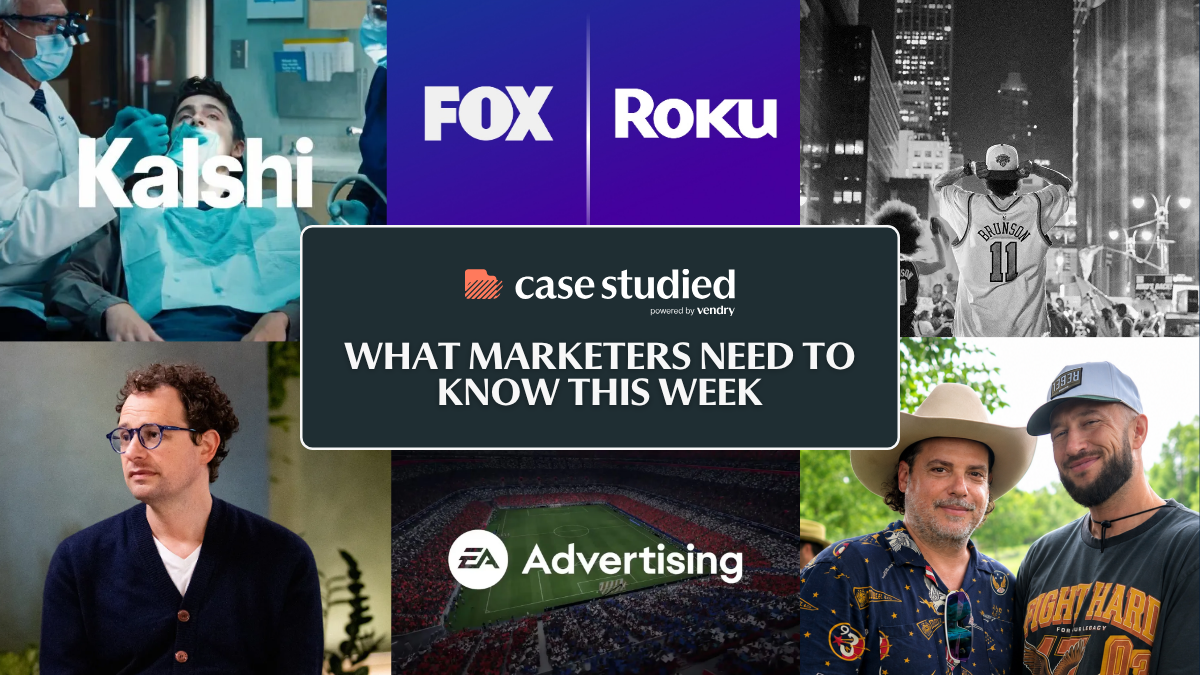
Nike and Josh Safdie bottled 53 years of Knicks heartbreak into 39 seconds. Tootsie Roll blended nostalgia with a new face. And Timothée Chalamet became the spokesperson of a prediction market that spent all awards season trading his odds.
Meanwhile, Fox agreed to buy Roku for $22 billion, Anthropic was forced to pull its newest models offline by government directive, and EA turned its sports games into a formal media buy.
Here's what you need to know.
Campaigns of the week 📺
Nike
New York finally exhales
With the Knicks winning their first NBA championship in 53 years, Nike dropped a 39-second spot within minutes of the final buzzer. Created by Wieden+Kennedy and directed by filmmaker Josh Safdie (a lifelong Knicks fan who was courtside for much of the playoffs), the film follows a young fan in a Jalen Brunson jersey sprinting through the streets of Manhattan. He arrives at Madison Square Garden to find crowds already spilling outside and celebrating the championship win. Billy Joel's "New York State of Mind" plays throughout, and Nike's caption read, "Sleep well, NY." Jordan Brand also released a companion video featuring Spike Lee in character as Mars Blackmon from the film She’s Gotta Have It. Blackmon is shown calling Michael Jordan to share the news of the Knicks win.

Why it stood out: The turnaround time on this ad went a long way in making it feel special. But the casting also does a lot of leg work. Safdie's signature style made the video feel less like an ad and more like a document of the moment. For marketers, it’s a reminder of how infrastructure can pay off in real-time marketing efforts.
📖 Read more: Ad Age
Tootsie Roll
Mr. Owl gets a sidekick
Tootsie Roll Industries is back with a follow-up to last year's restored "How Many Licks" spot. This time, it introduced a new animated character alongside the iconic Mr. Owl: a playful, color-changing chameleon who showcases the brand's flavor lineup. Created by the Chicago-based indie agency Schafer Condon Carter with animation by Calabash, the new ad maintains the key elements of the original “How Many Licks” commercial. It’s got the same illustration style, the same announcer voiceover, and the same whimsical pacing. It even closes with the familiar line, "The world may never know." This latest spot marks the first time Mr. Owl has ever been seen eating a Tootsie Roll rather than a Tootsie Pop. It could be a signal about what the brand is focusing on in this new chapter.
Why it stood out: Brand mascots are an underused asset in the modern era that’s focused so much on influencer partnerships. Tootsie Roll is making a case for why they can still work. Rather than rebooting Mr. Owl or modernizing him, their team simply built around him. Adding this new chameleon character helps give the brand a narrative anchor to showcase its broader product range without abandoning the recognition it’s built over decades with Mr. Owl.
📖 Read more: LBB Online
Kalshi
Timothée Chalamet, professional spokesperson
The prediction market platform Kalshi named Timothée Chalamet as its first Hollywood brand face in a campaign released June 10. The ad, directed by Academy Award-winning cinematographer Linus Sandgren, is deliberately surreal. Chalamet name-drops Kalshi to his dentist mid-procedure, bangs his head on the ceiling while beefing with upstairs neighbors, and tests keyboards at a Guitar Center. "KALSHI" is shown flashing across the screen after each segment. At no point does the ad explain what Kalshi actually does. The partnership has an interesting internal logic to it: during the 2026 awards season, Chalamet was Kalshi's most-traded entertainment figure. His Best Actor odds swung from 68 cents down to 51 cents as the race tightened before Michael B. Jordan ultimately won for Sinners.

Why it stood out: Celebrity endorsements for financial products are nothing new, but this one sits in new territory. Kalshi operates in the gray zone between finance and gambling, and Chalamet's fanbase skews young and parasocially invested. The backlash to their partnership was swift and loud, with fans calling Chalamet a "sellout" and flooding his comments with Obi-Wan Kenobi GIFs. But controversy aside, the casting logic is coherent. Few celebrities have been as literally quantified by a brand before signing with it.
📖 Read more: GQ
Smartphone Free Childhood
Your kid's algorithm, on VHS
As the UK government debates raising the minimum age for social media to 16, the grassroots movement Smartphone Free Childhood released a satirical film that makes its case. Created pro bono by Arts & Sciences London and directed by David Dearlove, the spot is set inside a Blockbuster-style video store where a father and his two kids browse for a rental. The employee's recommendations quickly reveal themselves to be thinly veiled versions of what children encounter online daily: content promoting misogyny, bullying, and predatory behavior. The film arrives as the UK government's consultation on raising the social media age limit recently closed, with ministers expected to announce next steps within weeks.
Why it stood out: With this spot, Smartphone Free Childhood showcased a setting where adults have clear instincts about what's appropriate. That helped reframe a complex policy conversation into something more obvious. It’s worth noting that the film made no reference to the many statistics on how social media impacts children, and instead opted to let the narrative do the heavy lifting. The pro bono production also indicates that the cause and the creative brief were weighty enough to attract serious talent without any payout.
📖 Read more: LBB Online

Supercharge your productivity with HubSpot's comprehensive guide. This free resource is your fast track to AI mastery:
Industry-Specific Use Cases: 15+ real-world applications across various sectors
Productivity Guide: 21 best practices to 10x your efficiency with AI
Prompt Powerhouse: 100+ ready-to-use prompts for immediate implementation
Challenge Buster: Overcome common AI hurdles with expert strategies
Plus, in-depth sections on email composition, content creation, customer support, and data analysis.
Industry news 🤝
Fox buys Roku for $22 billion
Fox Corporation announced that it’s acquiring Roku in a cash-and-stock deal valued at $22 billion or $160 per share. The transaction pairs Fox's live content portfolio—including sports, news, and the Tubi streaming service—with Roku's connected TV platform. The deal would make the combined company the third-largest player in US television by share of viewing, and one of the largest streaming businesses in the country. Fox CEO Lachlan Murdoch called it a "defining moment" for the company, framing it as a natural extension of a decade-long strategy. The acquisition follows Fox's 2020 pickup of Tubi and continues what Murdoch described as a disciplined approach to capital allocation. The company says it will maintain its investment-grade balance sheet and continue its shareholder return program uninterrupted. The deal is expected to close in the first half of 2027, pending regulatory approval. Fox has committed to continuing to operate Roku as a partner-friendly platform going forward.

What it signals: This can be read as a calculated bet from Fox that owning distribution platforms is a more defensible position than competing purely on programming. The combination of Tubi's ad-supported streaming with Roku's first-party data and 100+ million household reach gives the combined company a competitive position in the battle for connected TV ad dollars. It also puts pressure on legacy broadcasters without a direct-to-consumer pipe of their own. Many folks across the advertising industry are likely wondering what a vertically integrated Fox-Roku looks like as a media buy.
📖 Read more: Fox Corporation | Roku
Omnicom loses HP after 17 years
HP handed its global media account to Publicis Media, ending a 17-year partnership with Omnicom Media Group. The news follows a closed pitch between the two networks that concluded earlier this spring. Omnicom's PHD first won the business back in 2009, when it took home HP's global traditional media duties. Then it added digital media to its remit in 2017 and retained the account again in 2024 while HP managed a significant portion of its programmatic advertising in-house. The account is estimated to be worth around $250 million. HP spent $194 million on media globally in 2023, with 69% of that invested in digital channels, according to COMvergence data. The shift comes as HP has been increasingly focused on promoting its subscription services and leaning into digital-forward media strategies, raising questions about how much of the scope Publicis is inheriting versus how much remains managed internally.

What it signals: Seventeen years is a long time to hold any account and losing one of this scale is a significant blow to Omnicom. It comes at a moment when the holding company is navigating its own ongoing merger situation with IPG. For Publicis, it's the kind of win that reinforces its momentum in global media consolidation and signals continued strength in pitching integrated, tech-forward media solutions to major enterprise clients. A broader pattern to watch is what the in-house dynamic looks like going forward. Publicis could be stepping into a true full-service media remit or inheriting a more defined and bounded scope. Either way, the account shift is a reminder that longevity alone doesn't insulate a relationship from a competitive review.
📖 Read more: Adweek
CAA and TPG are building a creator holding company
CAA and TPG's Integrated Media Company launched Compound Creative Holdings, a $250 million holding company. It was built to acquire, operate, and grow businesses led by YouTubers and other creators. The venture will be led by Tucker Brown, a former partner at CAA Evolution with more than 15 years of experience advising entertainment, sports, and media companies. CAA and IMC will contribute combined resources to support the company, which will operate independently from CAA's existing creator representation business. The goal, as framed by CAA co-chairman Kevin Huvane, is to partner with creators who are already building full-fledged media companies and provide them with the capital architecture and operational infrastructure to scale.

What it signals: The talent agency-to-holding company evolution has been building for years. But a $250 million war chest from two institutions with CAA's creative relationships and TPG's capital infrastructure is a serious structural bet. It's a recognition that many valuable creator businesses have outgrown influencer deal-making. Rather than just brand partnerships, they now need M&A support, operational scaffolding, and long-term capital. It’s worth watching if this model attracts imitators quickly, as the creator economy matures.
📖 Read more: Variety
AI search is about to be a $100 billion business
WPP Media's midyear global ad spend forecast projects that generative search advertising revenue will surpass $100 billion by 2030, making it the fastest advertising channel to reach that milestone in history. This is also the first year WPP Media has broken out generative search as its own standalone category, defining it as advertising served within AI-mediated discovery environments including Google AI Overviews and standalone conversational AI products like ChatGPT. For 2026, generative search ad revenue is projected to reach $5.1 billion, or roughly 0.4% of total global ad revenue, growing at a compound annual rate of nearly 100% over the next five years. Overall, global ad revenue is expected to grow 8.9% this year, boosted by the FIFA World Cup, major sporting events, and continued AI investment acting as a countervailing force against geopolitical headwinds.

What it signals: The speed of AI search’s trajectory is worth paying attention to. Search advertising took decades to become a dominant channel. Generative search is projected to reach the same $100 billion threshold in roughly five years. The implication is that brands and agencies need to start treating AI agents and chatbots as media surfaces now, before the monetization infrastructure fully catches up. WPP Media uses a gold rush analogy in the report, claiming the picks and shovels moment is already here.
📖 Read more: Adweek
MarTech moves 🤖
The White House pulled Anthropic's newest models offline
On June 12, at 5:21 p.m. ET, Anthropic received a letter from the Commerce Department, signed by Secretary Howard Lutnick. It ordered the company to suspend all access to its two newest models, Fable 5 and Mythos 5, for any foreign national, including Anthropic's own foreign-national employees. Because Anthropic said it had no way to reliably separate foreign nationals from other users in real time, the company pulled both models entirely for all customers worldwide to ensure compliance. The directive cited national security authorities but did not, according to Anthropic's public statement, provide specific details of its concern. The company's understanding was that the government believed it had become aware of a method of jailbreaking Fable 5. Anthropic reviewed what it understood to be the basis for the directive and said the capability demonstrated was already widely available from other publicly deployed models, including OpenAI's GPT-5.5. White House AI adviser David Sacks offered a competing account on X, stating that a trusted partner had identified a jailbreak in Fable 5's guardrails and that Anthropic's CEO Dario Amodei had refused to fix the issue or withdraw the model before the export control was issued. The dispute arrives as Anthropic is reportedly preparing for an IPO. It is also separately engaged in ongoing litigation with the Trump administration stemming from an earlier Pentagon blacklisting dispute, in which the company was designated a "supply chain risk" after refusing to allow autonomous weapons use of its models.

What it signals: This episode represents a significant government intervention in commercial AI deployment, and the two accounts of what happened are sharply at odds. Anthropic maintains the jailbreak was narrow, non-universal, and no worse than what other frontier models already allow. It also stated that applying this standard across the industry would effectively halt all new model deployments. Meanwhile, the White House says Anthropic prioritized commercial access over safety and was given the option to fix the issue before the directive was issued. The situation makes clear that the government now has both the willingness and the legal tools to pull a frontier AI model from the market on short notice and the terms of that power are being contested in real time.
📖 Read more: Washington Post | Anthropic
EA turned video games into a media buy
Electronic Arts launched its first formal advertising platform, opening up in-game inventory across EA Sports FC, Madden NFL, and College Football 26 as targeted, measurable media. Built on a proprietary ad server and SDK designed for EA's Frostbite game engine, the platform allows brands to serve placements that mirror the surfaces seen during real sporting events: stadium ad boards, scoreboards, jumbotrons, and broadcast-style overlays. They’re all dynamically served within the 3D game environment and measured against IAB impression standards. Targeting at launch is available by geography and flight date. EA is also pairing the platform with an EA Sports Official Partner Program, granting brands official designations and access to tentpole franchise moments like cover reveals, player ratings reveals, and the Madden Bowl during Super Bowl week. Early partners include Visa, Lowe's, Red Bull, Xfinity, Gemini, and Mountain Dew.

What it signals: The pitch EA is making to brands is fundamentally an attention argument: gaming audiences are large, concurrent, and deeply focused in a way that live broadcast viewers increasingly are not. By formalizing what was previously a patchwork of one-off sponsorship deals into a self-serve, data-driven media platform, EA is positioning itself as a legitimate channel alongside television and social. The question now is whether media planners start treating in-game inventory as a standard line item, or whether it stays in the experiential silos where it’s historically lived.
📖 Read more: Adweek
Disney, Adobe, and the NYT formed an AI accountability coalition
A new cross-industry coalition called the Alliance for Responsible Innovation in the Arts & Media (ARIAM) launched, bringing together Disney, Adobe, the New York Times, Condé Nast, the Financial Times, ITV, BBC, Cambridge University Press, and several other major content and media organizations. They coalesce under a shared framework for responsible AI development. The group is led by Victoria Furniss, a former Netflix executive who held legal and public policy roles at the streamer for nearly nine years before founding The Birdella Group. ARIAM's stated mission is to ensure AI is developed with accountability, transparency, and safety embedded from the start. The coalition is explicitly not anti-AI: Furniss has framed the group's goal as ensuring that responsible innovation is good for society and that AI supports human creativity rather than undermining it. The launch arrives as the entertainment industry has begun reaching fragile equilibrium on the issue, with the DGA, WGA, and SAG-AFTRA each securing AI protections in their most recent contract renewals.

What it signals: When Disney, Adobe, and the New York Times sit at the same table with a shared policy agenda, it's worth paying attention. It signals that the content industry is organizing itself into a coherent lobbying and standards-setting body on AI, rather than responding to developments reactively company by company. The group’s framing around child safety, creator protection, and IP rights is strategic: these are the pressure points where public sentiment and regulatory appetite are most aligned. ARIAM is positioning itself to help shape what responsible AI looks like.
📖 Read more: Deadline
An AI podcast studio is open to the public
Rebel Audio, the AI-powered podcast production platform backed by former Apprentice producer Mark Burnett, moved from invitation-only access into public beta. The Nashville-based startup allows creators to record, edit, and distribute podcasts directly to YouTube, Spotify, and Apple Podcasts. It also offers immediate clip generation for social distribution and allows them to translate content into more than 30 languages using a cloned version of the creator's own voice. The company came out of stealth in March and raised a $4.15 million seed round from investors including Launch Tennessee and Market Square Ventures. The platform was built in partnership with Lattice Partners, an AI consulting firm and product studio. Founder and CEO Jared Gutstadt is launching a companion podcast called "Rebels," with inaugural guests including David Arquette, Don Lemon, Nile Rodgers, Steve Levitan, and Neal Brennan.

What it signals: The podcasting space has been consolidating at the top end for years, with big platforms locking up premium talent through exclusive deals. Rebel Audio is betting in the opposite direction, signaling they believe the next wave of audio growth comes from lowering the production floor. Voice cloning for multilingual translation is a detail worth watching closely. It's a capability that dramatically changes the economics of reaching global audiences. If it works at scale, it makes the question of language-locked content feel suddenly very solvable.
📖 Read more: Variety
Editors Choice 👀
🏳️🌈 Corporate Pride sponsorship is quietly declining as brands pull back from public LGBTQ+ allyship. 📖 Read more: Ad Age
🌊 A Peter Thiel-backed startup wants to solve the AI data center power crisis by floating servers at sea. 📖 Read more: Forbes
📺 Mindy Kaling's new Hulu show sold out 13 brand partnerships before its premiere, with a record five in-show integrations. 📖 Read more: Marketing Brew
Reach into the inbox: Did you know you can advertise in the Case Studied newsletter? That means having a direct line to 41,000+ senior marketers via a newsletter with a 52% open rate.
Don't miss the next Case Studied™.
Join 40,000+ marketers and receive a breakdown of the world's best brands every week.