Vol 136: Columbia dares flat earthers 🌍
A CEO bets the company on a conspiracy theory.
28 Jul 2026
Vol 136: Columbia dares flat earthers 🌍
A CEO bets the company on a conspiracy theory.

Case Studied by Vendry
July 28, 2026


Case Studied
Betting the company on a conspiracy theory
Brands tend to avoid internet conspiracy communities. After all, mocking a fringe group or appearing to take its side can carry some serious potential downsides.
Brands that do lean into conspiracy communities or online subcultures tend to play it safe. But we recently saw Columbia Sportswear go fully in the opposite direction.
This week, Case Studied explores how Columbia won 10 Cannes Lions awards by challenging flat earthers to prove their theory.
The Brief

Columbia Sportswear has made outerwear and outdoor gear for close to 90 years. The company's history was built on stories of toughness tied to founder Gert Boyle.
Back in 2023, Columbia president Joe Boyle gave the agency adam&eve\TBWA a copy of Gert Boyle's book, One Tough Mother, asking the team to reconnect the brand with what he described as its "anarchic roots." That assignment became the basis for Columbia's "Engineered for Whatever" brand platform. It launched in August 2025 with a film that leaned on humor and real outdoor hazards, rather than the scenic, aspirational imagery that’s typical of outdoor apparel advertising.
By late 2025, Columbia was looking for a way to stand out during the most competitive stretch of the year for outdoor apparel: Black Friday and the holidays. To do that, the brand's team was set out to make Columbia "the most irreverent brand in the outdoors."
With flat earth discourse being an established, ongoing presence online, Columbia's team saw an opening to make a related point about gear built for extreme conditions.
Sponsored
Nobody wants to hire a marketing agency in the middle of Q4.
Yet that's where plenty of brands land: buried in RFPs and back-to-back agency vetting calls right when they should be shipping campaigns.

Vendry takes that off your plate. Tell us your budget, industry, and goals, and you get a short list of agencies that actually fit, hand-picked from 4,000+ we've already vetted.
What you get:
A shortlist in <7 days, not a month of digging
Only agencies that fit your budget and your category
Warm intros to real decision-makers, not a directory to cold-email
$0 to you (agencies pay us)
One more reason to start now: kickoff a search with our team and we'll send you a $100 Amazon gift card. Our treat for giving us your time.
The Execution

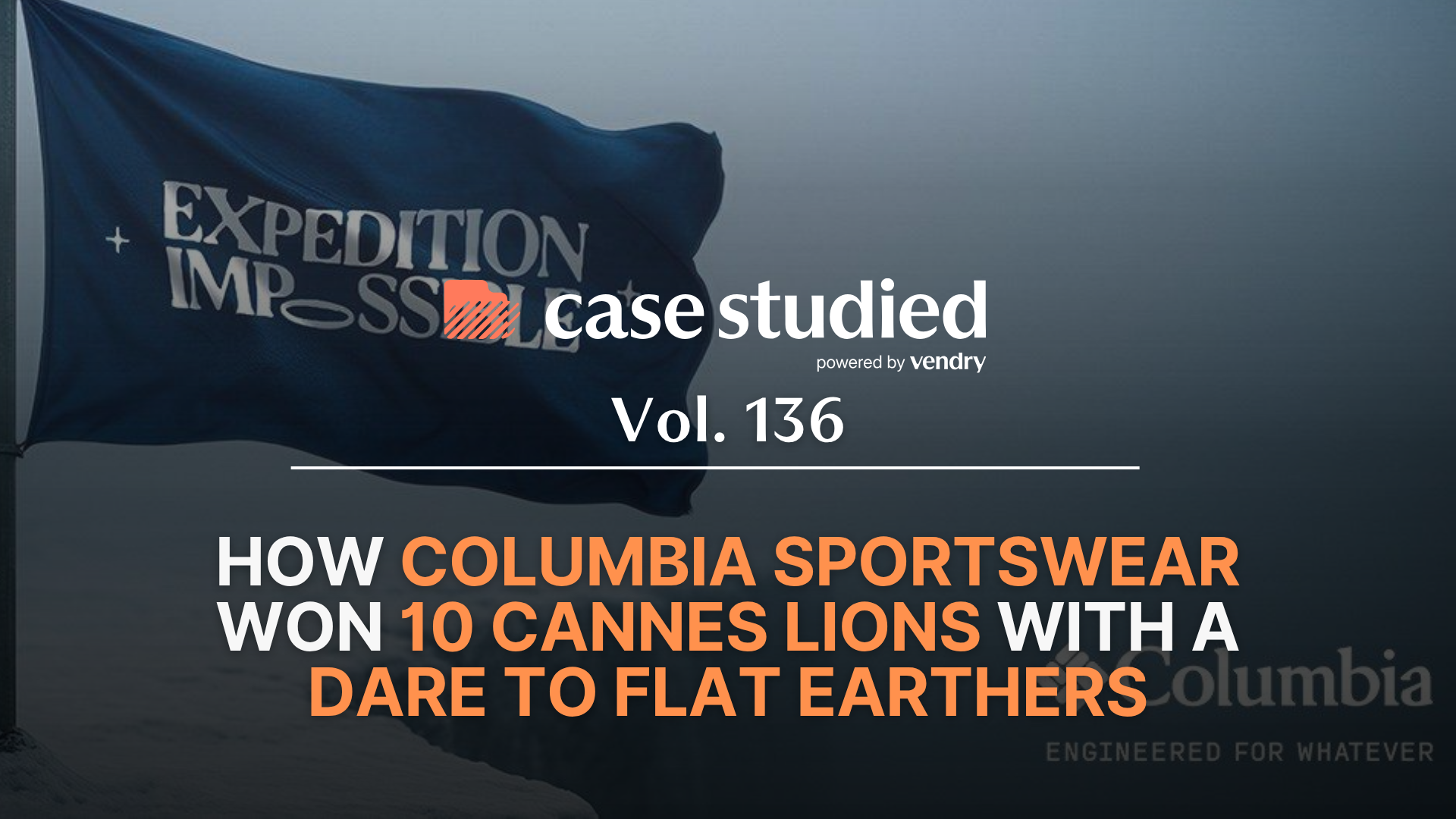
Columbia worked with adam&eve\TBWA London and production company Smuggler on an integrated campaign called “Expedition Impossible.” It opened with a full-page open letter in The New York Times, written by CEO Tim Boyle. He challenged flat earthers to prove their theory by finding the edge of the Earth and submitting a photo as proof. If they did, he would hand over the keys to the company.
That letter was followed by a social film in which Boyle walked viewers through Columbia's headquarters, showing the company assets that would be included in the deal. In a deadpan tone, Boyle pointed to various items around the office: clothing on hangers, a stapler, an employee’s laptop, an employee’s lunchbox, and an employee’s laptop (which he pulled directly out of their hands). Both the letter and the film had an absurd premise delivered with a straight face, and noted that anyone who embarked on the journey would need Columbia Sportswear.
The campaign's more targeted piece was direct outreach into flat earth blogs, forums, and YouTube channels. In posts and comment sections, Columbia encouraged flat earthers to attempt the expedition and reiterated that they’d need Columbia gear for the trip.
Columbia said this dialogue produced a running exchange with the community. The wager was also promoted to a Wall Street audience, extending the offer to anyone drawn to the idea of acquiring a public company outright.
The Results

Nobody found the edge of the Earth, but that didn’t stop people from trying. The standout entry was a drone photo, sent in with a tongue in cheek request for instructions on how to take over the company. Columbia said letters like that kept coming in on a weekly basis, long after launch, some genuinely annoyed and some just playing along with the joke.
Beyond the ongoing letters, the Expedition Impossible campaign generated an 80 million earned audience and 10.4 million social views, with a 75% view-through rate on YouTube, plus 261 pieces of earned media coverage.
At the 2026 Cannes Lions International Festival of Creativity, the campaign won:
The Dan Wieden Titanium Award
The Grand Prix in Brand Experience and Activation
Two Gold Lions in Direct Marketing and PR
Three Silver Lions in Social and Creator and in PR & Direct
Three Bronze Lions in Social and Creator, PR, and Brand Strategy
That's 10 Lions total, the most of any campaign at that year's festival, plus a Silver Pencil at The One Show.
The Takeaways
1) Meet a community where it already gathers.
While the New York Times letter and the social film was eye-catching, the activity on flat earth blogs and forums was a crucial element of this campaign. In those spaces, the brand kept the exchange going for months through letters and follow-up posts. That kind of direct presence may be a reason why the campaign read as playful engagement rather than a brand talking down to a community from the outside.
Showing up inside a community's own spaces changes how that community experiences the message. And the closer a brand gets to the group itself, the more important tone becomes. If you’re looking to engage a specific community or niche group online, be mindful about understanding the style and tone that resonates in those spaces.
2) Leverage your execs when it makes sense.
CEO Tim Boyle fronted both the open letter and the follow-up film, giving the wager a face as well as validity. Boyle later described the brief to the agency as a call for "groundbreaking work that most would be afraid to approve."
An executive on camera can signal that a company is willing to stand behind its message (or in this case, a bet). It can also add a layer of credibility that a stunt might not otherwise have. If your executive is open to advertising exposure, consider creating a process for evaluating when it makes sense to bring them in and what guardrails to establish.
3) Build toward a platform instead of a single stunt.
Expedition Impossible ran inside Columbia's "Engineered for Whatever.” That platform already included a jacket with a legally binding inheritance label and a limited-edition beer brewed with bear droppings. Adam&eve\TBWA CEO Miranda Hipwell described the process as pulling from "the best parts" of Columbia's history for each new idea, treating each activation as part of a bigger story instead of a one-off pitch.
Consider how a brand platform could help your brand accomplish its loftiest goals. Columbia wanted to be "the most irreverent brand in the outdoors." As such, their campaigns stayed within a combination of irreverence and product durability. Look at what your brand is trying to accomplish and how a brand platform (plus subsequent campaigns) could contribute to it.
Reach into the inbox: Did you know you can advertise in the Case Studied newsletter? That means having a direct line to 41,000+ senior marketers. Check out rates and availability.
Don't miss the next Case Studied™.
Join 40,000+ marketers and receive a breakdown of the world's best brands every week.