The week's biggest swings in marketing
Football, basketball, and a highly consequential blog post.
11 Jun 2026
The week's biggest swings in marketing
Football, basketball, and a highly consequential blog post.

Case Studied Brief by Vendry
June 11, 2026

Case Studied Brief
World Cups, a Knicks playoff run, and creepy chrome stalkers
This week's Brief covers brand moments built around live sports, AI news, and industry moves across media and tech.
Nike built a World Cup campaign designed to run the length of the tournament. Apple turned data trackers into characters that physically follow you. And Stella Artois set aside $100,000 to reimburse fans who work from the bar during World Cup matches.
Meanwhile, The Trade Desk lost another executive, NPR hired a YouTube veteran, and OpenAI filed to go public.
Here's what you need to know.
Campaigns of the week 📺
Nike
A studio full of football stars, no script
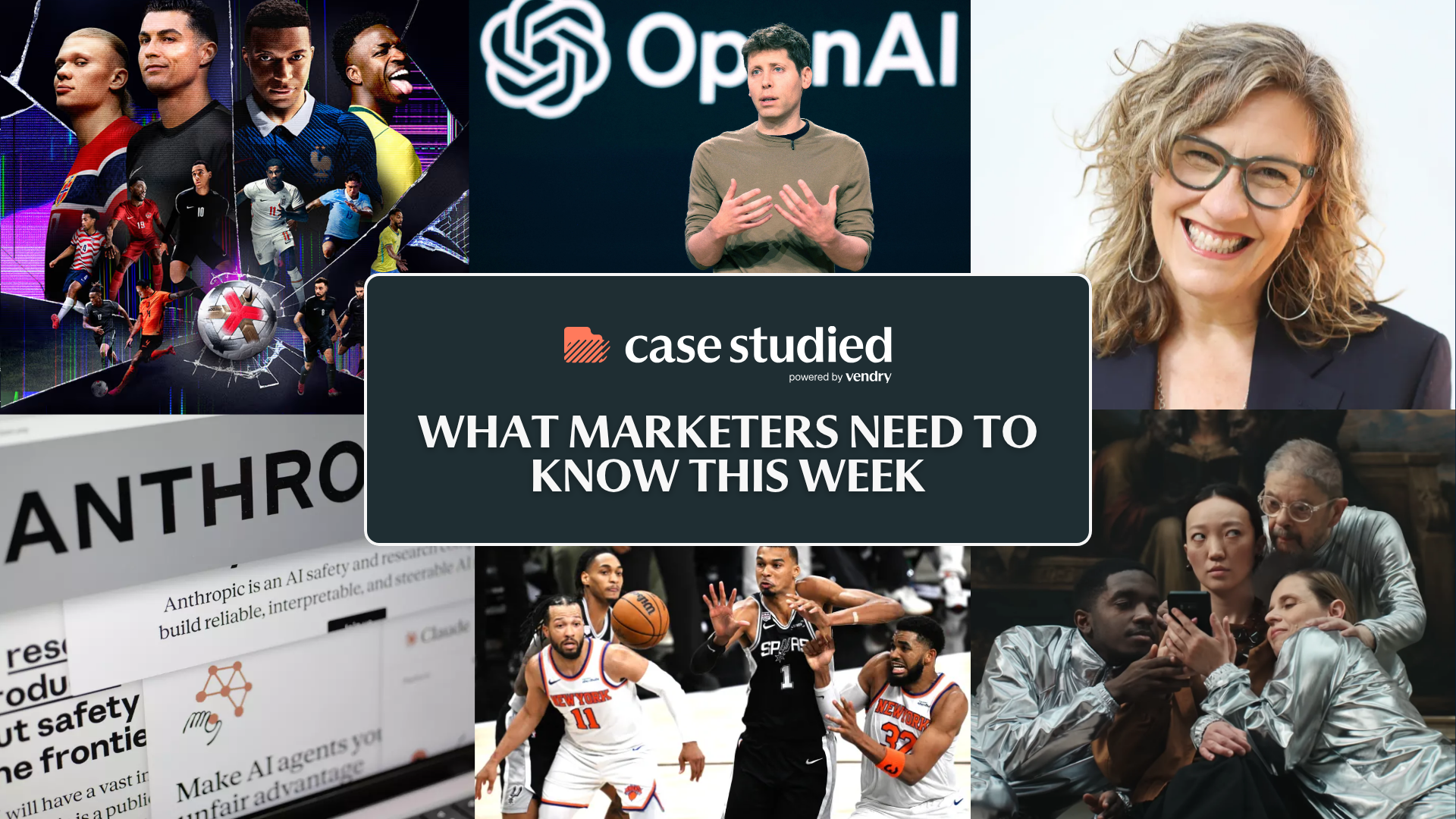
Nike launched "Rip the Script," which the brand describes as its largest football campaign in years. Timed to the 2026 World Cup, the centerpiece is a film set inside a fictional Hollywood mega-studio where Cristiano Ronaldo, Kylian Mbappé, Erling Haaland, and Vini Jr. abandon their scripted roles and play on instinct. Legendary footballers including Eric Cantona, Ronaldinho, Zlatan Ibrahimovic, and Didier Drogba round out the cast, alongside cameos from LeBron James, Travis Scott, Kim Kardashian, and Channing Tatum. Beyond the film, the campaign includes additional content releases planned throughout the tournament, localized activations across six continents, and retail takeovers in New York, Los Angeles, and Dallas. Nike is also refreshing more than 5,000 retail locations globally during the World Cup.

Why it stood out: Many World Cup campaigns are built around a single launch moment. Nike structured this one to unfold across the full tournament, with subplots seeded in the film (like Kim Kardashian's "soccer mom" character) that were made to be expanded in later content. Treating the World Cup as a content season rather than a one-time campaign flight could give Nike repeated chances to re-enter the conversation as tournament storylines develop.
📖 Read more: Nike Newsroom
OpenAI
An AI ad without the tech speak
OpenAI launched "Time to Fly," a brand campaign for its AI-powered coding tool, Codex. The work was created with agency Alto and directed by Mark Molloy through production company SMUGGLER. The concept came from qualitative research with developers around the world, where one phrase kept surfacing, unprompted, to describe building with Codex: "It feels like flying." The hero film stages that metaphor using large-scale, practical sets built on custom gimbals. The environments physically tilt and move around performers rather than relying on CGI. Alongside the film, OpenAI's in-house creative team produced "Workspaces," an out-of-home photography series. It features seven types of builders and the environments where they work. The campaign follows OpenAI's 2026 Super Bowl spot and builds on the premise that software creation is becoming more accessible to people other than traditional engineers.
Why it stood out: This campaign's central idea came from user research and the finished work used the language developers themselves supplied. The production choice is also worth noting: building physical sets instead of generating imagery for a campaign about AI software reads as a deliberate statement. Whether audiences pick up on that subtext is an open question, but it distinguishes the work from typical tech advertising that leads with product capability.
📖 Read more: Ad Age
Apple
They turned data trackers into actual stalkers
Apple launched "Clingers," a global campaign for Safari created by TBWA\Media Arts Lab and directed by Ivan Zacharias through SMUGGLER. The spot personifies online trackers as characters in chrome-colored tracksuits who follow and physically cling to people as they browse the internet on other browsers. When the lead character switches to Safari, the clingers explode. The campaign runs across broadcast, out-of-home, digital display, social, cinema, YouTube, and Apple’s website. It’s one of the brand’s broadest media plans for a privacy-focused campaign to date. It continues Apple’s long-running strategy of using absurdist humor to dramatize data tracking.

Why it stood out: Data tracking is largely invisible to consumers, which makes it a hard subject for advertising. This campaign turns it into a physical experience without relying on technical explanations. The chrome-colored costumes have been widely read as a reference to a competing browser, though the campaign never names one, which keeps the spot in comparative territory without becoming attack advertising.
📖 Read more: Adweek
AB InBev
They made bars the hero
AB InBev launched "Cheers to Bars," a global platform timed to the 2026 FIFA World Cup that positions local bars as the center of the tournament experience. The campaign spans several of the company's brands and regional subsidiaries. It includes an anthem film created with agency GUT, 200,000 watch parties across more than 40 countries, and market-specific activations. In the U.S., AB InBev's Stella Artois is running "Work From Bar," which will reimburse up to $100,000 total for fans 21 and over who watch weekday World Cup matches at their local bar while drinking a Stella Artois or Stella Artois 0.0. In Brazil, Ambev—AB InBev's Brazilian subsidiary—is extending the platform beyond advertising with more than R$100 million in mentoring and financial support for the entrepreneurs who run bars and other points of sale. Two more AB InBev brands, Michelob ULTRA and Budweiser, are serving as official FIFA World Cup beer sponsors, giving the company visibility across multiple brand lines throughout the tournament.
Why it stood out: Sponsor campaigns often center the sport itself, but this one centers the venues where the company's products are sold and consumed. Since the campaign's premise is that bars matter, the R$100 million in direct support for bar owners serves as proof of the message. Meanwhile, the "Work From Bar" mechanic gives people permission and incentive to do something they already want to do.
📖 Read more: AB InBev
Industry news 🤝
The NBA Finals sold out through Game 4 before tip-off
Disney Advertising sold out its NBA Finals ad inventory through Game 4, driven largely by the New York Knicks' first Finals appearance since 1999. The Knicks' playoff run—which included 12 consecutive victories and an all-time-high margin of victory—has generated strong advertiser demand. Of the 88 total advertisers committed to the series, 62 are returning brands, the majority of which increased their spend over last year. Disney also reported first-time sellouts on TikTok Pulse Premiere and Meta Trending Reels tied to the broadcast. Hollywood is buying in as well, with 16 different films purchasing time across the series, including titles scheduled as far out as Thanksgiving. Third-party estimates put last year's Finals at between $250 million and $300 million in total ad revenue. Disney declined to comment on pricing for this year's series.

What it signals: Live sports with genuine narrative stakes continue to draw major advertiser demand at a level few media products match. The Knicks' run has turned this Finals into a cultural event that brands want to be inside. But the outcome on the court matters commercially, too. A shorter series usually means make-goods and lost inventory, while five games is generally break-even territory. Six or seven is where networks and advertisers both come out ahead.
📖 Read more: Deadline
The Trade Desk loses its CRO after 7 months
Anders Mortensen, The Trade Desk's chief revenue officer, is out after seven months on the job. Mortensen joined the programmatic ad company from Google last October. COO Vivek Kundra will absorb the CRO responsibilities in an expanded role. The company confirmed the departure with a statement framing it as a natural part of scaling a global technology company. The exit adds to a turbulent stretch for The Trade Desk: it’s cycled through three CFOs in roughly a year, lost senior executives including chief strategy officer Samantha Jacobson (who has since joined OpenAI), and seen four board members depart. Most recently, the company named Nate Olmstead as its fourth finance chief in under a year, effective July 9. The company's stock is down roughly 70% over the past year, and it faces growing competitive pressure from Amazon's DSP.

What it signals: Mortensen's exit is the latest chapter in a prolonged leadership shakeup at one of adtech's most prominent independent players. Revenue leadership instability has real consequences: client relationships, go-to-market consistency, and advertiser confidence typically run through the CRO seat. With competition intensifying and investors growing impatient, The Trade Desk's ability to stabilize its executive bench is becoming as important to watch as its product roadmap.
📖 Read more: Adweek
NPR bets on a digital-native to lead its content
NPR has named Nadine Zylstra as its new chief content officer, effective July 2026. She previously led original programming at YouTube, served as global head of programming and original content at Pinterest, and spent more than a decade at Sesame Workshop. She takes over from Edith Chapin, who served as interim chief content officer before leaving the organization last fall. Zylstra will oversee more than 600 journalists and storytellers across news, arts, podcasts, and NPR Music. She arrives at a difficult moment for public media: Congress rescinded hundreds of millions of dollars in federal support for NPR and PBS. While a federal judge separately ruled that an executive order targeting public media funding violated the First Amendment, the congressional cuts remain in place. NPR has responded by mobilizing listener donations and securing philanthropic commitments, including a $113 million package anchored by an $80 million gift from Connie Ballmer. CEO Katherine Maher has said the organization's path forward runs through digital expansion, including video-first podcasts like Wild Card and Newsmakers.

What it signals: This hire is a statement about where NPR sees its future. Bringing in an executive whose career was built on digital platforms and audience development reflects a bet that distribution, discoverability, and meeting audiences where they already are now matter as much as editorial credibility. Zylstra herself drew parallels between NPR and YouTube, saying both are fundamentally about serving an audience. This could hint at how she may reframe the organization for listeners who don't tune in to linear radio.
📖 Read more: Variety
Netflix enters the World Cup without broadcasting a single game
Netflix is launching FIFA World Cup: Launch Edition, an exclusive interactive soccer game. It’s available starting June 11 across the U.S., Canada, the U.K., and more than a dozen other countries. Players can manage any of the 48 nations in the tournament, compete in virtual versions of 16 real-world stadiums, and control any of the 1,248 players in this year’s World Cup. The game also syncs with the tournament in real time. So if a player is injured during a live match, that change is reflected in the game. Consistent with Netflix's broader games offering, there are no ads, in-game purchases, or sponsors. The game launched in limited release on June 4 in Brazil and Germany before its wider rollout. Netflix does not hold English-language broadcast rights to the Men's World Cup (those belong to Fox) but it does hold rights to the 2027 Women's World Cup. Ads president Amy Reinhard has signaled plans to build brand partnerships around that tournament.

What it signals: This is an example of how a platform can build a presence around a marquee sporting event without holding broadcast rights. Netflix isn't competing with Fox for the broadcast but it is competing for time and engagement in the spaces around the matches. The real-time sync mechanics blur the line between passive viewing and active participation. And with Women's World Cup rights already secured for 2027, this launch reads as a proof of concept for what Netflix's sports strategy could look like at scale.
📖 Read more: Adweek
MarTech moves 🤖
OpenAI filed confidentially to go public
OpenAI submitted a confidential S-1 registration to the SEC, the first formal step toward a public offering. The company said it expected the filing to leak so it announced the news itself, noting that timing remains undecided—there are moves the company wants to make that are easier to execute while private, and a public listing may still be a ways off. The filing comes amid an aggressive product expansion. OpenAI has rolled out GPT-5.5 and successive model updates, built out enterprise offerings, and expanded developer tools through its platform. The company has also been working through its restructuring from a nonprofit-controlled entity to a for-profit public benefit corporation. The transition has faced legal challenges as well as regulatory scrutiny. A public listing, whenever it comes, would rank among the most significant tech IPOs in years.

What it signals: Even as a distant possibility, OpenAI going public could change how the AI industry gets valued and scrutinized. Public markets bring disclosure requirements, quarterly pressure, and shareholder accountability that tend to change how a company operates and communicates. For the broader AI industry, it could also set a pricing benchmark. How Wall Street values OpenAI is likely to shape expectations for competitors, partners, and investors across the space.
📖 Read more: OpenAI
Google gives publishers and creators a dedicated home on Search
Google launched Search Profiles, a feature that gives publishers, creators, and brands a customizable space within Google Search to showcase their work. Publishers and creators with a sizable following on at least one major social or video platform can claim a profile and populate it with an avatar, bio, website links, platform handles, and their latest content. Audiences can follow sources directly from their profile, making it more likely that content surfaces on Discover, Google's personalized content feed on the Google app home screen. Profiles can be accessed through a creator's knowledge panel on Search, by tapping a publisher name on Discover, or via a direct URL. Claiming a profile may also trigger the creation of a knowledge panel for eligible creators who don't already have one. The feature is launching in the U.S. first, with plans to expand globally.

What it signals: This reads as an acknowledgment from Google that AI-generated search summaries have made organic discovery harder for publishers and individual creators. As AI Overviews increasingly answer queries without sending users to source websites, Search Profiles give content creators a way to maintain visibility and build audience relationships inside Google's ecosystem. For media brands and independent creators, it's a new distribution lever worth paying attention to.
📖 Read more: Google
Apple rebuilt Siri
Apple unveiled Siri AI at WWDC 2026, a rebuilt version of its voice assistant running on the next generation of Apple Intelligence. The new Siri is conversational, contextually aware, and integrated across iPhone, iPad, Mac, Apple Watch, Apple Vision Pro, CarPlay, and AirPods. It can draw on personal context from a user's messages, emails, photos, and calendar to surface relevant information, answer web queries in real time, and take actions across apps. Visual Intelligence (previously available only on iPhone) expands to iPad and Mac, letting users ask Siri about what's on their screen or in front of their camera. A dedicated Siri app syncs conversation history across devices via iCloud. On privacy, Apple says queries route to on-device models when possible and to Private Cloud Compute for more demanding tasks. Per the company, personal data is never stored or accessible by Apple or third parties during cloud processing. Siri AI is available for developer testing now across iOS 27, iPadOS 27, macOS 27, and visionOS 27, with a public beta later this year. It will not be available at launch in China or, initially, in the EU for iOS and iPadOS due to regulatory constraints.

What it signals: Apple has trailed ChatGPT, Claude, and Gemini in the AI assistant race for years. Siri AI is an attempt to close that gap by prioritizing device integration and privacy over raw model capability. For brands, the expansion of app actions, onscreen awareness, and third-party Spotlight integration opens new territory for how users reach products and services through a voice layer. Given the size of Apple's install base, even incremental adoption of Siri AI would represent a meaningful shift in how AI assistants get used day to day.
📖 Read more: Apple Newsroom
Anthropic wants a pause button on AI development
Anthropic published a blog post co-authored by co-founder Jack Clark and Anthropic Institute lead Marina Favaro calling for an industrywide mechanism to slow or temporarily halt AI development when necessary. The company argued that AI is advancing toward a point where it could make human labor far more efficient or replace it altogether. It went on to say that AI systems could begin improving themselves and building their own successors in ways that are difficult to predict or control. Anthropic pointed to international nuclear weapons regulation as a model for the kind of coordinated governance structure it’s envisioning, and said it would convene conversations with policymakers, researchers, and other AI companies to explore coordination frameworks. The call echoes a 2023 letter from the Future of Life Institute, which gathered over a thousand signatures (including Elon Musk's) urging a six-month AI pause. Anthropic itself has continued releasing advanced models throughout this period, including its Claude assistant family and the recently developed Mythos model.

What it signals: An AI lab calling for a mechanism to pause its own industry is an unusual move. It reflects the tension at the center of frontier AI development: Anthropic is both one of the companies pushing the technology forward and one of the most vocal about its risks. For brands, marketers, and businesses integrating AI into their operations, this kind of signal is worth tracking. It suggests that the governance conversation around AI is accelerating.
📖 Read more: Los Angeles Times
Editors Choice 👀
🎬 Agencies keep erasing the collaborators who actually make their award-winning work. 📖 Read more: LBB Online
⚽ EA Sports FC is surfing the World Cup wave through Visa, without ever saying ‘FIFA.’ 📖 Read more: Adweek
👻 “Backrooms” and “Obsession” offer brands valuable lessons on marketing to Gen Z. 📖 Read more: Ad Age
🏳️🌈 NYC Pride lost $750K in corporate sponsorships last year and budgeted even lower for 2026. 📖 Read more: Marketing Brew
Reach into the inbox: Did you know you can advertise in the Case Studied newsletter? That means having a direct line to 41,000+ senior marketers via a newsletter with a 52% open rate.
Don't miss the next Case Studied™.
Join 40,000+ marketers and receive a breakdown of the world's best brands every week.