The marketing news worth your attention
A Met Gala controversy, a meme stock bid, and some very soft candy
05 May 2026
The marketing news worth your attention
A Met Gala controversy, a meme stock bid, and some very soft candy

Case Studied Brief
May 05, 2026


Case Studied Brief
GameStop, Bezos, and the fall of Spirit Airlines
This week's Brief covers brand comebacks, billionaire backlash, and more AI news for advertisers.
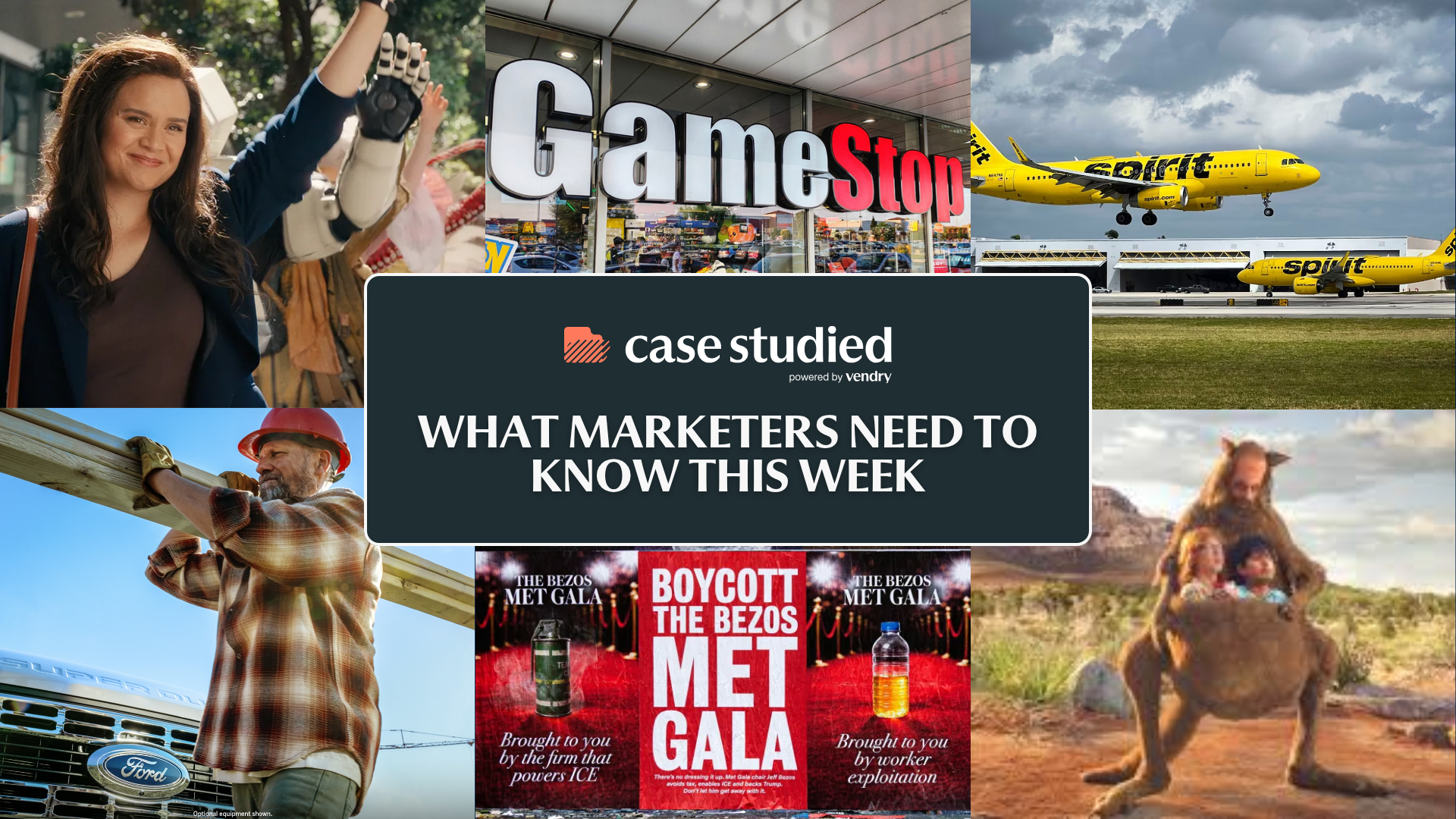
Skittles got weird on purpose. PETA riffed on an iconic movie scene. And Ford turned a pricing promotion into a patriotism play.
Meanwhile, Spirit Airlines shut down for good, GameStop made a $56 billion play for eBay, and Amsterdam banned burger ads from its streets.
Here's what you need to know.

Feel like critical context is missing? Same. Make 2026 the year context travels with every campaign. Discover 14 apps across creative, ads, events, and more that pair well with HubSpot — so your team always has the full picture.
Campaigns of the week 📺
PETA
Gird your loins and ditch the leather
PETA debuted a new theater spot running before screenings of The Devil Wears Prada 2 across 100 U.S. cinemas for two weeks. Created with creative director Chris Carl, the ad spoofs the original film's iconic "gird your loins" scene. It shows employees frantically hiding leather accessories and wool sweaters as a Miranda Priestly-esque editor issues a memo banning all animal skins from a fictional magazine. The spot closes with the line, "A change of heart could change everything."
Why it stood out: Cause-based advertising often defaults to guilt or shock but PETA took a different approach here. Placing an anti-leather message alongside a film about the luxury fashion industry is well-played contextual advertising. The spoof format also helps PETA earn goodwill through nostalgia and humor while still landing a pointed message.
📖 Read more: Variety
Skittles
Soft the rainbow
Skittles is back in its weird era. TBWA\Chiat\Day's new campaign for Skittles Gummies leans hard into absurdist discomfort. The spots feature real puppetry and puppeteers that show oddities like a kangaroo man cradling teens in his pouch and jellyfish giving massages. Mars describes it as turning softness into a "distinctly Skittles universe: unexpected, immersive and pleasantly perplexing." It's built specifically for Gen Z, a demographic increasingly driving the gummy and fruity candy category. Riffing on the brand's iconic tagline, the campaign is titled "Soft the Rainbow” and rolls out across linear, CTV, OLV, and social.
Why it stood out: With cocoa prices rising, gummy candy is increasingly taking over the confection category and this campaign widens Skittles’ presence there. Soft the Rainbow plays on Skittles’ exaggerated absurdist branding, helping the product feel like a natural evolution. Creative directors at TBWA\Chiat\Day said, “To make ourselves stand out in a saturated gummy market, we pushed past ‘softness’ and into the realm of the uncomfortably soft.”
📖 Read more: Ad Age
Vue
A love letter to the big screen
European cinema chain Vue launched "Feel It Forever," its first major brand campaign since 2020. It consists of a two-minute film directed by Academy Award-winning filmmaker Taika Waititi and created by agency Hijinks. The spot follows a young couple heading to the cinema for a first date, each trailed by a growing line of movie characters from every film they've ever seen: neo-noir detectives, fantasy princesses, 80s VHS-textured figures, Wild West silhouettes. Shot across New Zealand and London with 148 actors, 74 wigs, and a crew that includes the colorist behind Black Mirror, the film airs before all screenings at Vue's European estate. It rolls out across the UK, Ireland, Germany, Italy, Denmark, Poland, and Lithuania throughout May, alongside social, OOH, and CTV.

Why it stood out: Streaming has made film watching easier, cheaper, and increasingly forgettable. This campaign makes a genuine emotional case for why the big screen still matters without once mentioning seat upgrades, sound systems, or ticket prices. The central metaphor is simple enough to feel familiar and cinematic enough to earn its placement on the very screens it's celebrating.
📖 Read more: Vue
Ford Motor Company
Employee pricing for all
Ford launched "American Value. For American Values" on May 1. It offers employee pricing to all U.S. customers on most new 2025 and 2026 Ford and Lincoln vehicles through July 6. The program lets buyers pay what Ford employees pay, which sits below MSRP and can save anywhere from a few hundred to several thousand dollars depending on the vehicle. Timed to America's 250th anniversary, Ford framed the campaign as a direct gesture of gratitude to American workers, small business owners, and families. The messaging leans heavily on Ford’s domestic manufacturing credentials, including being the largest employer of hourly U.S. autoworkers. A similar employee pricing campaign launched last year during tariff uncertainty. This one arrives as Ford navigates an 8.8% year-over-year U.S. sales dip in Q1.
Why it stood out: With this campaign, Ford is using a pricing promotion to make a values statement. By anchoring the campaign to America's 250th anniversary and framing employee pricing as a gesture, Ford sidesteps the race-to-the-bottom optics of a typical sales event. Whether the patriotism lands depends on the audience, but it’s worth watching how much this campaign impacts sales.
📖 Read more: Ford
Industry news 🤝
The Met Gala's Bezos problem
Jeff Bezos and Lauren Sánchez served as the primary sponsors and honorary chairs of this year's Met Gala. The move ignited immediate backlash online. Social media users calling for a boycott. Protest groups, including Amazon workers and labor unions, staged a counter-event called "Ball Without Billionaires" in downtown New York on the day of the gala. The museum's director defended the Bezos partnership as consistent with the institution's longstanding approach to philanthropy. Historically, the gala raises enormous sums for the Costume Institute, bringing in a record $31 million last year. Several high-profile stars skipped this year’s event, including Zendaya, Meryl Streep, Bella Hadid, and NYC mayor Zohran Mamdani.

What it signals: Billionaire-brand association is not neutral or inherently positive, especially at high-visibility cultural moments. When a sponsor's presence overshadows the event itself, the PR calculus changes. For brands thinking about sponsorship, naming rights, or high-profile philanthropic partnerships, the Met Gala situation with Bezos is a useful case study in how quickly cultural goodwill can curdle.
📖 Read more: CNN
The meme stock that wants to buy eBay
GameStop CEO Ryan Cohen made an unsolicited $55.5 billion offer to acquire eBay on May 3. He proposes $125 per share in a 50-50 cash-and-stock deal, which translates to roughly a 20% premium to eBay's Friday close. Cohen has quietly built a 5% stake in eBay since February and secured a $20 billion debt financing commitment from TD Bank to back the bid (supplemented by GameStop's $9.4 billion cash pile). The offer is non-binding and subject to eBay board, shareholder, and regulatory approval. Cohen stated he's willing to take the bid directly to shareholders if the board resists. He’s pledged $2 billion in annualized cost cuts within 12 months of closing, with $1.2 billion of that coming from eBay's own sales and marketing operations. Both companies share growing overlap in collectibles and secondhand goods.

What it signals: This is a brand reinvention story as much as a business deal. GameStop has been quietly transforming from a dying retail chain into a cash-rich holding company under Cohen, and eBay would give it instant scale in e-commerce. Of course, the $1.2 billion proposed cut to eBay's marketing budget is the detail worth watching. It's a reminder that when financial engineers take the wheel, marketing is often the first line item on the chopping block. However, many would argue that eBay's brand—including buyer trust, seller reputation, and category authority—is one of its most valuable assets.
📖 Read more: Bloomberg
Versant sheds a good business to build a better brand
Versant, the media company spun off from NBCUniversal, sold its youth sports management platform, SportsEngine, to PlayMetrics for an undisclosed sum. It’s reported to be in the $400 to $500 million range. SportsEngine provides software and payments tools for youth sports clubs, leagues, and tournaments, and had been part of the NBCUniversal portfolio since 2016. The sale is part of Versant's deliberate strategy to sharpen its identity around four core pillars: business news and personal finance, political news and opinion, golf, and sports and genre entertainment. Versant's portfolio includes CNBC, Golf Channel, USA Network, E!, Fandango, and Rotten Tomatoes. Now PlayMetrics, backed by Genstar Capital, becomes one of the dominant operating platforms in youth sports tech, combining its existing tools with SportsEngine's five product lines across clubs, leagues, and governing bodies.

What it signals: With this move, Versant is showing that it’s willing to sell a profitable, growing business that simply doesn't fit its identity. By all accounts, SportsEngine was a good asset. It was projected to stream 200,000 events in 2026, up from 9,000 just three years ago. However, it’s clear the brand didn’t fit the story Versant is trying to tell. For marketers, it’s a clear example of strong brand discipline.
📖 Read more: Variety
MarTech moves 🤖
Spotify has an answer to AI music
Spotify launched "Verified by Spotify," a new badge system that distinguishes authentic human artists from AI-generated content and functional music factories. Marked by a green checkmark, artists can earn the badge by showing consistent listener engagement over time, complying with platform policies, and demonstrating a real-world presence through things like concert dates, merch, and linked social accounts. AI-persona artists are explicitly excluded from verification at launch. Spotify says more than 99% of artists that listeners actively search for will be verified at launch, covering hundreds of thousands of artists across genres and career stages. The rollout also includes a new artist details section that shows career milestones, release activity, and touring history across all profiles, regardless of verification status.

What it signals: As AI-generated music floods streaming platforms, verification is becoming a trust infrastructure play. With this badge rollout, Spotify is building a credibility layer into its product that protects both listeners and legitimate artists. In a world where content farms can generate thousands of tracks overnight and game algorithmic discovery at scale, the green checkmark is a consequential line in the sand. The question now is whether other platforms follow, and how quickly authenticity becomes a baseline expectation.
📖 Read more: Spotify: For the Record
OpenAI quietly rewrote the rules on user data
OpenAI updated its U.S. privacy policy on April 30, formalizing the advertising infrastructure it’s been building behind the scenes. The changes explicitly acknowledge that OpenAI now receives purchase data from advertisers and their partners to measure ad effectiveness. It also shares user information with marketing partners for third-party ad targeting and leverages user data to market its own products. Additionally, the company renamed its vendor disclosure category to include "marketing partners." The update comes as ChatGPT uninstalls are reportedly on the rise, raising questions about whether users are growing wary of the platform's expanding commercial ambitions.

What it signals: Formalizing ad data-sharing changes the dynamic between ChatGPT and its users. This infrastructure change wasn't announced with a press release or a product launch. It was buried in a privacy policy update, which is exactly how platforms tend to formalize things they'd rather not make a headline. The AI assistant is becoming an ad platform and questions around the data that powers it are only going to get louder.
📖 Read more: Adweek
USA Today is making real money from AI licensing
USA Today Co. reported that its "other" digital revenue—which includes AI licensing deals with Meta, Microsoft, and Perplexity—grew 125.6% year-over-year to $33.75 million in Q1 2026. It marks the first time the publisher gave a clear signal that AI licensing is a meaningful growth driver. The news comes alongside less rosy figures for USA Today. Digital advertising revenue dropped 3% year-over-year, page views declined from 195 million unique visitors in Q1 2025 to 180 million in Q1 2026, and programmatic revenue softened. CEO Mike Reed cautioned that AI licensing revenue would be "lumpy" going forward rather than consistently rising, but expressed confidence in its long-term value.

What it signals: Publishers have spent years watching AI companies scrape and summarize their content for free while their own traffic and programmatic revenue declined. AI licensing changes that equation by allowing publishers to charge AI companies for formal, legal access to it. USA Today Co. is one of the first to show that these licensing deals can actually move the needle financially. A 125% year-over-year jump in that revenue category is hard to ignore, even with the CEO's own caveat that it will be "lumpy." What makes this moment more significant is the shift in what AI companies want. Reed noted that real-time content is becoming more valuable than archived material, which means publishers with live, high-frequency news output may have more leverage than they think.
📖 Read more: Digiday
Editors Choice 👀
🌍 Amsterdam just officially became the very first capital city to ban meat and fossil fuel ads today. 📖 Read more: BBC
🤖 Coca-Cola, Hershey, and United are using AI to finally prove marketing's real worth to the C-suite. 📖 Read more: Ad Age
🏀 The Dallas Wings keep doubling sponsorship revenue and the right brands are taking notice. 📖 Read more: Marketing Brew
🍎 While rivals spent billions on AI, Apple held way back and somehow quietly still came out on top. 📖 Read more: Bloomberg
Reach into the inbox: Did you know you can advertise in the Case Studied newsletter? That means having a direct line to 41,000+ senior marketers via a newsletter with a 52% open rate.
Don't miss the next Case Studied™.
Join 40,000+ marketers and receive a breakdown of the world's best brands every week.