Bold bets, AI moves, and creative collabs
The campaigns, deals, and AI moves that defined the week
28 May 2026
Bold bets, AI moves, and creative collabs
The campaigns, deals, and AI moves that defined the week

Case Studied Brief
May 28, 2026

Today’s Case Studied is sponsored by pb+j
Constantly being asked to do more with less? Tired of seeing a gazillion ways to grow but not sure which to choose? Juggling a bunch of misaligned vendors feeling a bit chaotic? Well! pb+j is the DTC cheat code that leaders of multi-channel brands secretly whisper to their colleagues. We've been called the Ocean's 11 of eComm, and our turnkey growth department gives you a full-funnel, KPI-guaranteed, performance-based system that delivers 3x-5x DTC growth... profitably.
Case Studied Brief
Accessible recipes, $50 million sponsorships, and user-generated music
This week's Brief covers some well-played campaigns, industry moves that signal where the money is going, and a wave of AI infrastructure shifts.
Tesco tackled accessibility. Coinbase hid its brand message in plain sight. And StreetEasy let New Yorkers make dinner reservations for 2046.
Meanwhile, brands are cutting $50 million checks for World Cup sponsorships, OpenAI is hiring someone to sell the ad world on its ads, and Microsoft's longest-serving consumer CMO is heading for the exit.
Here's what you need to know.
Campaigns of the week 📺
Coinbase
The ad that rewards a second look
Coinbase's latest 60-second spot, "Hidden in Plain Sight," uses looping visuals with repeating patterns. The repetition is hard to catch at first, which is the point. The ad is built around the idea that the financial system is so entrenched that most people have stopped noticing its flaws altogether. Made in-house by Coinbase Creative Studio and directed by Steve Rogers, the video is part of Coinbase’s ongoing “Your way out of their system” platform. It marks the brand’s first major product-focused push that’s introducing a new suite of financial tools, including stock trading, prediction markets, and Coinbase One.
Why it stood out: Where most fintech brands default to features and rate comparisons, Coinbase leaned into the growing frustration individuals have with financial institutions. As the brand tries to position itself as a counterpoint to traditional finance, "Your way out of their system," gives each new product a consistent ideological frame. In a fintech industry where differentiation can be a huge hurdle, that approach will likely be more sticky than a standalone sales message.
📖 Read more: Ad Age
Tesco
Now everyone's cooking
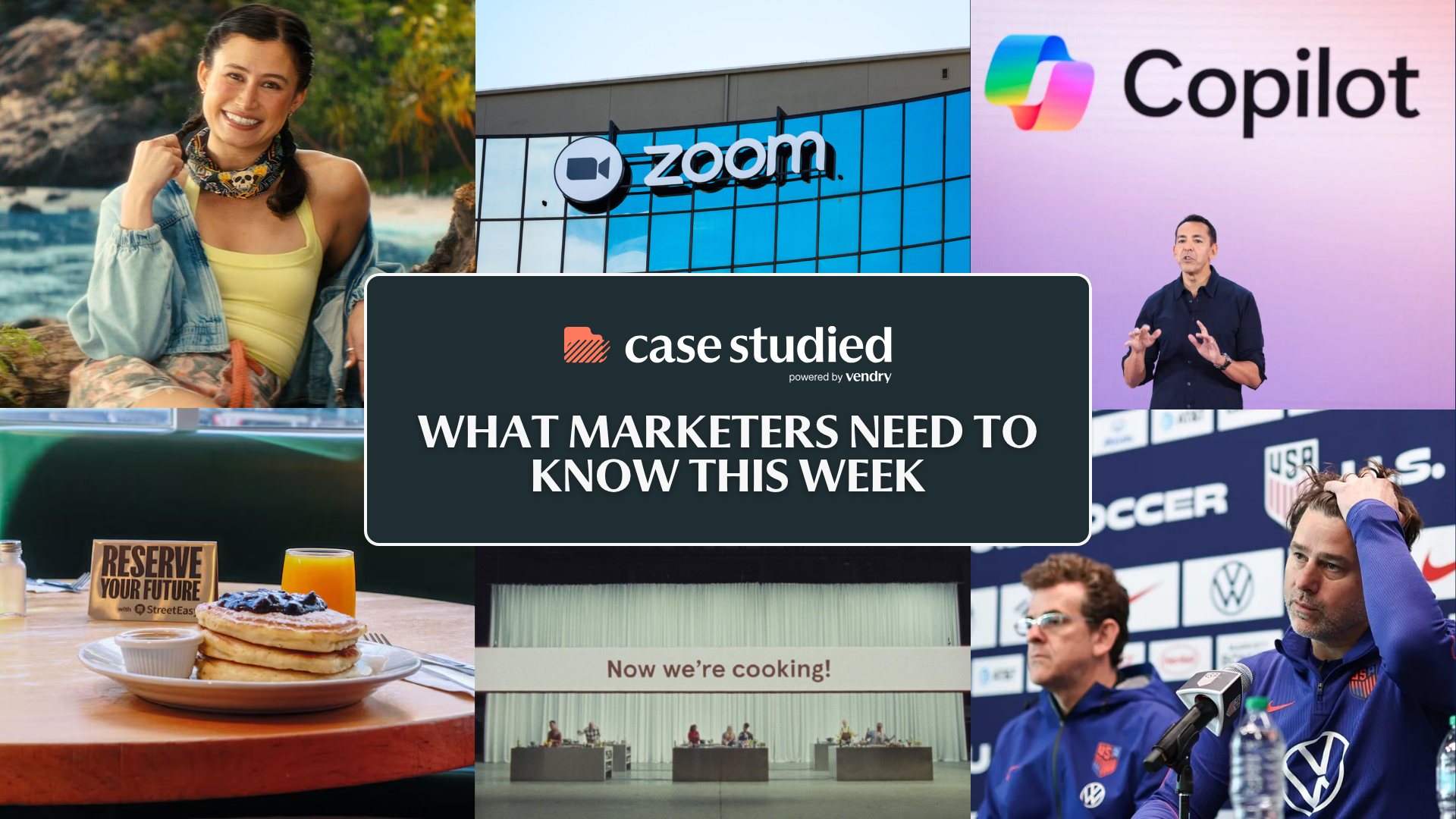
After winning Channel 4's 2025/26 Diversity in Advertising Award, Tesco unveiled "Now We're Cooking” with BBH London and EssenceMediacom. The campaign was built around the insight that 60% of disabled people face barriers when using online recipes. Directed by Alan Masferrer, the ad is set in a test kitchen and stars a cast of cooks with a range of disabilities. Together, they showcase practical ways to make cooking more accessible. The finished film features 70-foot screens displaying open captions, high-contrast visuals, and audio description. Even the pace of editing is carefully considered for accessibility. In tandem with the ad, Tesco also launched 100 recipes that were adapted to inclusive standards (think: screen-reader compatible, audio files for Alexa-enabled devices, and Braille editions). To ensure inclusivity was engrained in every part of production, BBH London worked alongside The Diversity Standards Collective and the disability-founded production agency With Not For.

Why it stood out: Tesco identified a specific, practical problem that millions of people face every day. Usually, brands tend to stop there and build their campaigns using the typical formula. But in this case, Tesco extended their commitment into the production itself. They used open captions, high-contrast visuals, and deliberate pacing, showing they were putting their production where their message was. The 100 adapted recipes further reinforced that the campaign has a functional component beyond the ad itself.
📖 Read more: Little Black Book
e.l.f. Cosmetics
Beauty won immunity in Season 50
E.l.f. Cosmetics debuted a first-of-its-kind partnership with Survivor during the live three-hour Survivor 50 finale on CBS and Paramount+. The brand aired a vignette series that shows three of the brand's hero products being used in Survivor-style challenges. The spots starred content creator Delaney Rowe alongside Survivor contestant Tiffany Ervin. The partnership comes at a buzzy moment for the show. Survivor 50 averages nearly 10 million viewers and the premiere earned the most social interactions of any Survivor episode in history. Plus, this finale marked the first live winner reveal since Season 40. Beyond the broadcast spots, e.l.f. also launched a limited-edition Survivor Buff Bundle.
Why it stood out: The timing here does a lot of work. Attaching to Survivor's 50th season finale and its first live winner reveal in a decade meant the partnership landed at a particularly engaging time. The vignette format also fits natively into Survivor's challenge-based format, helping to lower the friction between ad and content. And the limited-edition Buff Bundle rounds it all out by tying the brand’s hero products to the show's most iconic physical item, giving fans something to physically engage with.
📖 Read more: e.l.f. Beauty
Street Easy
Reservation for your future self
StreetEasy, Zillow's real estate brand built for New York City, celebrated its 20th anniversary with a campaign called "Reserve Your Future." Developed with Mother New York, it lets New Yorkers book real reservations at some of the city's most iconic institutions in the year 2046. Partners include Roberta's, Russ & Daughters, the Guggenheim, and Playwrights Horizons. It’s all bookable through a dedicated microsite and yes, everything is already fully booked. The campaign is an extension of StreetEasy's existing "Be a Forever New Yorker" platform that encourages people to put down roots in the city.

Why it stood out: This campaign turns an abstract idea—committing to New York for the long haul—into something tangible and interactive. Booking a real reservation 20 years out is a concrete act that reinforces the "Forever New Yorker" platform. The partner selection also does specific work here. Roberta's, Russ & Daughters, the Guggenheim, and Playwrights Horizons are all institutions with their own deep roots in the city, which reinforces the campaign's theme without needing to say it directly.
📖 Read more: New York Times
Sponsored
Thursday, June 4 | 9am PT / 12pm ET

Points are lame, and your loyalty program is probably coasting. See how we're building world-leading loyalty programs for brands like BERO, and how you can get yours dialled in before Q4.
In 20 minutes, we'll cover:
Why your points program quietly works against you…
How to reward the customer, not the channel…
How loyalty can become the brain of your brand…
Why the hard part is the thinking, not the tech…
Drawing from experience with brands like BERO, Wonderbread, Woxer, AwearMarket, Lansinoh, and hundreds more, pb+j co-founders Kyle and Tom will highlight the gap between what most loyalty programs settle for and what really drives meaningful customer connection and LTV growth.
Industry news 🤝
Brands are cutting $50 million checks for the World Cup
The 2026 FIFA World Cup kicks off in June and the event is commanding some of the most expensive advertising rates in the history of sports media. Premium sponsorship packages on Fox, the English-language broadcaster, are running anywhere from $15 million to $50 million. Fox and Telemundo together are projected to pull in as much as $850 million in ad revenue from the tournament, more than double the $384 million generated during the last summer World Cup in 2022. Ad inventory on Fox is effectively sold out, with CPMs for in-game spots running at roughly double what competing packages on streaming and virtual pay-TV platforms command. The tournament spans 48 teams, over 100 matches, and 39 days of coverage, with the U.S. as co-host for the first time.

What it signals: The World Cup is one of the few remaining media events that reliably delivers live viewing at scale. The sell-out of Fox inventory this far in advance narrows the options for media buyers that held off, pushing them toward streaming and vPTV packages that command less reach. The $850 million revenue projection also reveals that sports rights are not just holding their value, but appreciating at a head-turning rate.
📖 Read more: Ad Week
Microsoft's consumer CMO is leaving after 35 years
Yusuf Mehdi, Microsoft's Executive Vice President and Consumer Chief Marketing Officer, announced he will leave the company after 35 years. The Microsoft veteran will step down officially on June 30, 2027 in what he's calling his "final season." Mehdi has been one of Microsoft's most visible executives, overseeing product marketing for Windows, Surface, Bing, Xbox, and most recently Copilot. He started as an intern in 1991 and has been present for nearly every major consumer platform shift the company has navigated. From the rise of Windows and the early internet era to search, gaming, Mehdi has been there. His priorities for his final year include repositioning Windows for the agentic era, scaling Microsoft 365 consumer toward 100 million subscriptions, and building out the "One Copilot" vision across work and personal life. Microsoft has not named a successor, and Mehdi is working closely with CEO Satya Nadella and CMO Takeshi Numoto on the transition plan.

What it signals: Mehdi's departure is an indicator that the executives who built the consumer internet era are making way for a new generation shaped entirely by AI. The fact that he's staying a full year to help Microsoft navigate the agentic transition says something about how seriously the company is taking this moment. Whoever replaces him will inherit one of the most consequential marketing briefs in tech: selling consumers on AI tools in everyday life.
📖 Read more: Business Insider
OpenAI is building its pitch for the ad industry
OpenAI posted a job listing for a Head of Ads Enterprise Marketing.The role is designed to shape the company's reputation among CMOs, agency executives, and media buyers, while also expanding OpenAI's presence at major industry events including Cannes Lions, CES, Advertising Week, and Possible. The hire will build programs to position OpenAI as a "leading voice on the future of advertising, AI, creativity, and measurement." The listing is the latest development in what has become a rapid and deliberate buildout of OpenAI's advertising business. The company has been expanding its ads pilot internationally, opening ChatGPT advertising to the UK, Mexico, Brazil, Japan, and South Korea. And it’s simultaneously hiring marketing leads across Latin America, Europe, and Asia. All of this comes after CEO Sam Altman once described advertising as a "last resort" for AI companies, a position that has clearly changed as OpenAI faces projected cash burn of $15 billion in 2026.

What it signals: OpenAI is building the full commercial infrastructure of a major ad platform, one senior hire at a time. The decision to hire a dedicated enterprise marketing leader to court CMOs and show up at Cannes signals that OpenAI wants a seat at the table where ad budgets are actually decided. For brands and agencies, this is worth paying close attention to. ChatGPT has over 500 million weekly users so if OpenAI gets the ad product right, it becomes one of the most significant new media buying opportunities in years.
Viant built a bias meter for CTV news
The demand-side platform Viant announced a partnership with Ad Fontes Media that brings news reliability and political bias scoring to CTV ad buying. The integration is live now in Viant's platform, powered by IRIS_ID content identifiers, and allows advertisers to target individual news shows based on content-level quality thresholds. This is a departure from the blunt instruments of app-level or domain-level blocking that have defined brand safety in news for years. Ad Fontes Media rates news sources across both reliability and political bias using a blend of human analysts and AI. With 2026 on track to be the most expensive midterm cycle in U.S. history, it’s a crowded and consequential time for brands navigating the news environment.

What it signals: Brand safety in news has long been handled with a sledgehammer: broad blocklists, topic exclusions, and outright category avoidance. This partnership moves the needle toward precision, giving buyers the ability to make show-level decisions based on content quality data. As news consumption on CTV continues to grow and political advertising floods the airwaves ahead of the midterms, the brands that can navigate news environments with confidence are likely to find themselves with a meaningful competitive advantage.
📖 Read more: Business Wire
MarTech moves 🤖
Gemini is expanding its search presence
At Google Marketing Live, Google announced new AI-powered ad formats built with Gemini that will fundamentally change how ads work inside Search. The headline formats include Conversational Discovery Ads, where Gemini builds custom ad creative tailored to a specific search query in real time, and Highlighted Answers, where high-quality ads appear directly within AI Mode's recommendation lists. For shopping, Google is launching AI-powered ads that automatically generate custom explainers for why a specific product matches what someone is searching for. Google is also expanding its Direct Offers pilot to include promotion bundling, native checkout for eligible merchants, and travel deals through partners like Booking.com and Expedia. Underpinning all of it is Google's data that 75% of people report making faster, more confident decisions using AI Mode in Search.

What it signals: Google is quickly rebuilding the architecture of search advertising around AI. The shift from keyword-matched ads to Gemini-generated, query-specific creative marks a significant change to the search ad model. For brands, the implications are massive: the creative and targeting decisions that used to require human strategy are increasingly being made by Google's models in real time. That evolution marks both an efficiency gain and a loss of control. Figuring out where to trust the machine and where to intervene is becoming one of the defining challenges of modern media buying.
📖 Read more: Google Blog
Zoom's $51 million AI bet is now worth $1.27 billion
Back in May 2023, Zoom invested $51 million in Anthropic through its investment arm, Zoom Ventures. It was part of a product partnership to integrate Anthropic's Claude models into its platform. Three years later, that stake is now carried at approximately $1.27 billion on Zoom's balance sheet, a nearly 25x return. The figure is based on Anthropic's February 2026 fundraising round, which valued the company at $380 billion. It's likely to climb further as Anthropic nears completion of another round that could value the startup at close to $1 trillion. Zoom also made an additional $46 million investment in Anthropic preferred stock during its most recent quarter, bringing its total carrying value to $1.2669 billion. The news landed alongside a strong quarterly earnings report where Zoom beat Q1 estimates, raised full-year guidance, and authorized a $1 billion share buyback. Analysts at Baird estimated the stake could ultimately be worth between $2 billion and $4 billion depending on dilution, calling it the company's "hidden gem."

What it signals: Zoom didn't necessarily set out to become an AI investor. It wrote a strategic check to bring Claude into its products and ended up with one of the most valuable private stakes in tech. It's a striking illustration of how the AI investment cycle is rewarding early movers. For companies still sitting on the sidelines of AI partnerships, Zoom's balance sheet makes a compelling case for moving sooner rather than later. The line between strategic partnership and investment thesis is blurring fast and the companies that recognized that early are now reaping the rewards.
📖 Read more: Bloomberg
An AI music deal that’s asking for permission
Spotify announced a licensing deal with Universal Music Group that will allow premium subscribers to use AI to create covers and remixes of songs from participating artists. It’s the first time the streaming platform has enabled users to produce AI-generated content using licensed music. The feature will launch as a paid add-on for Spotify Premium subscribers, with a revenue share going directly to participating artists and songwriters for any AI-generated music based on their work. Universal Music Group's roster includes Taylor Swift, Ariana Grande, Drake, and Billie Eilish, though Spotify has not yet disclosed which artists have agreed to participate. The deal was announced at Spotify's 2026 Investor Day alongside a broader suite of AI-powered features, including AI-generated personal podcasts and prompted playlists. Spotify stressed that these deals will involve “upfront agreements, not asking for forgiveness later." No pricing or launch date has been announced.

What it signals: This deal addresses a major issue in the music industry. By providing a licensed, consent-based framework for AI music creation that compensates artists, Spotify is positioning itself as the responsible player in the AI music landscape. This approach is clearly distinct from startups like Suno and Udio that have faced lawsuits for training on copyrighted material without permission. For brands and marketers, it’s worth watching the advertising and partnership opportunities that materialize on a platform where fans are actively creating and sharing music
📖 Read more: The Guardian
Pomo wants to think for your marketing team
A team of former engineers from Google, Adobe, and DeepMind launched Pomo, a new agentic marketing intelligence platform built for mid-market companies. The platform raised $4.5 million in seed funding led by Kindred Ventures, plus angel investors including former Google and Adobe AI and product leaders. The company is designed as a closed-loop intelligence and decision support system. It monitors competitors and performance trends, surfaces daily priorities, and helps execute actions within brand-safe guardrails. The core problem it's trying to solve is one that's become endemic in modern marketing teams: too many channels, too much data, too little time to make decisions that actually matter. Early pilots with D2C businesses have shown the platform can detect demand and competitor signals days before they appear in a team's existing tools and deliver prioritized action plans with less need for manual research.

What it signals: Pomo is an early example of what the next generation of marketing platforms may look like: less dashboard, more intelligence layer. The fact that it's targeting mid-market companies is significant too. Enterprise brands have had access to sophisticated intelligence tools for years. But if agentic platforms like Pomo can deliver that same level of precision to smaller teams, it could reshape how mid-market brands compete against larger players with bigger budgets and bigger tech stacks.
📖 Read more: Marketing Tech News
Editors Choice 👀
🔍 AI is quickly changing the way people search, shop, and engage with the internet. 📖 Read more: CNN
📺 Ciara Miller landed Sephora and L'Oreal deals, showing that Bravo drama can pay off. 📖 Read more: Wall Street Journal
🤖 PR firms are quietly being pressured to rebrand basic automation as AI technology. 📖 Read more: The Guardian
Reach into the inbox: Did you know you can advertise in the Case Studied newsletter? That means having a direct line to 41,000+ senior marketers via a newsletter with a 52% open rate.
Don't miss the next Case Studied™.
Join 40,000+ marketers and receive a breakdown of the world's best brands every week.