This week's smartest moves in marketing
Soccer bots, biometric ads, and a $2.1B handshake
09 Jul 2026
This week's smartest moves in marketing
Soccer bots, biometric ads, and a $2.1B handshake

Case Studied Brief
July 09, 2026

Case Studied Brief
Robots play soccer, Adidas switches sides, and Fable 5 returns
This week's Brief catches the tail end of World Cup mania, a campaign built entirely with AI video, and a string of industry moves that are reshaping who owns what in media and marketing.
On the campaign side, Hyundai sent a Boston Dynamics robot out for a World Cup halftime show, Whoop turned Cristiano Ronaldo's biometric data into a career retrospective, and Polymarket recruited Rick Rubin for an ad that looks nothing like a betting platform.
Meanwhile, Omnicom poached Adidas from WPP after eight years, Sky and ITV agreed to reshape British broadcasting, and Anthropic brought Fable 5 back online after a three-week export control standoff.
Here's what you need to know.
Campaigns of the week 📺
Hyundai
Atlas steals the halftime show
Hyundai brought its Boston Dynamics robot Atlas onto the pitch at a World Cup Round of 16 match, having it deliver the match ball and perform goal celebrations from stars like Erling Haaland. It's the first live integration of a humanoid robot into a World Cup match environment, and the debut builds on Hyundai's "Next Starts Now" campaign platform, which has been showcasing the brand's shift from automaker to mobility company throughout the tournament. Atlas trained for the moment using retargeting technology that translates human movement into robot motion, alongside reinforcement learning built on thousands of simulations, and an operator only initiated the sequence, with the robot's balance and recovery driven entirely by its own systems. The activation caps a 27-year partnership between Hyundai and FIFA, one that has expanded this year for the first time into robotics rather than just vehicle sponsorship.

Why it stood out: Hyundai didn't just sponsor a moment, it manufactured one built to survive the scroll. In a tournament packed with content, a robot delivering a soccer ball is the rare activation that's genuinely undeniable on sight, and it doubles as proof of concept for Hyundai's robotics ambitions well beyond the automotive category. With plans to deploy tens of thousands of Boston Dynamics robots across its own facilities by 2028, this World Cup moment functions as much as an investor and workforce signal as it does a piece of fan-facing marketing. Few brand activations manage to double as both entertainment and a corporate roadmap update.
📖 Read more: Hyundai Newsroom
Polymarket
A prediction market ad with no odds in sight
Polymarket's newest spot, which debuted during the World Cup, ditches the frantic betting-platform playbook entirely. It opens on producer Rick Rubin asking "if you could ask one question, what would you ask," then cuts to people around the world posing questions in their own languages, set to Kanye West's "Runaway." The tone lands closer to an art film than an ad for a wagering app, and it cut through even during a difficult stretch for the company, drawing a notably strong reaction from CNBC's Andrew Ross Sorkin, who called it one of the few ads to genuinely stop him in his feed. Rubin's involvement drew its own backlash, with critics online accusing the famously anti-commercial producer of "selling out" by lending his minimalist, question-first persona to a gambling platform.
Why it stood out: By borrowing the register of prestige documentary filmmaking instead of leaning into urgency and odds, Polymarket reframed itself as a platform for curiosity rather than speculation, and did it while absorbing real reputational heat from other parts of its business. Changing how a brand sounds can change what people think it's for, but only if the borrowed tone connects to something true about the brand rather than functioning as aesthetic cover. The Rubin casting sharpens that tension: the discomfort people feel about a "sellout" tastemaker is really a proxy for whether they trust Polymarket's own reinvention, which means the backlash and the ad's intended message are, in effect, arguing about the same thing.
📖 Read more: Inc.
Whoop
Ronaldo's data does the talking
Whoop's new global campaign "In the Blood" follows Cristiano Ronaldo from his childhood in Madeira to his sixth World Cup, pairing that story with the brand's biometric tracking. Rather than leaning on trophies, the campaign centers on Ronaldo's physiological data, spotlighting a "Whoop Age" metric that puts his body years younger than his actual age. The campaign was shot on location in Madeira, using talent from Ronaldo's first youth club and a local narrator to keep the storytelling grounded in place, and it was created by Flower Shop, the indie agency that joined Whoop's roster earlier this year. Ronaldo isn't just a paid face for the brand; he has been a Whoop investor and ambassador since 2024, which the company has described as one of its largest athlete partnerships to date.

Why it stood out: Turning a wearable's data into a single, shareable number gives Whoop something no spec sheet could: a stat people want to beat themselves. Pairing it with an athlete who's also a company investor blurs the line between endorsement and product proof, and for a health tech brand trying to feel essential rather than optional, that's exactly the point. The timing matters too, since this year's World Cup features more players over 40 than every previous tournament combined, giving Whoop a broader cultural narrative about longevity and recovery science to hook the campaign to beyond one athlete's storyline.
📖 Read more: AdAge
Jeep
A tire's journey, entirely AI-generated
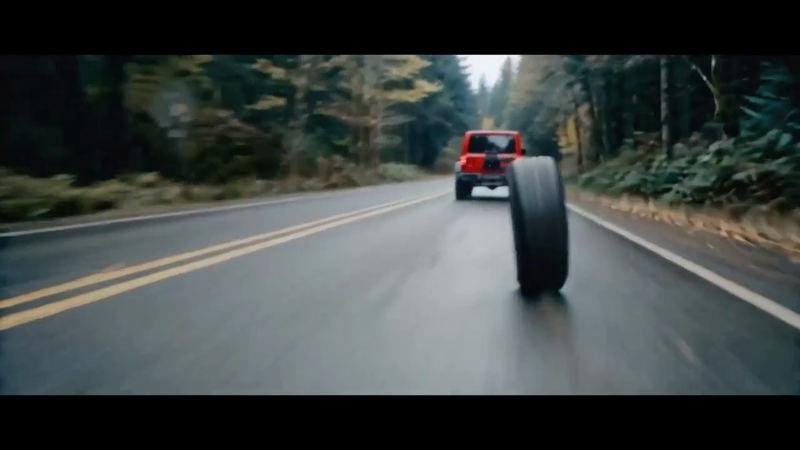
Jeep's new "Tire Story" spot, created by Highdive and its studio 1986, follows a discarded tire chasing a Jeep across various terrains, and was built almost entirely using Google's Veo and Luma Dream Machine. The AI-generated vehicles were built to millimeter-level accuracy and approved by product specialists, cutting production time from six months to two. The creative team storyboarded key story beats first, then reviewed AI-generated takes together in sessions that functioned like dailies, discovering what executive creative director Nathan Monteith called "happy accidents," unplanned moments in the generations that ended up reshaping scenes. The campaign premiered at Google's lunch event during this year's Cannes Lions and was developed under Google's Creative Lighthouse programme, an initiative built specifically to encourage "Impossible Ads" that couldn't exist without AI while still keeping a human creative team driving the story.
Why it stood out: This isn't AI used to cut costs. It's AI used to compress a production timeline while keeping creative control intact, right down to vehicle-accuracy sign-off, and a useful data point for any brand still treating generative video as a novelty rather than a legitimate production tool. Monteith's own framing is telling: he describes the shift as moving from "what can we afford" to "what else is possible," arguing that AI expanded the creative team's role rather than replacing it. That distinction, tool versus shortcut, is likely to become one of the more contested questions in advertising as more agencies adopt similar workflows.
📖 Read more: LBB Online
Industry news 🤝
Omnicom takes the Adidas account from WPP
Omnicom Media Group is set to win Adidas's $512 million global media account, beating out incumbent WPP and rival pitcher Publicis Groupe. WPP's EssenceMediacom had controlled the business since Mediacom first won it in 2018, prior to its 2023 merger with Essence, ending an eight-year relationship between Adidas and WPP. The account will now be led by OMG media agency PHD, whose client roster already includes Volkswagen, Google, Audi, and 7-Eleven. The win lands as Adidas ramps up marketing spend more broadly, with the brand committing €3.079 billion to marketing and point-of-sale expenditure in 2025, up 8% year-on-year, powering campaigns like "You Got This" alongside partnerships with Liverpool FC, the Audi F1 team, and NBA star Anthony Edwards.

What it signals: Losing a $512 million global account is a meaningful blow for WPP at a moment when holding companies are fighting hard to prove their relevance against leaner, faster-moving competitors. The win also caps a strong stretch for PHD specifically, which recently took home the Media Grand Prix at Cannes Lions for Uber Eats's "Build Your Own Super Bowl" campaign, and follows other recent global wins for Omnicom including IBM and Dyson. As Wren argued at Cannes last month, Omnicom's pitch is increasingly data infrastructure: the completed IPG merger paired Acxiom's data platform with the Flywheel commerce arm, and this win suggests future account reviews may hinge on that kind of capability rather than incumbency or creative reputation alone.
📖 Read more: Adweek
Getty walks away from its $3.7B Shutterstock merger
Getty Images has called off its planned $3.7 billion merger with Shutterstock after the UK's Competition and Markets Authority demanded Shutterstock sell its editorial business, including celebrity and news photo units Backgrid and Splash, as a condition of approval. Getty's board voted unanimously against that divestiture and chose to terminate the deal instead. The merger had already cleared US antitrust review in February with no conditions attached, making the UK regulator the sole obstacle that ultimately sank it, more than a year and a half after the deal was first announced in January 2025. The combined company, which would have carried a library of 450 million images and been led by current Getty CEO Craig Peters, had projected annual cost savings of $150 to $200 million within three years. Notably, just days before killing the deal, Getty signed a separate licensing agreement with OpenAI to bring its image library into ChatGPT.

What it signals: Both companies pursued this merger specifically to build scale against the growing threat of AI image generation, and losing that scale leaves each one more exposed to the same pressure they were trying to counter. US antitrust clearance also means less than it used to when a UK or EU regulator can still unilaterally block a global deal, a dynamic that's likely to shape how future media mergers get structured and negotiated. The CMA has a track record here, having previously forced Meta to divest Giphy in 2021, and this case follows the same pattern: a transaction can sail through American review and still collapse entirely over a single foreign regulator's conditions.
📖 Read more: Wall Street Journal
Walmart buys its way deeper into streaming ads
Walmart is acquiring Vibe.co, a self-serve connected TV advertising platform built for small and mid-sized businesses, folding it into Walmart Connect, the retailer's commerce media arm. Vibe.co brings self-serve campaign activation, direct supply-partner integrations, proprietary ad technology, and performance-driven optimization to more than 10,000 existing advertisers. The deal builds on Walmart's earlier acquisition of VIZIO and recent partnerships with Magnite, Yahoo DSP, and Google DV360, further rounding out Walmart Connect's CTV ecosystem, and specifically targets advertisers, including Walmart's own third-party marketplace sellers, who lack the media teams or budgets to buy CTV effectively today. Vibe.co's leadership team, including co-founder and CEO Arthur Querou and co-founder and CTO Franck Tetzlaff, is expected to join Walmart Connect after the deal closes.

What it signals: Retail media has become one of advertising's fastest-growing categories, and Walmart is positioning itself to own not just the shopper data but the entire path from streaming ad impression to purchase. By making CTV self-serve and measurable for smaller advertisers who previously lacked the media teams to buy it effectively, Walmart is betting that accessibility, not just scale, will be what wins the next phase of the retail media land grab. Walmart's public commitment to keeping the ecosystem "open and collaborative" with existing broadcasters and SSPs suggests it wants this positioned as an expansion of advertiser choice rather than a walled garden play.
📖 Read more: Walmart Newsroom
Sky buys ITV's networks in a $2.1B British TV shake-up
Sky has agreed to acquire ITV's media and entertainment division, including its broadcast channels and ITVX streaming service, for £1.6 billion ($2.1 billion). ITV Studios, the production arm behind shows like Love Island and Coronation Street, is not part of the deal and will remain a standalone listed company, though Sky has committed £2.1 billion to content from ITV Studios over the next five years. As part of the agreement, Sky is also selling Great British Bake Off producer Love Productions to ITV Studios in a separate £200 million side deal, and ITV plans to return roughly £950 million of the proceeds to shareholders. The transaction still requires approval from Ofcom and the UK's Competition and Markets Authority, with completion not expected until late 2027. Notably, the deal arrives just a week after Comcast, Sky's parent company, announced it would spin Sky off together with NBCUniversal into a standalone media business, meaning the new UK broadcasting champion is being assembled inside a company its own owner has already decided should be split apart.

What it signals: This is British broadcasting consolidating in real time to compete with YouTube, Netflix, and other global platforms that increasingly dominate both viewing time and ad budgets. Combined, Sky and ITV would account for roughly 20% of UK in-home video viewing, a figure the companies are already using to argue that scale here is defensive rather than dominant, since YouTube alone captures a similar share on its own. The deal also reflects a broader reassessment of what's valuable in media right now: ITV concluded that separating its declining broadcast business from its growing production arm unlocked more value than staying combined, the same logic Comcast applied to its own Sky and NBCUniversal businesses just days earlier.
📖 Read more: Comcast | Hollywood Reporter
MarTech moves 🤖
Fable 5 comes back online with tighter guardrails
A week after Mythos 5 returned for approved institutions, Anthropic has restored full access to Claude Fable 5, ending a three-week suspension triggered by US export controls. The controls were applied on June 12 following a report that Amazon researchers had found a way to prompt the model into identifying software vulnerabilities and, in one case, demonstrating how to exploit one. Anthropic's testing found that several less capable models, including Claude Opus 4.8, GPT-5.5, and Kimi K2.7, could reproduce the same behavior, meaning the bypass reflected a borderline safety-margin case rather than a unique cyber capability. The company built an improved safety classifier that now blocks the reported technique in over 99% of cases and worked closely with the government throughout the suspension, with US Department of Commerce researchers independently testing and endorsing both the prior and new safeguards. Access was restored on July 1. Alongside the fix, Anthropic is partnering with Amazon, Microsoft, Google, and other Project Glasswing members to build a shared industry framework for scoring the severity of AI jailbreaks, and is deepening pre-release testing collaboration with the US government going forward.

What it signals: A three-week suspension of a flagship model is a rare, concrete example of export controls directly shaping product availability in real time, not just corporate strategy. The response also signals something bigger than one company's fix: a shared jailbreak-severity framework, if adopted industry-wide, could become the AI equivalent of a common vulnerability scoring system, giving developers and regulators alike a consistent way to triage risk rather than reacting case by case.
📖 Read more: Anthropic Newsroom
Instagram wants your TV, not just your phone
Instagram for TV is now available on Samsung Smart TVs across the US, covering 2020 model year and newer, joining its existing presence on Amazon Fire TV, where it debuted in December 2025, and Google TV, added in February 2026, to reach the majority of connected TV devices in the American market. The rollout brings interest-based channels that group Reels by category like comedy, sports, and favorite creators, phone-to-TV casting for Reels and saved content, and Stories viewable on the big screen, features designed around what Meta says is largely a shared, group viewing experience where friends and family pass the remote and swap recommendations in real time. Instagram is also testing a dedicated home for horizontal video, acknowledging that vertical phone content doesn't always translate to a living room screen, and is exploring longer-form formats including episodic series and live creator broadcasts. This marks a notable departure from Instagram's failed 2018 attempt at long-form video, IGTV, which only drew seven million downloads before being quietly retired within 18 months. This time, the strategy leans on repurposing existing short-form Reels content rather than asking creators to produce new hour-long videos for a mobile-first audience.

What it signals: Every minute spent watching Reels on a television is a minute not spent on YouTube or Netflix, and Meta is chasing this at a moment when YouTube's share of US TV watch time hit 13%, its highest since Nielsen began tracking the metric in late 2023, while TikTok simultaneously struggles with content quality, with one recent study finding nearly 60% of videos shown to new accounts are AI-generated. Positioning Instagram as a living-room platform rather than just a mobile app also opens a real advertising opportunity, since advertiser intent to increase connected TV spending sits at 82%, far ahead of the 56% intent for paid social, giving Meta a fresh inventory category to sell against as attention keeps shifting to bigger screens.
📖 Read more: Instagram Newsroom
Microsoft cuts 4,800 jobs as Xbox absorbs the worst of it
Microsoft is eliminating 4,800 jobs, about 2.1% of its global workforce, in a restructuring that hits its Xbox gaming division hardest, with 1,600 roles cut immediately and a total of 3,200 gaming positions, roughly 20% of the division, disappearing by the end of fiscal year 2027. Xbox CEO Asha Sharma told staff the division's profit margin had fallen to just 3%, three to ten times lower than competing platforms, and described the business as facing "the most severe hardware crisis in its history," while framing the cuts as a necessary reset rather than managed decline. As part of the overhaul, four gaming studios, including Compulsion Games, Double Fine Productions, Ninja Theory, and Undead Labs, are being spun out to new management or independence. Microsoft's leadership was explicit that the roles being eliminated are not being replaced by AI, even as the company simultaneously plans to spend $190 billion on AI infrastructure and data centers in 2026, and stock has fallen roughly 19 to 23% so far this year amid investor concern that Microsoft's own AI products haven't yet become major commercial hits.

What it signals: This is one of the clearest examples yet of a company drawing a hard line between cost-cutting and AI, insisting the layoffs are workforce reallocation rather than automation, even as it pours record capital into the technology in the same breath. Microsoft's move also lands inside a much larger pattern: tech layoffs have topped 100,000 for the year with AI cited as the leading cause, and Alphabet, Microsoft, Meta, and Amazon combined are projected to spend nearly $700 billion on AI infrastructure in 2026 alone, meaning the same balance sheets funding the AI buildout are simultaneously shedding thousands of jobs to make room for it.
Editors Choice 👀
🤖 AI giants like OpenAI and Anthropic are handing startups up to $500K in free compute to lock in loyalty early. 📖 Read more: Wall Street Journal
🐻 The Bear's final season sold out sponsorships again, proving Disney's ad playbook still works. 📖 Read more: Adweek
🎙️ Natalie Silverstein talks influencer strategy and brand trust in a candid Marketing Brew Q&A. 📖 Read more: Marketing Brew
🎓 Elite students are skipping Wall Street internships this summer to chase startup dreams instead. 📖 Read more: Wall Street Journal
Reach into the inbox: Did you know you can advertise in the Case Studied newsletter? That means having a direct line to 41,000+ senior marketers via a newsletter with a 52% open rate.
Don't miss the next Case Studied™.
Join 40,000+ marketers and receive a breakdown of the world's best brands every week.