This week's moves in marketing
Ranch dressing, hip-hop debates, and a trillion-dollar pause
02 Jul 2026
This week's moves in marketing
Ranch dressing, hip-hop debates, and a trillion-dollar pause

Case Studied Brief
July 02, 2026

Case Studied Brief
Cannes wraps, ranch goes viral, and OpenAI hits pause
This week's Brief lands in the thick of Cannes Lions aftermath, a World Cup that's turning condiments and rappers into cultural moments, and several significant pieces of AI news.
On the campaign side, DoorDash turned a case of mistaken identity into a viral stunt, Skims turned a fictional Will Ferrell golfer into a menswear model, and Sprite put hip-hop's greatest songs up for debate.
Meanwhile, Omnicom defended its big bet, OpenAI got cold feet about Wall Street, and France proclaimed that it’s making creativity a national strategy.
Here's what you need to know.
Campaigns of the week 📺
DoorDash
The "intern mistake" that was never a mistake
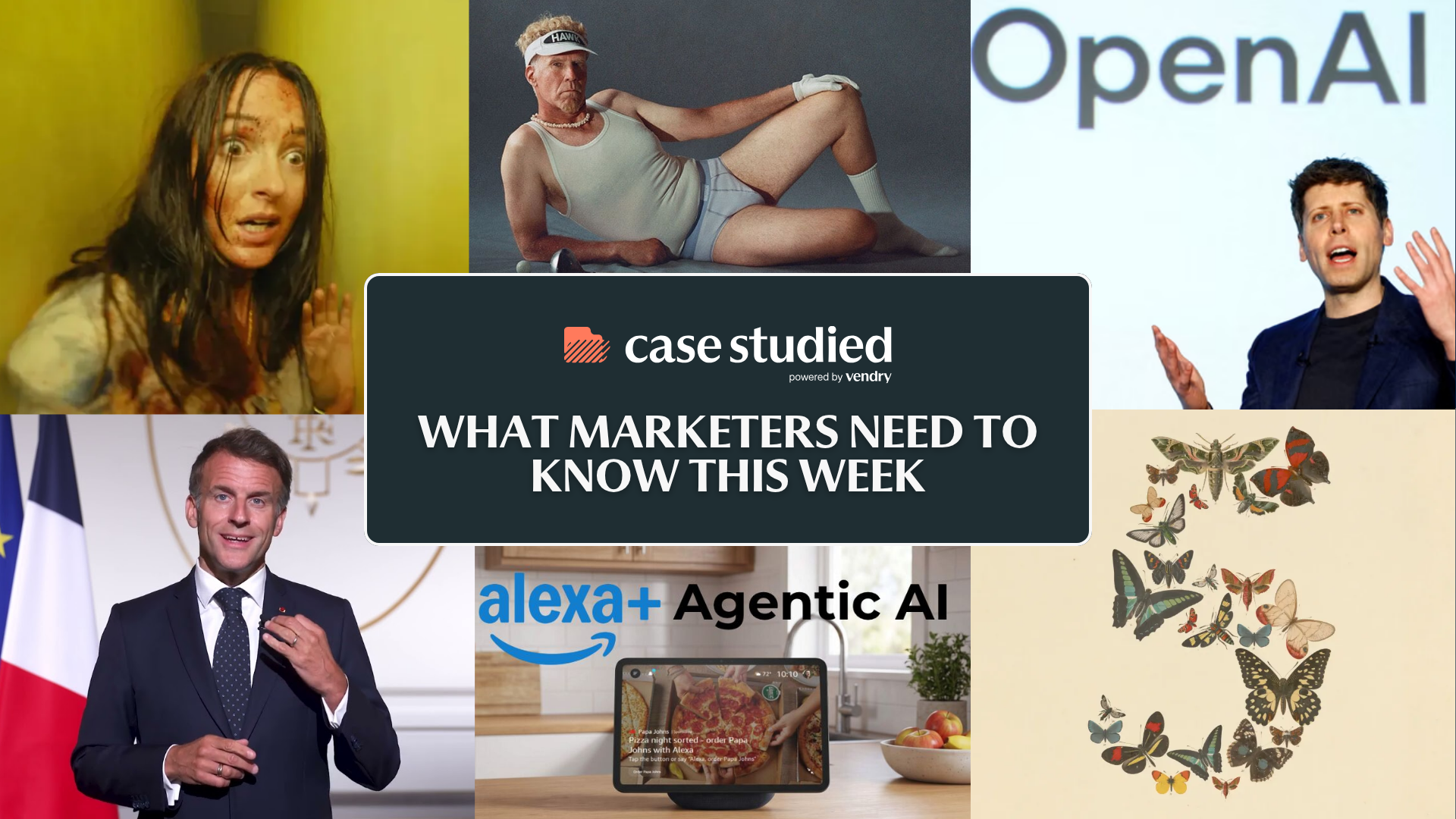
During New Zealand's Group Stage match against Egypt on June 21, DoorDash tagged rapper T-Pain nine times in a series of World Cup posts on X, appearing to confuse him with New Zealand defender Tim Payne. T-Pain played along, asking DoorDash if they were okay and predicting "the intern is gonna sht a brick when they realize." The “mix-up” was all planned: DoorDash had coordinated the stunt with T-Pain in advance, leaning into the near-identical name of the tournament's breakout fan favorite defender. After the exchange went viral, DoorDash sent T-Pain dozens of insulated delivery bags stuffed with soccer balls, TimTam bars, and kiwis. T-Pain posted the haul with the caption "I do not play soccer. And I did not order all of this sht!" with a DoorDash partner tag buried at the end. The nine original posts generated 7,500 likes and 400 comments, and Google searches for T-Pain spiked 9% in the days following.

Why it stood out: This campaign drew a wide array of reactions. Some praised its cleverness, while others argued that it disregarded transparency rules by positioning a paid partnership as an organic mistake. Regardless, it certainly garnered plenty of attention. T-Pain's replies were timed and deadpan enough to make the confusion feel real for some who watched the interactions unfold. DoorDash was intentional about its sequencing: it went from mistaken tags to a physical delivery to a partner post that revealed the arrangement, which came well after the earned media had compounded.
📖 Read more: Campaign
Skims
Will Ferrell's fictional golfer is now a Skims model
Skims tapped Will Ferrell's character Lonnie Hawkins from The Hawk to front its latest menswear campaign. Shot by photographer Nadia Lee Cohen, the campaign features Ferrell in full character. He poses in Skims briefs, tanks, and a visor in a deliberately deadpan pinup aesthetic. It plays directly into Hawkins' bloated self-mythology as a former world No. 1 golfer who’s attempting an improbable comeback two decades past his prime. The campaign comes ahead of the 10-episode comedy’s Netflix series premiere on July 16. The show was co-created by Ferrell with the PGA Tour as a production partner. Netflix has been running an in-character promotional campaign alongside the Skims partnership, including a Hawk Bus Tour with stops at the Travelers Championship Pro-Am in Connecticut. Ferrell also appeared in character at Netflix House in Pennsylvania alongside real PGA Tour players Rickie Fowler, Harris English, and Tony Finau.

Why it stood out: The Skims launch is doing two things at once. On the brand side, it gives Skims' expanding men's line a comedic and culturally timed entry point that departs from the earnestness audiences are used to seeing in celebrity menswear campaigns. On the content side, it extends The Hawk's fictional universe into retail, treating the character as continuing IP rather than a one-off promotional tie-in. The timing also lines up with the PGA Tour's own promotional push around the show.
📖 Read more: AdAge
Sprite
Sprite put hip-hop's greatest songs up for debate
Sprite launched "The Living Tracklist," a campaign built around an evolving Spotify playlist that’s meant to both establish and start debate about hip-hop's most important songs. To assemble the initial slate, the brand convened a Cultural Authority Panel of seven hip-hop figures including Angie Martinez, Speedy Morman, and Scottie Beam, whose full 40-minute discussion is live on YouTube, with associated social cutdowns. The campaign spans 26 limited-edition Sprite packaging designs that feature key lyrics from iconic tracks across six decades. The songs range from The Sugarhill Gang's "Rapper's Delight" to GloRilla's "TGIF,"and represent the most songs Sprite has ever licensed at once. Packaging appears on cans and bottles from July through September, with on-pack QR codes leading to a Genius-hosted microsite where fans can explore additional content and enter sweepstakes.
Why it stood out: This campaign's core decision is built around disagreement rather than celebration. Sprite isn’t taking a stance itself but it is opening up the floor for discourse. That structural choice invites participation rather than just attention. The panel format, the YouTube debate, and the social cutdowns were all designed to provoke and sustain the conversation. Sprite brand director Terika Fasakin noted, "We want to encourage the discussion because that's where the richness and the engagement happens." The approach also reflects a longer pattern for the brand—Sprite has run hip-hop-tied campaigns since the 1980s and this campaign can be seen as a new approach to that familiar playbook.
📖 Read more: Marketing Dive
Kraft
Ranch dressing's unexpected World Cup moment
Ranch dressing became one of the breakout stars of the 2026 FIFA World Cup. It went viral as international fans discovered the condiment for the first time and began smuggling full bottles home in their carry-on luggage. The TSA followed with a series of Instagram posts showing agents confiscating bottles at checkpoints across the U.S and advising fans to stop chugging ranch outside the security line. In response, Kraft moved fast to launch a limited-edition TSA Compliant Ranch kit on June 19. It comes in a clear quart-size TSA-approved bag with enough individual ranch packets to equal a full bottle and a ranch-bottle-inspired luggage tag.

Why it stood out: Brands across the category, from Hidden Valley to Heinz to the Cheesecake Factory, piled into the TSA's comments section, but Kraft was the only one to turn the moment into an actual product. Kraft's kit landed about a week after the TSA's first public warning, which was fast enough to still ride the trend. For a quick-turn campaign built around packaging design and a well-timed Instagram caption, the earned media it generated was substantial.
📖 Read more: People
Industry news 🤝
France made creativity a national strategy
French President Emmanuel Macron addressed the Cannes Lions festival via video on June 26 as France was awarded Creative Country of the Year, the festival's annual recognition of a nation's exceptional commitment to creativity. In his address, Macron framed French creativity as a national philosophy running through fashion, luxury, cinema, and advertising. He used the moment to make an explicit pitch for France as a destination for foreign investment, creative studios, and European headquarters. Macron also cited the France 2030 project, which received €350 million in government investment to boost domestic film production, noting that foreign companies pledged €93 billion in investment at the annual Choose France summit earlier this month, with a significant portion directed at AI and data projects. France has now been ranked the most attractive country for foreign investment in Europe for seven consecutive years. Macron closed his address by inviting attendees to the Lumiere Summit on September 7 in Saint-Paul-de-Vence, a summit on cinema, series, and video games that’s co-chaired by France and South Korea.
What it signals: A head of state addressing an advertising festival via video is unusual. Using that address to explicitly position creativity as economic infrastructure, soft power, and a driver of foreign investment is even more out of the ordinary. Macron's speech connected Cannes, the Paris Olympics, France's video game industry, the Choose France investment commitments, and the France 2030 production fund in a way that framed creative industries as a competitive strategy. The fact that LePub Milan (a Publicis agency headquartered in Italy) won Agency of the Year at the same ceremony and France received the country honor underscores how seriously the French creative ecosystem is being taken. Many governments treat creative industries as a cultural afterthought but France is treating them as an economic asset class.
📖 Read more: LBB
The merger is working, and Wren wants you to know
Seven months after closing the largest merger in advertising history, Omnicom CEO John Wren used his Cannes Lions appearance to make the case that the $26.5 billion acquisition of Interpublic Group is already delivering. Speaking at the festival, Wren reported a 98% client retention rate since the deal closed, with new business wins from American Express, Kroger, IBM, Merck, Unilever, and Bayer. The combined entity now generates roughly $26.5 billion in annual pro-forma revenue and has doubled Omnicom's AI investment capacity according to Wren. The integration of Acxiom's consumer identity platform into Omnicom's existing Omni system and Flywheel commerce platform gives the holding company what it describes as an end-to-end view of the global consumer journey. Wren committed to staying as CEO through 2028 and has set a target of $1.5 billion in cost savings over the next 30 months, double the original projection. He also pledged to scale Omnicom Global Solutions India to 8,000 employees by the end of 2026.

What it signals: Wren's framing at Cannes emphasized infrastructure. With AI threatening to disintermediate agencies, the Omnicom/IPG deal is being framed as a data and infrastructure bet rather than a consolidation play. Wren’s argument is that combining Acxiom's identity graph, Flywheel's commerce data, and Omni's planning infrastructure creates a different proposition than any of those three assets individually. The harder question is whether clients see the benefit before the cost savings materialize. Roughly 10,000 roles were cut across the two holding companies in the run-up to the deal, with more expected. At Cannes, Wren presented the upside. The industry will be watching to see which version of the story proves true.
📖 Read more: Bloomberg
The trillion-dollar company that isn't ready to go public
OpenAI is weighing a delay of its planned IPO from late 2026 into 2027, according to the New York Times. The news comes after the company saw market conditions temper enthusiasm for high-profile tech listings. OpenAI confidentially filed its S-1 with the SEC in May, with Goldman Sachs and Morgan Stanley leading the deal at a target valuation near $1 trillion. Despite generating roughly $5.7 billion in Q1 revenue and nearly 905 million weekly ChatGPT users, OpenAI is still burning through cash at scale and does not project positive cash flow until 2030. The delay reflects both public market caution and the reality that OpenAI's aggressive infrastructure spend—on data centers, model development, and an expanding hardware division—continues to outpace its revenue growth. OpenAI also made its first Cannes Lions appearance this year, using the festival as a coming-out party for its nascent ad business. It pitched advertisers on what it calls "super intentional" users as a premium audience.

What it signals: An IPO delay from a company valued at $1 trillion is a telling sign of how much public market appetite for AI has shifted in twelve months. The gap between OpenAI's revenue trajectory and its spending rate is no secret, but going public forces that gap into a quarterly disclosure structure that private status avoids. Staying private longer also gives OpenAI room to build out its hardware ambitions and ad business before either faces Wall Street scrutiny. For brands and agencies that have built enterprise strategies around OpenAI tooling, an extended private runway means continued pricing opacity and uncertainty around the platform's long-term commercial structure.
📖 Read more: The New York Times
A24 took Google's money and lost loyalists
A24 announced a $75 million research partnership with Google DeepMind to develop new AI workflows, tools, and techniques for filmmaking and distribution. It marks the first time Google has taken a stake in a film studio. The deal gives A24 and its tech arm A24 Labs access to DeepMind's research and infrastructure, while DeepMind's researchers work with the studio to build tools for production. The partnership does not give Google access to A24's content library or data, and there is no mandate for filmmakers to use any tools developed through it. The backlash from A24's cinephile fanbase was immediate and intense. Fans canceled memberships to the studio's AAA24 subscription service and flooded its social posts with criticism. The studio issued a statement through spokesperson Sophia Shin: "This partnership exists because we want to dictate what tools get built for artists, and so they have a voice in shaping them rather than having tools handed to them. We'd rather have a seat at the table than on the sidelines." The reaction was amplified by the fact that A24's biggest current box office hit, Backrooms, was directed by Kane Parsons, who has publicly said he would make generative AI "disappear forever" if he could.

What it signals: This A24 story reveals a lot about brand trust in the AI era. A24 spent a decade building cultural credibility on the premise of protecting filmmaker vision and artistic integrity, and its audience responded to this deal as if a covenant had been broken. The "seat at the table" framing may be strategically sound, but for many, it landed as corporate. For brands that identify with authenticity and creative independence, the A24 situation shows how quickly AI association can destabilize that positioning.
📖 Read more: Deadline \ Google DeepMind
MarTech moves 🤖
Alexa’s ads take you straight to checkout
Amazon introduced Alexa+ Agentic Ads on June 23, the first ad format that takes a customer from seeing an ad to completing a purchase within a single conversation, without leaving the interaction. Launched alongside Prime Day, the format debuted with Papa Johns for food ordering and artists Beck, Jill Scott, and Omar Courtz for concert ticket purchases via Ticketmaster. A shopper can see an ad, ask Alexa questions, check availability, review options, and complete a transaction through conversation on Echo Show devices. There are no redirects, no separate checkout, and no app switching. The format sits within Amazon's broader agentic advertising suite, which also includes Creative Agent for producing ads quickly, Ads Agent for automating campaign setup, and an Amazon MCP server that connects external AI agents to the Amazon Ads API without custom coding.

What it signals: Agentic Ads collapse the distance between discovery and purchase to zero, which is the direction performance marketing has steadily been moving. The format's reach is currently limited by Alexa+'s installed base, which remains modest compared to mobile, but the underlying architecture matters more than the launch numbers. If a shopper can go from curiosity to confirmed order inside a single voice exchange, the traditional funnel no longer supports what’s happening. Brands that can structure offers for conversational completion, rather than click-through, may have an edge as the format scales.
📖 Read more: Amazon Ads
A tariff threat that reaches straight into ad budgets
On June 26, U.S. President Donald Trump threatened to impose immediate 100% tariffs on all goods from any country that implements a digital services tax on American technology companies. he threat escalates pressure on European nations ahead of a July 4 deadline, when the EU and U.S. are set to begin implementing a broader trade agreement capping most EU export tariffs at 15%. In a post on Truth Social, Trump named European countries as the primary targets, stating the tariff would supersede any existing trade deals. Digital services taxes, which levy charges on the gross revenues of U.S. tech companies operating in a given country without a physical presence, are already in place or under active consideration across roughly half of all European OECD members. Affected companies would include Meta, Alphabet, and Amazon. The threat follows a similar warning Trump issued in August 2025 and mirrors his successful 2024 pressure campaign that led Canada to rescind its own digital services tax during trade negotiations.

What it signals: For global marketing and ad tech ecosystems, a 100% tariff threat tied to digital revenue taxes is not abstract. Meta, Google, and Amazon underpin much of the digital advertising infrastructure in European markets. Any retaliatory escalation that disrupts those platforms' operations or pricing in Europe ripples directly into media buying, campaign delivery, and measurement for brands running cross-border campaigns. The Trump administration has now twice demonstrated willingness to use trade policy as a lever against digital regulation, which means international ad strategy increasingly requires a geopolitical risk layer.
📖 Read more: BBC
Adobe just bought the tool professionals already use
Adobe announced a definitive agreement to acquire Topaz Labs, an AI company specializing in video and image enhancement technology. Used by 20 of the world's 50 largest companies, Topaz Labs' product suite includes tools for upscaling, sharpening, stabilization, frame interpolation, noise removal, and footage restoration. Its Emmy Award-winning AI technology has been used across professional filmmaking, documentary restoration, and archival workflows. The acquisition brings two specific capabilities into Adobe's stack: enhancement models that work across hybrid workflows combining real-world footage with AI-generated content, and Topaz Labs' proprietary Neurostream technology, which lets large AI models run locally on consumer devices rather than requiring cloud processing. Topaz Labs CEO Eric Yang will continue leading the team after the deal closes, which is expected in the second half of 2026. Standalone Topaz products will remain available through the company's own website.

What it signals: Adobe is not buying an audience here so much as a capability it hasn't built in-house. As creative workflows increasingly blend traditionally captured footage with AI-generated content, the ability to enhance, restore, and upscale existing material at professional quality becomes more foundational than optional. For the broader creative software market, the acquisition signals that the next phase of AI integration may not be about generation alone. Rather, the focus is more centered on quality control, restoration, and the hybrid pipelines that connect human-shot content with AI-assisted output.
📖 Read more: Adobe
The government decided who gets the most powerful AI
The U.S. government lifted its export block on Anthropic's Claude Mythos 5 model on June 26, allowing limited deployment to more than 100 U.S. institutions including major companies and government agencies. The move comes after two weeks of daily negotiations between Anthropic and the Commerce Department. Commerce Secretary Howard Lutnick confirmed the decision in a letter to Anthropic, stating that appropriate safeguards were in place for trusted partners to access Mythos 5. The model was blocked earlier in June over its ability to find and exploit software vulnerabilities, which the government flagged as a national security risk. Anthropic disputed that characterization, calling it a narrow jailbreak that added no real capability beyond what other public models already offer. The partial lift covers Mythos 5 but not Fable 5, a less powerful Mythos-tier model that was briefly available for general consumer use before the block. Negotiations over restoring Fable access were ongoing at the time of the announcement.

What it signals: The Mythos situation could mark the start of a new regulatory approach in which the U.S. government controls the release of frontier AI models, mainly through direct negotiation with the labs themselves. For brands and enterprises that have built workflows around frontier AI access, the episode is a reminder that availability is not purely a commercial decision. The framework being built here will likely shape how the most powerful AI tools reach the market. What is being decided isn’t just who gets Mythos but who makes those decisions moving forward.
📖 Read more: CNN
Editors Choice 👀
🏆 Columbia Sportswear's flat-earther challenge "Expedition Impossible" won the Brand Experience Grand Prix. 📖 Read more: Ad Age
📺 Streaming is quietly becoming the ad-supported medium it swore it would never be. 📖 Read more: The Verge
🎤 Sir John Hegarty asked Cannes if advertising is "all f*cked," then answered his own question. 📖 Read more: LBB
🤖 Brands are now fighting to be recommended by ChatGPT, not just ranked by Google. 📖 Read more: The New York Times
Reach into the inbox: Did you know you can advertise in the Case Studied newsletter? That means having a direct line to 41,000+ senior marketers via a newsletter with a 52% open rate.
Don't miss the next Case Studied™.
Join 40,000+ marketers and receive a breakdown of the world's best brands every week.