The marketing moves worth paying attention to this week
World Cup campaigns, AI infrastructure, and a few bold brand bets.
19 May 2026
The marketing moves worth paying attention to this week
World Cup campaigns, AI infrastructure, and a few bold brand bets.

Case Studied Brief
May 19, 2026

Case Studied Brief
Crocodiles, Charli XCX, and a $2.5 billion data deal
This week's Brief covers World Cup campaigns, major agency shake-ups, and AI infrastructure moves impacting how advertising is bought.
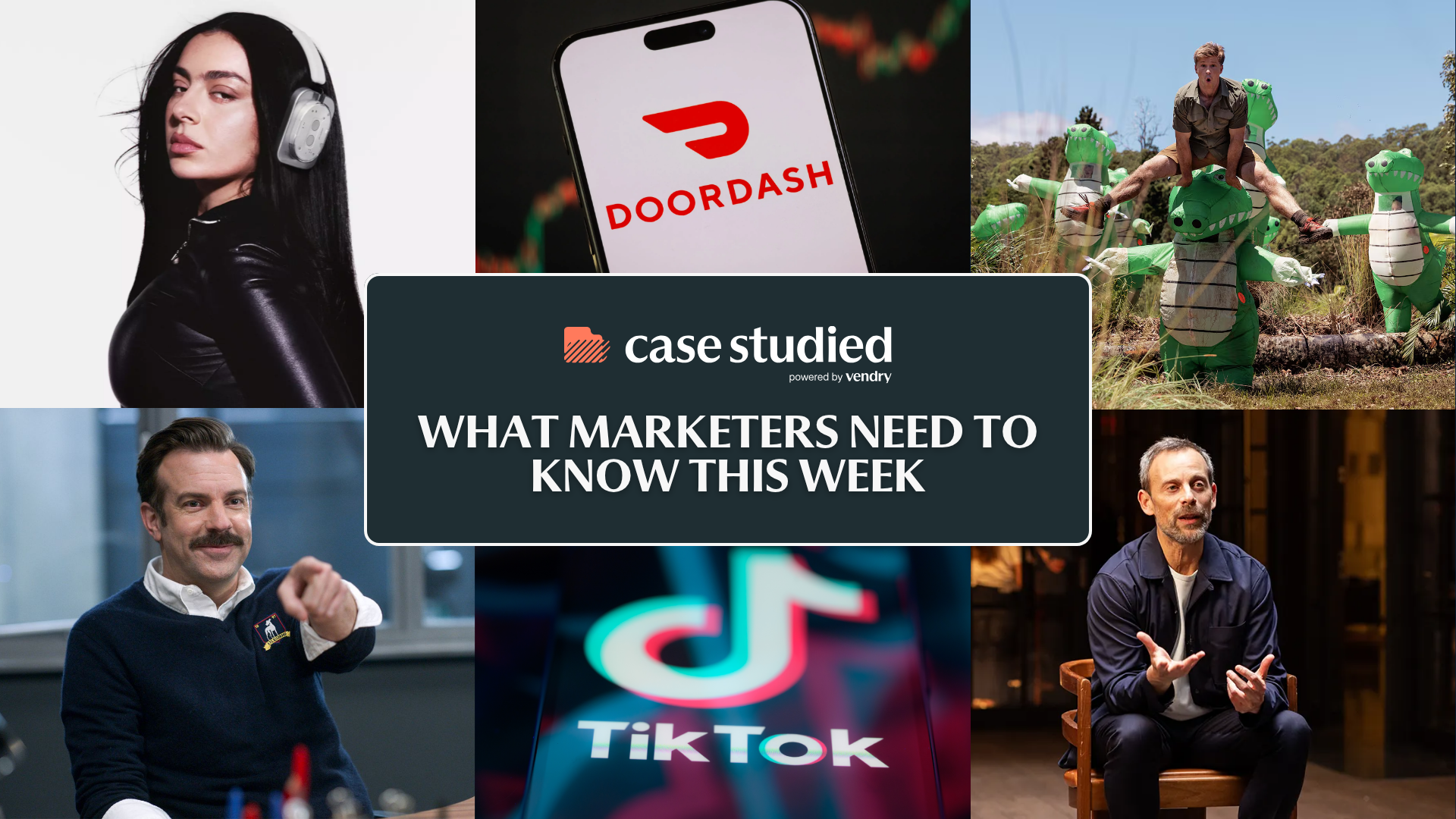
Columbia Sportswear put Robert Irwin up against 100 crocodiles. Visa turned a tap-in goal into a global campaign with Jason Sudeikis. And Charli XCX bought into a tech brand instead of just signing with it.
Meanwhile, Publicis wrote a $2.5 billion check for LiveRamp, TikTok handed the keys to AI agents, and DoorDash brought in new marketing leadership as it outgrows its food delivery roots.
Here's what you need to know.
You know the drill. Three weeks writing a brief, 50 generic pitches in your inbox, eight intro calls that blur together, and you still end up picking the wrong one.
We built Vendry so you never have to do that again. Tell us what you need. In 10 days you get:
3 agencies, not 50 — hand-picked for your budget, category, and stage
Proof before the pitch — real case studies from real brands, attached upfront
No bait-and-switch — the senior team that pitches you is the team that runs your account
Take the calls you want. Skip the ones you don't.
Shopify, Coca-Cola, Burt's Bees, Roc Nation, Estée Lauder, and 1,000+ other brands have run their last RFP this way.
Free for brands. Always will be.
Campaigns of the week 📺
Columbia
Robert Irwin vs. 100 crocodiles
Columbia Sportswear tapped conservationist Robert Irwin, son of the legendary Steve Irwin, as its newest ambassador. The partnership launched with a stunt called "Robert vs. 100 Crocs." The centerpiece is a film that shows Irwin fending off 100 crocodiles—only they aren’t real animals but people in inflatable crocodile costumes. Irwin dramatically dodges them while wearing Columbia's new Tellurix Titanium OutDry trail shoe. The campaign leans into Irwin's charisma and his connection to the outdoors. He’s built a massive following across social media through his wildlife conservation work at Australia Zoo. The campaign spans video and social, with a dedicated landing page featuring shoppable gear from the shoot.

Why it stood out: The importance of casting is on full display here. Robert Irwin is one of the most likable and culturally relevant figures in the outdoor and wildlife space. Columbia led with an interesting, sharable hook with the 100 crocs headline. Then, it surprised and delighted viewers with a satirical video that nods to their product without squashing the humor.
📖 Read more: Columbia Sportswear
Nothing
Charli XCX turns Nothing into something
Consumer tech brand Nothing announced Charli XCX as its first ever Global Brand Ambassador. And unlike most celebrity partnerships, this one comes with a stake in the company. Charli invested in Nothing, joining an investor roster that already includes The Weeknd, Casey Neistat, and Swedish House Mafia. The launch campaign, titled "Nothing (Charli XCX)", centers on the proof point that Charli wore Nothing's Headphone (a) for five consecutive days to demonstrate its 135-hour battery life. Nothing is a London-based hardware startup valued at $1.3 billion after a $200 million Series C raise. And Charli XCX, the architect of Brat summer, was apparently on the company's radar from the very beginning. Nothing's chief brand officer revealed that Charli was mentioned in the brand's very first strategy presentation as "this embodiment of rebellious creativity."
Why it stood out: Nothing is betting on cultural alignment as well as celebrity reach here. Charli's entire brand is built on rejecting the polished and the expected, which maps perfectly onto Nothing's positioning against the minimalist monotony of mainstream tech. By making her a shareholder rather than just a face, the partnership carries a different kind of credibility than a standard endorsement. It also signals a potential shift in how ambitious challenger brands are thinking about celebrity partnerships.
📖 Read more: Vogue
Visa
One tap to pay, one tap to score
Visa launched its official campaign for the FIFA World Cup 2026, anchored by Ted Lasso star Jason Sudeikis. The campaign, titled "Tap In," is built around a double meaning: "tap in" refers to both the simplest goal in football (scored from close range with minimal effort) and the act of tapping a Visa card to pay. Sudeikis stars in a hero film that follows him across all three host countries, the US, Mexico, and Canada, using his Visa card to navigate every moment of his World Cup experience. The broader campaign roster includes Spanish soccer star Lamine Yamal, Mexican legend Jorge Campos, and Argentine commentator Andrés Cantor. As part of the campaign, cardholders have chances to win match tickets and prizes triggered by real tap-in goals during the tournament. The brand is also committing $600,000 to nonprofit partners across all three host countries through a "Tap In to Impact" initiative.
Why it stood out: Visa has been a FIFA World Cup sponsor since 2007 and this campaign puts that experience on full display. The "tap in" metaphor effectively connects Visa's core product function to one of the most universally understood moments in football. Sudeikis is also a smart choice following his successful run on Ted Lasso and his widely beloved deadpan humor. Incentivizing with cardholder prizes and having nonprofit partners helps round out the campaign.
📖 Read more: Forbes
Industry news 🤝
A new CMO steps in as DoorDash thinks bigger
DoorDash announced today that Tim Castree joined the company as Chief Marketing Officer, effective May 18, 2026. Castree comes from Amazon, where he led EU Prime and Marketing across more than 15 markets, overseeing brand, performance, and growth marketing. Before Amazon, he spent years building large global marketing organizations at GroupM and Wavemaker, working across some of the world's biggest consumer brands. He replaces Kofi Amoo-Gottfried, who spent seven years building DoorDash's marketing function into an industry-recognized operation before stepping back for personal reasons. Castree's appointment comes as DoorDash is actively pushing beyond its core food delivery identity and expanding into reservations, grocery, and everyday essentials.

What it signals: CMO transitions at companies undergoing a platform shift can be worth watching, especially when the hire comes with a specific skillset. Castree's experience helping brands evolve beyond a single-category relationship with customers lines up with DoorDash's current challenge of convincing users it's not just a food app anymore. The hire signals DoorDash is ready to compete hard in an increasingly crowded delivery and local commerce space.
📖 Read more: DoorDash
Omnicom's top creative voice exits
Javier Campopiano, global chief creative officer for Omnicom Advertising, is stepping down at the end of May. The move comes just six months after Campopiano took on the role as part of Omnicom's $9 billion acquisition of IPG in December 2025. He came from McCann Worldgroup where he spent three years as global chief creative officer leading award-winning work for brands like Xbox and L'Oréal. He also helped the network land major clients like Ferrero, IKEA, and LinkedIn. Omnicom said publicly it has no plans to replace his role. That decision lands against the backdrop of sweeping agency restructurings. Omnicom already cut 4,000 jobs post-merger, retired the DDB, FCB, and MullenLowe brand names, and consolidated its creative operations down to three global networks: BBDO, TBWA, and McCann.

What it signals: When a holding company eliminates a global creative leadership role rather than refilling it, it's a signal about how they see the future. The Omnicom/IPG integration is still very much in motion, and Campopiano's exit suggests the new structure is leaning on its individual agency networks for creative leadership rather than maintaining a layer above them. For the broader agency world, it's another data point in the ongoing question of what creative leadership actually looks like inside the holding company model as consolidation accelerates.
📖 Read more: AdWeek
Congress wants to pull gambling ads off kids’ feeds
Republican Senator Katie Britt of Alabama and Democratic Senator Richard Blumenthal of Connecticut introduced the Gaming Advertisement to Minors Enforcement (GAME) Act this week. The bill would place a federal ban in the United States on sports betting and prediction market ads targeting minors on social media platforms like TikTok and Instagram. The FTC would be responsible for enforcement starting one year after enactment, with civil penalties for violations and repeat offenders referred to the Department of Justice. Fines could reach $100,000 per ad shown to a minor. The legislation arrives against a backdrop of a 2024 study that found that people who begin gambling before age 18 are 50% more likely to develop a gambling problem. A Common Sense Media report also found that 36% of boys aged 11–17 reported gambling activity in the past year. Nearly 60% of those exposed to gambling content said it appeared in their feeds without them ever searching for it.

What it signals: The explosion of sports betting advertising is now drawing the same regulatory heat that alcohol and tobacco ads faced before it. If the GAME Act passes, it would force sportsbooks and prediction market platforms to fundamentally rethink how they target and acquire users on social media. It would also put platforms like Meta and TikTok on the hook for enforcement. For anyone buying or planning digital advertising in regulated categories, this is a preview of where ad accountability legislation may be heading.
📖 Read more: Wall Street Journal
MarTech moves 🤖
Publicis just spent $2.5B to own the data layer
Publicis Groupe announced it will acquire the global data collaboration platform LiveRamp in an all-cash deal worth $2.55 billion. LiveRamp connects over 25,000 publisher domains and 500+ technology and data partners. This gives brands the infrastructure to unify and activate first-party data across the ecosystem securely without exposing raw customer records. The deal adds LiveRamp's data connectivity capabilities directly into Publicis's existing stack alongside Epsilon and Publicis Sapient. The company said it’s building the ability to combine data across partners and generate new proprietary data assets that neither party could build alone. Publicis says this is the missing piece for brands trying to build smarter AI agents, pointing to research showing 93% of companies currently lack the right data to do it effectively. LiveRamp will continue operating as a neutral, open platform post-acquisition, meaning existing clients and competitors who rely on it won't be locked out. The deal is expected to close before the end of 2026.

What it signals: The race to own the data infrastructure layer is accelerating and holding companies aren't waiting. Publicis already made a major bet on first-party identity when it acquired Epsilon in 2019. LiveRamp is the next piece: the connective tissue that lets brands pool and co-create data across partners without handing it over to walled gardens. As AI agents become the new execution layer for marketing, whoever controls the data pipeline feeding those agents holds some serious leverage.
📖 Read more: Publicis Groupe
OpenAI bought a startup that can clone any celebrity's voice
OpenAI acquired Weights.gg, a small AI startup behind a consumer app called Replay. The app allows users to clone voices including those of Taylor Swift, Samuel L. Jackson, Kanye West, Donald Trump, and members of Blackpink with striking accuracy. The deal, which happened earlier this year but was only recently reported by the New York Times, included the startup's intellectual property and small team, though financial terms were not disclosed. Weights.gg shut down its services on April 1, weeks before the acquisition became public. OpenAI says it has no plans to launch a standalone voice cloning product, and the Weights.gg team has been distributed across internal divisions to support broader audio and multimodal AI initiatives. The move is notable given OpenAI's own stated caution around voice replication technology. The company developed advanced voice cloning capability back in 2024 but chose not to release it publicly over concerns around impersonation, misinformation, and copyright.

What it signals: OpenAI is building out its voice infrastructure quietly and carefully, acquiring the talent and technology without taking on the reputational risk of a public-facing product. For brands and marketers, the broader story here is the accelerating tension between AI voice capability and consent. As synthetic voices become cheaper and more convincing, questions are being raised around whose voice can be used, for what, and with whose permission. Anyone using AI-generated voices in advertising or content or considering it is operating in an increasingly scrutinized space.
📖 Read more: New York Times
TikTok just let AI agents take the wheel on ad campaigns
At TikTok World, the brand’s sixth annual global ad product summit, TikTok announced the launch of its Ads Model Context Protocol (MCP) server. This infrastructure lets third-party AI agents like Claude and ChatGPT connect directly to TikTok's ad platform and autonomously plan, launch, and optimize campaigns without human intervention. That means the laborious, click-heavy work of running campaigns can now be handed off entirely to AI agents rather than managed manually by a media buyer in an ads dashboard. TikTok also opened the platform to third-party API agents, letting advertisers build custom AI infrastructure for their own unique workflows on top of TikTok's ad stack. The move makes TikTok the last of the four major platforms to build this infrastructure layer. Google, Meta, and Amazon all launched comparable MCP servers earlier this year. TikTok paired the announcement with a broader slate of new ad products, including Branded Buzz, which enables advertisers to collaborate with creators on large-scale campaigns to drive mass awareness.

What it signals: Major ad platforms are racing to build MCP infrastructure and the reason goes beyond automation convenience. As one adtech expert put it, whoever controls the MCP controls the data. Routing agent traffic through your own server means you keep visibility into how brands query your platform, what they compare it against, and what drives conversion. That signal is enormously valuable in an agentic world, which is why big tech is moving fast to establish their own standards before someone else's becomes the default. For media buyers and marketing teams, it’s clear that AI agents are becoming the operational layer of paid media. The question is no longer whether to adopt them but which platforms and workflows to build around.
📖 Read more: AdWeek
Editors Choice 👀
💄The co-founder of e.l.f. Cosmetics gave up his fortune and is being ordained as a Catholic priest this month. 📖 Read more: USA Today
📺Brands are still buying late night TV and NBCU's upfront numbers show why it still works. 📖 Read more: AdWeek
⚖️ A jury sided with OpenAI and Sam Altman, tossing Elon Musk's lawsuit in under two hours of deliberations. 📖 Read more: New York Times
📸 Instagram wants to be casual again — Instants lets you share unedited, disappearing photos with Close Friends. 📖 Read more: Instagram
Reach into the inbox: Did you know you can advertise in the Case Studied newsletter? That means having a direct line to 41,000+ senior marketers via a newsletter with a 52% open rate.
Don't miss the next Case Studied™.
Join 40,000+ marketers and receive a breakdown of the world's best brands every week.