The marketing moves that defined the week
Star-studded World Cup ads and AI expansions
12 May 2026
The marketing moves that defined the week
Star-studded World Cup ads and AI expansions

Case Studied Brief
May 12, 2026

Case Studied Brief
Chalamet, ChatGPT ads, and potato chips
This week's Brief covers World Cup campaigns, a digital twin marketplace, and plenty of AI news.
Adidas and Lay’s both tapped into serious star power. The Guardian put a modern twist on a 40-year-old commercial. And IKEA told stories from a unique perspective.
Meanwhile, OpenAI is piloting its ad platform across the globe, Old Navy got a new Chief Customer Officer, and The Trade Desk lost a top strategist.
Here's what you need to know.
You know the drill. Three weeks writing a brief, 50 generic pitches in your inbox, eight intro calls that blur together, and you still end up picking the wrong one.
We built Vendry so you never have to do that again. Tell us what you need. In 10 days you get:
3 agencies, not 50 — hand-picked for your budget, category, and stage
Proof before the pitch — real case studies from real brands, attached upfront
No bait-and-switch — the senior team that pitches you is the team that runs your account
Take the calls you want. Skip the ones you don't.
Shopify, Coca-Cola, Burt's Bees, Roc Nation, Estée Lauder, and 1,000+ other brands have run their last RFP this way.
Free for brands. Always will be.
Campaigns of the week 📺
adidas
Chalamet built a dream soccer team
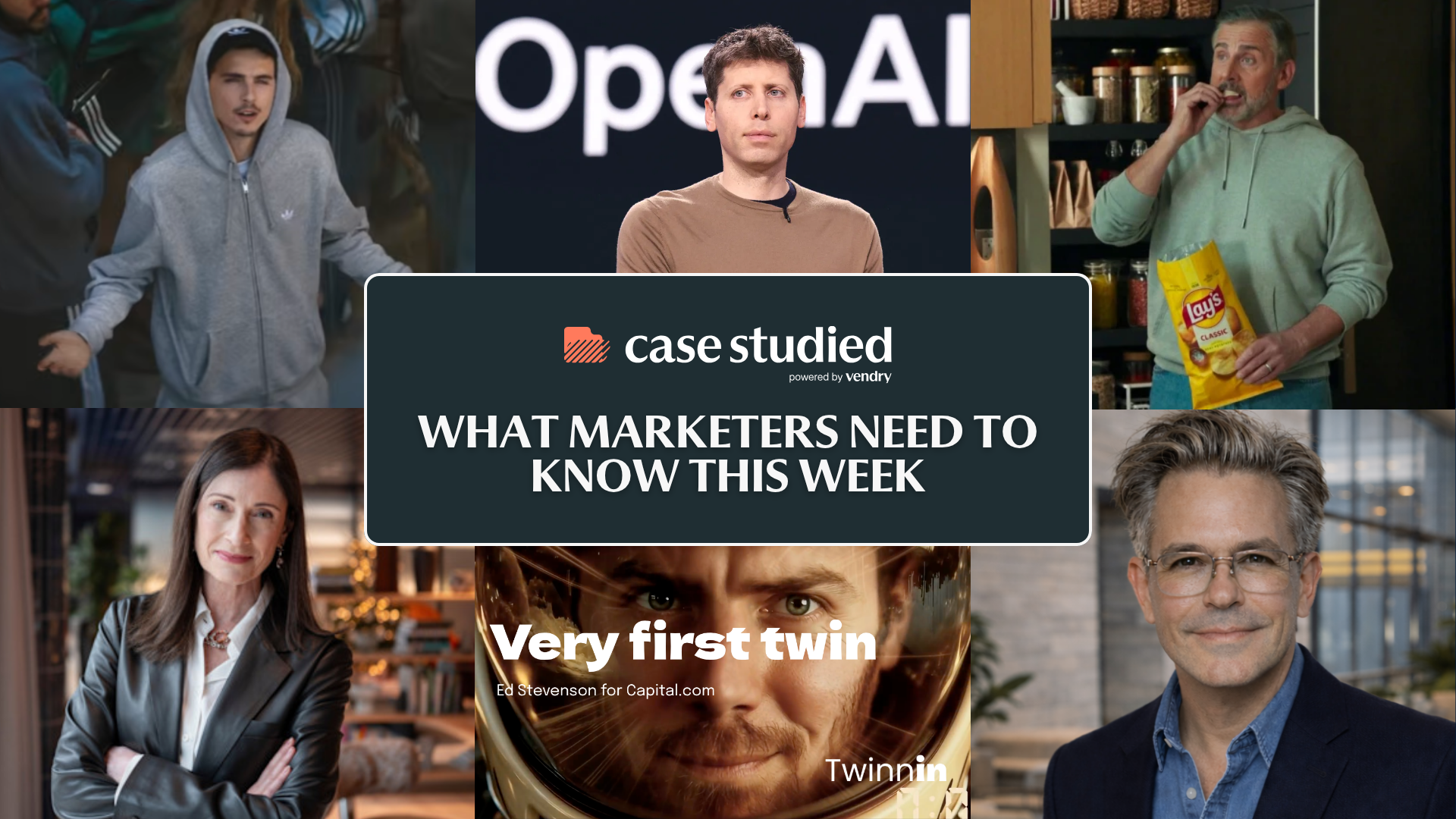
To promote the 2026 FIFA World Cup, adidas dropped a five-minute cinematic short film called "Backyard Legends.” Directed by Mark Molloy and developed by agency Lola USA, the film stars Timothée Chalamet as he assembles a football team to play against a local team of “backyard legends” who haven’t lost a game since the 90s. Chalamet’s crew is made up of Jude Bellingham of Real Madrid, Lamine Yamal of Barcelona, and Trinity Rodman of the US Women’s National Team. The film includes flashbacks to the 90s, showing CGI-generated versions of Zinedine Zidane, David Beckham, and Alessandro Del Piero. Bad Bunny and Lionel Messi also make appearances.

Why it stood out: Most World Cup ads revolved around match footage, stadium energy, or star players. Adidas took a unique approach here by focusing on football’s street culture. The casting also does a lot of work here. Pairing current stars like Bellingham and Yamal with a Hollywood lead like Chalamet and a musician like Bad Bunny helps extend the film's reach beyond typical sports audiences. And the CGI recreations of Zidane, Beckham, and Del Piero help give the story a generational thread that further extends its audience reach.
📖 Read more: adidas
The Guardian
A 40-year-old ad got a sequel
The Guardian revived its iconic 1986 "Points of View" ad with a new film called "The Whole Picture." The original spot used a single scene shot from multiple angles to argue that context changes everything. The new version opens with the same footage as the original, before actor Kathy Burke (who appeared as a bystander in the original) steps out of the scene and breaks the fourth wall. Filmed on the same street with the original director Paul Weiland, Burke delivers a pointed update: "I just want the truth, told by real people, not an AI robot or some dodgy billionaire." The campaign, created with agency Lucky Generals, runs across the UK and US, where the Guardian has been expanding aggressively.
Why it stood out: The "Points of View" spot was considered one of the best ads in history and every creative decision in its sequel reinforces that original message. It’s on the same street, with the same director, and the same cast member. In a media moment defined by distrust, AI-generated content, and billionaire-owned outlets, the campaign carries just as much relevance and resonance as it did in the 80s (if not more).
📖 Read more: The Guardian
Lay’s
No chips, no invite
To promote the World Cup, Lay’s launched ‘The Epic Watch Party’ with Slap Global, hungryman, and Washington Square Films. The spot shows Messi, Beckham, Thierry Henry, Alexia Putellas, and Steve Carell venturing to a Florida supermarket where they asked real customers leaving the store what they bought. If they’d bought a bag of Lay’s, the customers could go to a World Cup watch party with the stars. If not, they were sent on their way. The video is part of the ‘No Lay’s, No Game’ campaign, which is in its fourth year running.

Why it stood out: This year, Lay’s is a global sponsor of the World Cup for the first time. And it's clearly aiming to appeal to the dedicated soccer fans as well as the casual consumers. The celebrity casting in this spot was deliberate. Messi provides global reach, Beckham offers North American crossover, and Putellas extends reach to the women's game. Meanwhile, Carell helps make the ad feel approachable for the folks who are down to watch the World Cup, but aren’t die-hard football fans.
📖 Read more: Little Black Book
IKEA
Think inside the bag
IKEA Sweden and agency NoA Åkestam Holst turned the brand’s iconic blue Frakta bag into a camera. "FRAKTA Point Of You" is a national OOH, DOOH, and print campaign running across Sweden this spring. Every single ad in the campaign is shot from the bottom of the bag looking up. Think: picnics, laundry runs, beach days, last-minute airport dashes. The Frakta frames them all, capturing the everyday moments where the bag shows up. The campaign builds on last autumn's "Wherever life goes" platform, which already drew attention for its stripped-back approach.

Why it stood out: The Frakta bags cost a few bucks, making it one of the cheapest items you can buy at IKEA. But its accessibility and ubiquity are what made it a compelling subject for a national campaign. The perspective of the bag is visually distinct and aligns with the brand’s recent approach of understated storytelling.
📖 Read more: AdAge
Industry news 🤝
Old Navy taps a retail heavyweight
Gap Inc. announced that Michael Francis was appointed Chief Customer Officer at Old Navy and Head of Marketing Shared Services across Gap Inc. Francis brings a highly decorated résumé: former CMO at Target, President of JCPenney, and Chief Global Brand Officer at DreamWorks Animation. He was already advising Old Navy before the hire was formalized, so he knows the brand and its challenges coming in. In his new role, Francis will lead Old Navy's end-to-end customer strategy, brand storytelling, and customer experience. As Head of Marketing Shared Services for Gap Inc., he'll also oversee media strategy and execution across the full portfolio that includes Old Navy, Gap, Banana Republic, and Athleta.

What it signals: Old Navy is an $8+ billion brand with massive reach, but it's been searching for a sharper cultural identity for years. Bringing in Francis suggests the brand is serious about elevating how it shows up beyond promotions and price points. His dual mandate is notable, too. By giving Francis responsibility across the entire Gap Inc. marketing infrastructure, the company signals potential ambition. Beyond Old Navy, it may be looking to build a more coherent house of brands.
📖 Read more: Gap Inc.
The Trade Desk's top strategist is heading to OpenAI
Samantha Jacobson, Chief Strategy Officer at The Trade Desk, is departing the programmatic advertising giant to join OpenAI. Jacobson spent more than five years at The Trade Desk, rising to CSO for one of the largest independent demand-side platforms in the world. Before that she held senior roles at Oracle, eBay, and American Express. Her specific title and start date at OpenAI haven't been disclosed, but she will retain a seat on The Trade Desk's board of directors while the company conducts a search for her successor. The move comes as OpenAI has been aggressively expanding its advertising business, signaling a serious push to compete for brand and agency budgets.

What it signals: OpenAI is actively building the infrastructure to become an advertising platform and hiring someone with Jacobson's pedigree suggests it wants to do that with credibility. As AI platforms push deeper into advertising, we may see them do more recruitment from established programmatic giants. For The Trade Desk, losing a CSO to an AI company is the kind of talent signal the industry will be watching closely.
📖 Read more: AdWeek
WPP approved a $14.8M pay package for its new CEO
WPP shareholders voted to approve a maximum pay package of $14.8 million per year for CEO Cindy Rose at the company's annual general meeting in London. Rose's base salary is set at $1.7 million, with total compensation rising substantially if short- and long-term bonuses are paid in full. The package significantly exceeds the maximum $10.8 million earmarked for her predecessor Mark Read before his exit in September 2025. There's also an upside scenario. If Rose manages to boost WPP's share price by 50%, her annual payout could climb as high as $19.3 million. The approval comes as WPP navigates a difficult stretch. Q1 revenue fell 8.9%, and Rose notably opted out of the earnings call entirely, leaving the CFO to face investors.

What it signals: WPP is in the middle of a genuine turnaround effort. Its revenue is declining, its clients are reassessing, and its holding company model is under pressure from a rapidly changing agency landscape. Approving this pay structure—with such significant upside tied to share price performance—can be interpreted as the board's way of prioritizing results. Whether Rose can deliver those results and what WPP looks like on the other side is the bigger story worth watching.
📖 Read more: Adweek
MarTech moves 🤖
ChatGPT ads are going global
Just two days after OpenAI launched its self-service ads platform in the US, the company announced it's expanding the ChatGPT ads pilot to the UK, Japan, South Korea, Brazil, and Mexico. The pilot was previously limited to the US, Canada, Australia, and New Zealand. Ads are now appearing in categories like shopping, retail, and travel. They target users in what OpenAI is calling a "conversational, intent-driven environment." The expansion comes the same week it was reported that OpenAI has updated its privacy policy to formally share user data with advertisers.

What it signals: OpenAI is moving from an AI company to an advertising platform at a pace that should get the attention of every media buyer and brand strategist. The combination of 500 million monthly ChatGPT users, high-intent search behavior, and a self-service buying platform puts OpenAI in direct competition with Google and Meta for ad dollars. The question many brands are asking isn’t whether they should test this platform, but when to start.
📖 Read more: Adweek
A startup wants to be the marketplace for your digital twin
Twinnin, a UK-based AI platform backed by Google and Nvidia, launched its first seed funding round targeting $3 million at a $25 million post-money valuation. The platform lets actors, performers, and anyone else license their digital likeness. It creates a blockchain-secured "identity record" that studios and brands can then purchase for use in films, shows, and ads. Actors pay $14.99 per year to list their digital twin, while studios and brands subscribe to access them. Founder Katrien Grobler said her goal is that by 2030, half of the human-looking figures in AI-generated content are licensed digital twins (rather than fully synthetic AI-generated faces). The platform has already met with the actors union Equity and the casting platform Spotlight, though Equity was careful to note it doesn't endorse any specific platform.

What it signals: For marketers, Twinnin represents an early look at where talent licensing in advertising may be heading. Brands already navigate NIL deals for athletes and influencers. Twinnin is essentially proposing the same framework for digital likenesses. If this model gains traction, it could give brands a more straightforward path to licensing real human likenesses for AI-generated campaigns, rather than relying on fully synthetic faces.
📖 Read more: Deadline
Apple Music wants to label AI content
Apple Music rolled out a new metadata system called Transparency Tags, requiring record labels and distributors to disclose when AI was used in the creation of music uploaded to the platform. The tags cover four categories—artwork, track, composition, and music video—and apply whenever AI contributed a "material portion" of the work. Labels can begin applying them immediately, and will be required to use them for all new content going forward. There's a significant catch though: Apple defers entirely to labels and distributors to determine what qualifies as AI-generated, and there's no visible enforcement mechanism or cross-verification process.

What it signals: The Transparency Tags system is an interesting contrast to Spotify’s Verified by Spotify badge. While Spotify developed their own criteria for authenticity and trust, Apple Music is essentially relying on labels to adhere to the honor code. For brands and advertisers using music in campaigns, this is an early signal that AI content provenance is becoming a tracked and regulated space.
📖 Read more: Forbes
Editors Choice 👀
📺 Dua Lipa is suing Samsung for $15M after her face ended up on TV boxes without permission. 📖 Read more: Variety
📊 Brand and agency execs went on record about Google, The Trade Desk, and Meta's black box ad platforms. 📖 Read more: Digiday
🎬 Marc Jacobs, Crocs, and MCoBeauty are all making branded microdramas and it's working. 📖 Read more: AdAge
Reach into the inbox: Did you know you can advertise in the Case Studied newsletter? That means having a direct line to 41,000+ senior marketers via a newsletter with a 52% open rate.
Don't miss the next Case Studied™.
Join 40,000+ marketers and receive a breakdown of the world's best brands every week.